Image



MINNESOTA (June 20, 2026) Minnesota's legal cannabis industry was designed around a simple promise: products would reach consumers only after passing rigorous state-mandated safety testing.
Three years after lawmakers legalized adult-use cannabis and months into the rollout of the state's regulated marketplace, that promise remains intact. What has become increasingly uncertain, however, is how quickly those products can make it through the testing pipeline.
Across Minnesota, cannabis retailers are reporting growing frustration with laboratory backlogs that are delaying the arrival of adult-use products ranging from flower and pre-rolled joints to vape cartridges and concentrates. Cultivators say harvested cannabis is often ready for market but unable to reach store shelves because mandatory testing requirements have created a bottleneck within the state's limited network of licensed laboratories.
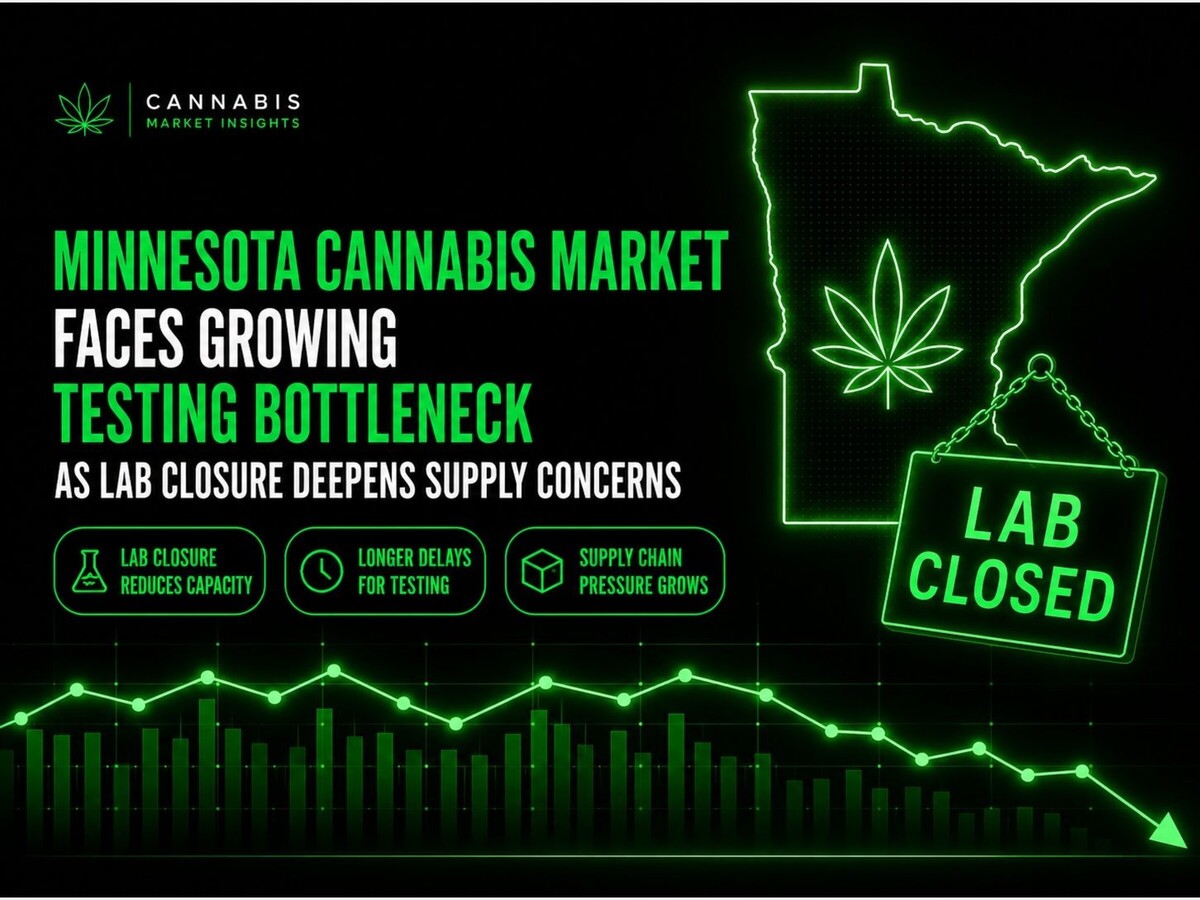
The situation has become more urgent following the loss of one of Minnesota's testing providers, a development industry participants say threatens to place additional strain on an already constrained system.
For a market still in its formative stages, the challenge represents one of the most significant operational hurdles facing Minnesota's cannabis industry since legalization.
Unlike most consumer products, cannabis cannot move directly from cultivation facilities to retail shelves.
Before any adult-use cannabis product can be sold in Minnesota, state law requires comprehensive laboratory testing designed to verify potency and screen for contaminants, including pesticides, heavy metals, mold, bacteria, residual solvents, and other substances that could pose health risks to consumers.
The testing process is administered under regulations established by the Minnesota Office of Cannabis Management (OCM), the agency responsible for overseeing the state's legal cannabis industry.
Consumer advocates, regulators, and industry leaders broadly agree that rigorous testing is essential to ensuring public confidence in the legal marketplace. The challenge is not the testing itself. The challenge is capacity.
As new cultivators, manufacturers, and retailers enter the marketplace, every product batch must compete for access to a limited number of laboratories capable of performing the required screenings.
The result has been a growing backlog that increasingly affects businesses throughout the supply chain.
Retailers say they often know products have been harvested, processed, packaged, and prepared for sale. What they do not know is when those products will emerge from the testing queue.
"I've heard pretty much from every vendor that it's testing that we are waiting on," Grey Area dispensary owner William Drexler told CBS Minnesota. "Week by week they may say, 'it's next week,' and that can delay into the following week. At this point I don't think many of them are giving a date."
For store operators attempting to forecast inventory needs, the uncertainty has become a persistent challenge.
The industry's concerns accelerated following regulatory actions involving Legend Technical Services, one of Minnesota's cannabis testing laboratories.
Legend, which had previously participated in testing associated with Minnesota's medical cannabis system, received temporary authorization in September 2025 to conduct adult-use cannabis testing while the broader market infrastructure was being established.
However, state regulators later determined the laboratory had failed to satisfy certain security and analytical testing requirements necessary for continued operation within the adult-use market.
The Office of Cannabis Management subsequently suspended the facility's testing privileges.
The consequences reverberated throughout the industry.
Unable to continue operating under the existing regulatory framework, Legend announced it would cease testing activities altogether. In communications provided to clients and later reported by multiple Minnesota news organizations, company officials indicated that continuing operations under the circumstances was no longer economically viable.
The closure forced the laboratory to return more than 400 unprocessed samples to cultivators and manufacturers.
Each returned sample represented cannabis products that could not legally enter the marketplace until testing was completed elsewhere.
For businesses already experiencing delays, the development created new uncertainty.
Those samples now must be redistributed among Minnesota's remaining licensed laboratories, increasing pressure on facilities that were already working through substantial testing volumes.
Industry leaders warn that the impact of the closure may continue to be felt for months as laboratories absorb additional workloads and businesses attempt to reestablish predictable testing schedules.
The bottleneck has become particularly noticeable within Minnesota's emerging adult-use retail sector.
Store operators report that product categories most affected by testing delays include cannabis flower, pre-rolls, vape products, concentrates, and other inhalable products requiring comprehensive regulatory review before sale.
Many retailers describe a recurring pattern.
Suppliers announce that products are nearly ready for distribution. Weeks later, those same products remain unavailable because testing has not been completed.
Unlike traditional retail inventory disruptions, cannabis retailers have limited alternatives. Products cannot be substituted, redirected, or released before testing concludes.
The result is an unpredictable supply chain that complicates purchasing decisions, inventory management, marketing efforts, and customer expectations.
Several operators report that low-potency hemp-derived beverages and edible products remain more consistently available than adult-use cannabis flower, largely because those products have benefited from temporary regulatory flexibility designed to ease testing demand.
The laboratory bottleneck reflects a broader reality confronting newly legalized cannabis states.
Building a regulated cannabis market requires more than licensing growers and opening retail stores. It also requires the creation of a sophisticated infrastructure capable of handling testing, compliance, transportation, inventory tracking, enforcement, and consumer safety oversight.
In many states, laboratory capacity struggles to keep pace with market growth during the early years of legalization.
Minnesota appears to be experiencing a similar challenge.
Earlier this year, some cultivators reported waiting six weeks or longer for testing results before products could be released for sale. In certain cases, first harvests intended for the adult-use market remained in storage for nearly two months while laboratories worked through existing backlogs.
Every new cultivation license, manufacturing operation, and retail dispensary increases demand for testing services. Without corresponding growth in laboratory capacity, delays become increasingly difficult to avoid.
The problem is particularly acute because testing cannot simply be bypassed.
State law requires compliance before products reach consumers.
Recognizing the strain, Minnesota lawmakers and regulators have taken steps aimed at preserving laboratory capacity for the adult-use market.
Earlier this year, Governor Tim Walz signed legislation extending authorization for lower-potency hemp-derived edible manufacturers to use accredited out-of-state laboratories through May 31, 2027.
The measure, enacted through HF3615 and SF3670, was designed to reduce competition for limited in-state testing resources.
By allowing hemp-derived THC beverages and edible products to continue using laboratories outside Minnesota, regulators hope to reserve more in-state capacity for adult-use cannabis testing.
The policy effectively separates two rapidly growing sectors of Minnesota's cannabinoid marketplace.
State officials believe the approach may provide temporary relief while additional laboratories complete licensing and accreditation requirements.
Office of Cannabis Management Executive Director Eric Taubel has repeatedly emphasized that Minnesota's experience is not unusual.
"Minnesota is not alone," Taubel said earlier this year. "Every state has had challenges with lab capacity at launch of their adult-use markets because of the rush of new businesses preparing to enter the market needing to test new products."
The Office of Cannabis Management continues to review and license additional testing facilities, though industry participants say the process must move quickly enough to match market demand.
At its core, the testing backlog represents a collision between two legitimate public objectives.
The first is consumer safety.
Minnesota's testing standards are intended to ensure that cannabis products sold through licensed businesses are accurately labeled, free of dangerous contaminants, and subject to consistent quality controls.
The second is market accessibility.
Retailers, cultivators, manufacturers, and consumers all depend on a supply chain capable of moving products efficiently through the regulatory process.
Few industry participants argue for weaker testing requirements.
Instead, businesses are calling for greater testing capacity so that safety standards can be maintained without creating prolonged delays.
The challenge facing Minnesota is therefore not whether products should be tested, but whether sufficient infrastructure exists to conduct that testing at the pace required by a rapidly expanding market.
For now, Minnesota's cannabis industry finds itself in a transitional period.
Demand continues to grow. Additional businesses continue to enter the marketplace. Consumers increasingly expect reliable access to legal products.
Yet one of the most important components of the entire supply chain remains constrained.
The closure of Legend Technical Services, the redistribution of hundreds of untested samples, and continuing laboratory backlogs have exposed vulnerabilities in the state's cannabis infrastructure at a pivotal moment in market development.
Whether regulators can expand testing capacity quickly enough may help determine how smoothly Minnesota's adult-use cannabis market matures over the next several years.
Until then, retailers, cultivators, and manufacturers remain united in a message increasingly heard across the industry: the cannabis is ready.
The testing system simply needs to catch up.
MinneapoliMedia | Community. Culture. Civic Life.



Sunny, with a high of 73 and low of 49 degrees. Sunny during the morning, clear during the afternoon and evening, smoky haze overnight.