68° and Patchy rain nearby
Image
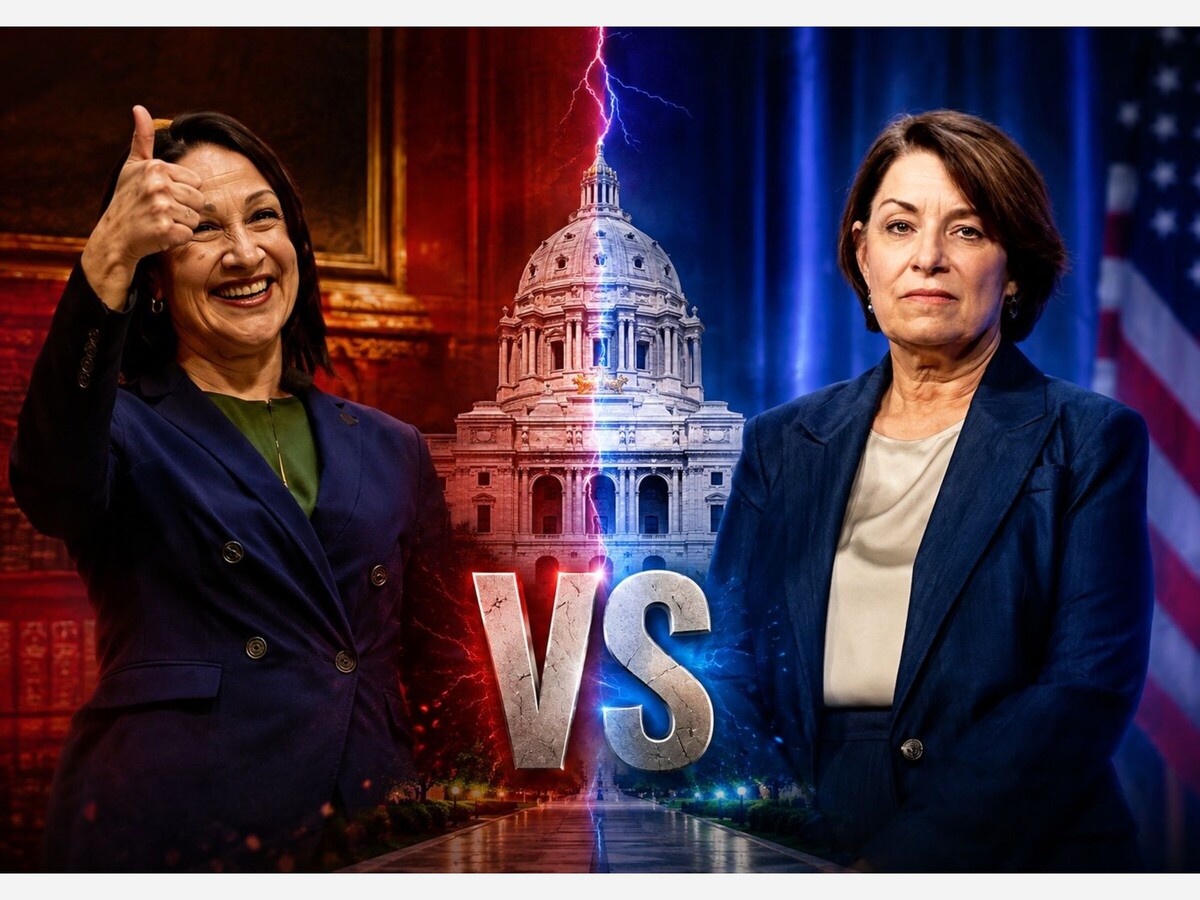



MINNEAPOLIS, MN (August 17, 2026) Minnesota already knows one thing about the outcome of its November gubernatorial election: for the first time in the state’s 168-year history, the next governor will be a woman.
With incumbent DFL Governor Tim Walz stepping aside after two terms, Minnesota faces an open-seat race for the highest office. U.S. Sen. Amy Klobuchar won the Democratic-Farmer-Labor nomination in the August 11 primary alongside her running mate, former Fergus Falls Mayor Ben Schierer. Minnesota House Speaker Lisa Demuth won the Republican nomination alongside attorney Ryan Wilson, defeating a primary field that included Mike Lindell and Kendall Qualls. Their victories guarantee that Minnesota’s 42nd governor will break a barrier that survived generations of political change.
That achievement deserves to be recognized without qualification. Minnesota has elected women to the U.S. Senate, Congress, statewide constitutional offices, legislative leadership, county offices, city halls and school boards, yet the governor’s office remained the conspicuous exception. MinneapoliMedia addressed the significance of that change immediately after the primary, when it noted that voters had moved beyond the old question of whether a woman could win Minnesota’s highest executive office. The November question is now which woman should govern.
But history will not be the only thing waiting at the governor’s office door in January.
The winner will inherit a Minnesota that has been through an unusually punishing period of political and civic strain. Residents have watched a former House speaker and her husband assassinated in their home. They have seen another legislator and his wife shot and wounded. They have endured bitter disputes over immigration enforcement, widespread allegations and prosecutions involving fraud in publicly funded programs, uncertainty over the state’s longer-term finances, fights over taxes and affordability, and repeated clashes over what state government should do and whom it should trust.
The November election therefore carries two stories at once. One is about representation. The other is about repair. Minnesota should celebrate the first. It cannot afford to neglect the second.
The Election Comes After a Period Minnesota Will Not Easily Forget
The assassination of former House Speaker Melissa Hortman and her husband, Mark, on June 14, 2025, cannot be treated merely as another event in the political chronology preceding this election. State Sen. John Hoffman and his wife, Yvette, were also shot in their Champlin home in the related attacks. In July, Vance Boelter was sentenced to two consecutive life terms without parole plus 40 years after pleading guilty in the federal case.
The legal case has reached its conclusion. The civic consequences have not.
The Minnesota Bureau of Criminal Apprehension reported this summer that its behavioral threat assessment team handled about 100 threats against public officials last year and had already dealt with more than 150 through April 2026. That is a warning about the environment in which public officials are now being asked to serve.
The next governor will therefore take office in a state where political disagreement can no longer be discussed as though the only danger is an unpleasant television advertisement or an angry exchange at the Capitol.
Minnesota needs a governor capable of drawing a firm boundary between political disagreement and political dehumanization. That obligation belongs equally to Klobuchar and Demuth.
Neither should be expected to abandon her political beliefs in the name of artificial unity. Elections exist because differences matter. Voters deserve clear choices on taxation, abortion, education, public safety, labor, environmental regulation, immigration, energy, healthcare and the size and purpose of government.
But there is a difference between political conflict and civic corrosion. A governor helps establish that distinction through language, appointments, public conduct and the way opponents are described when cameras are rolling and when they are not. Minnesota's next chief executive should be able to argue forcefully without teaching supporters that fellow citizens are enemies. After what this state has experienced, that is not ceremonial leadership. It is part of the job.
Government Trust Must Be Rebuilt Through Competence
The election will also take place under the shadow of fraud involving publicly funded programs.
Republicans have made failures in state oversight a central argument against continued DFL control, and they have substantial political material with which to make that case. Criminal prosecutions and convictions involving programs intended to serve vulnerable Minnesotans have turned government accountability into one of the defining issues of the 2026 election. The Walz administration itself proposed a new anti-fraud legislative package in February, including stronger prevention, detection, investigation and enforcement measures.
The partisan arguments over responsibility will continue through November. They should. But the public interest requires something more useful than assigning every failure exclusively to one party.
Minnesota needs administrative reform that survives whichever party controls the governor’s office.
Public programs handling large amounts of taxpayer money need reliable auditing, data sharing, payment controls, investigative capacity and consequences when warning signs are ignored. Agencies must be able to identify suspicious billing before millions of dollars leave the treasury rather than reconstructing the damage years later.
The state already has institutions designed to provide oversight, including the Office of the Legislative Auditor, which continues to conduct financial audits, program evaluations and special reviews of state operations. The next administration should strengthen a culture in which independent scrutiny is welcomed rather than treated as an inconvenience.
Klobuchar should not answer every oversight question by defending the DFL record. Demuth should not answer every oversight question by promising simply to remove Democrats. Neither response is sufficient.
Minnesotans need to know what each candidate would change in the machinery of government: who would be accountable, what information would be made public, how suspicious payments would be stopped, how agency leaders would be evaluated and what would happen when internal warnings were repeatedly missed.
Government trust is not restored by insisting that people trust government. It is restored by making government demonstrably worthy of trust.
The State's Finances Require More Than Campaign Arithmetic
Minnesota's fiscal position also demands careful treatment.
The February state budget forecast projected a $3.7 billion balance for the 2026-27 biennium, an improvement of $1.3 billion from the November estimate. That is encouraging. But Minnesota Management and Budget also warned that spending growth is expected to outpace revenue growth through fiscal year 2029. The projected general fund balance for the 2028-29 biennium was only $377 million, and state economists continued to identify a significant structural imbalance and substantial uncertainty surrounding federal policy and economic conditions.
Those facts resist easy political slogans. Minnesota is not facing immediate insolvency. Nor does it have unlimited room to expand spending without considering future obligations.
The next governor will have to make choices. That means telling Minnesotans not only what programs deserve funding but how those commitments remain sustainable when revenue growth slows. It means examining whether programs are producing measurable results. It means distinguishing between investments that prevent greater costs later and expenditures that continue primarily because eliminating them is politically difficult.
Republicans should not pretend every fiscal challenge can be solved by eliminating waste. Democrats should not pretend every valued public service can be protected indefinitely without confronting its cost.
A serious gubernatorial campaign should show voters the arithmetic. The next governor will not inherit a campaign brochure. She will inherit a budget.
Affordability Has Become a Government Question
For many Minnesotans, however, the state's finances are secondary to their own.
Housing, property taxes, childcare, groceries, insurance and utilities are not ideological concepts when a household is balancing its monthly expenses. They determine whether families can remain in the communities where they work and whether retirees can afford the homes in which they expected to grow old.
The problem becomes particularly important when multiple levels of government face their own fiscal pressures. Minneapolis Mayor Jacob Frey's proposed 2027 budget, for example, calls for an 11.3 percent property-tax levy increase while eliminating roughly 100 city positions to address a projected $60 million budget gap. The proposal illustrates the difficult environment in which governments are attempting to maintain services while residents are already sensitive to rising household costs.
A governor cannot dictate every local property-tax decision. But state policy directly influences Local Government Aid (LGA), school finance formulas, housing development grants, transportation, healthcare, energy costs and numerous other expenses that ultimately reach households.
The gubernatorial campaign should therefore move beyond competing declarations that Minnesota is either thriving or collapsing.
Most residents do not experience the state through statewide averages. They experience it through the rent increase, the property-tax statement, the childcare invoice, the health insurance premium and the time required to commute to work.
Klobuchar and Demuth should explain how their economic agendas would affect those household pressures and what tradeoffs their proposals require.
Immigration Has Left Damage That Politics Alone Cannot Repair
The next governor will also inherit the consequences of an extraordinary confrontation between Minnesota communities and federal immigration authorities.
Operation Metro Surge brought thousands of federal immigration personnel into Minnesota and disrupted daily life across parts of Minneapolis and Saint Paul. Residents changed routines involving work, school and healthcare. State and local officials challenged aspects of the federal operation in court. Two U.S. citizens, Renee Good and Alex Pretti, were fatally shot by federal agents during separate confrontations.
The economic consequences were also substantial. Minneapolis estimated more than $203 million in economic and community impact during a one-month period of the operation. Subsequent survey research cited by the Minnesota Attorney General's Office estimated more than $240 million in lost wages across Minneapolis and Saint Paul and roughly $610 million in lost business revenue. Those estimates are part of continuing litigation and should be understood in that context, but they demonstrate the scale of disruption reported by residents and businesses.
The political debate over immigration will remain fierce.
The next governor must nevertheless govern immigrants and nonimmigrants, citizens and refugees, urban neighborhoods and rural communities, people who supported the federal enforcement operation and people who protested against it.
That requires something harder than choosing a side in a national argument. It requires maintaining public safety, protecting constitutional rights, communicating clearly with local law enforcement, preserving confidence in schools and healthcare systems and defending the state's lawful authority while recognizing the federal government's lawful responsibilities.
Minnesota cannot govern effectively if entire communities believe government is something done to them rather than something in which they have a legitimate place.
Growth Must Be Examined Before It Is Subsidized
Another question awaiting the next administration is what kind of economic development Minnesota wants.
The rapid expansion of large data-center proposals has created a debate over jobs, investment, electricity demand, water consumption, utility infrastructure and public subsidies. A bill introduced during the 2026 legislative session proposed pausing new data-center permits until the Public Utilities Commission could complete a comprehensive assessment of energy use, water use and other effects. The proposal itself demonstrates that Minnesota has not reached a settled consensus on how aggressively these facilities should be encouraged.
This is precisely the type of issue on which a governor must resist simplistic choices. Economic development matters. So do ratepayers, water resources and local communities.
Minnesota should welcome investment that produces durable public value. But government should not assume that every project carrying a large capital-investment figure is automatically a good bargain.
The next governor should insist that major development proposals answer basic questions before taxpayers are asked to support them: How many permanent jobs will result? Who pays for new energy infrastructure? What are the water requirements? What happens to utility rates? What tax benefits are being offered? What measurable return does the public receive?
Those are not anti-business questions. They are pro-accountability questions.
A Historic Election Cannot Become an Excuse for a Shallow One
There will be a temptation over the next several months to frame the Klobuchar-Demuth contest principally through biography and history.
Those dimensions matter.
Klobuchar brings nearly two decades in the U.S. Senate and earlier service as Hennepin County attorney. Demuth brings experience in local education governance and legislative leadership and became the first Black person and first Republican woman to serve as speaker of the Minnesota House. If Demuth wins in November, she would become Minnesota's first Black governor as well as its first woman governor.
Those are meaningful facts. They are not governing plans.
The campaigns, news organizations, debate moderators and voters should resist allowing a historic election to become a shallow election.
Ask Klobuchar how she would manage a state executive branch after spending two decades in federal legislative office. Ask her what she would change from the Walz administration and what she would retain. Ask how she would address fraud, spending growth and distrust among Minnesotans who believe state government has become too large or insufficiently accountable.
Ask Demuth how she would translate legislative leadership into executive administration. Ask which programs she would cut, which she would preserve and how her tax proposals would balance against Minnesota's obligations. Ask how she would manage disagreements with federal leadership when Minnesota's interests diverge from those of the federal government. Ask how she would govern a state in which many residents will have voted emphatically against her.
Neither candidate should receive lighter scrutiny because electing her will make history. Making history is what happens on Election Day. Governing begins afterward.
Minnesota Needs a Governor for the People Who Vote Against Her
Perhaps the most important test of this election will come after the ballots are counted.
Minnesota's next governor will almost certainly enter office after a campaign in which millions of residents divided sharply over what the state has become and where it should go. The winner will have every democratic right to implement the program on which she campaigned.
But she will also have an obligation that receives too little attention in modern American politics: to govern people who opposed her.
That does not require ideological surrender. It requires recognizing that political victory is temporary stewardship, not ownership of the state.
The residents of Greater Minnesota who believe Twin Cities policymakers do not understand their communities are Minnesotans. So are immigrant families in Minneapolis who spent part of this year afraid to leave their homes. So are business owners worried about regulation, workers worried about wages, parents worried about schools, homeowners worried about taxes, renters worried about housing, police officers worried about public safety and protesters worried about government power.
The next governor does not have to agree with all of them. She does have to govern all of them.
Minnesota's first woman governor will therefore assume an office carrying more than historical symbolism. She will inherit a state that needs proof that government can still solve difficult problems without turning every disagreement into another front in a permanent political war.
The November election will settle a question Minnesota has taken 168 years to answer. Yes, a woman can become governor of Minnesota.
Now Klobuchar and Demuth must answer the question that matters more for the state's future: Who can govern Minnesota well enough that people who disagree about politics can still believe they belong to the same state?
That is the standard this election deserves. And after everything Minnesota has been through, it is the standard the next governor should be required to meet.

Local stories matter. Subscribe free to MinneapoliMedia and receive independent news, community reporting and important updates from Minneapolis, the North Metro and communities across Minnesota.
SUBSCRIBE FREE: https://minneapolimedia.town.news/subscribe
MinneapoliMedia | Community. Culture. Civic Life



Overcast, with a high of 73 and low of 57 degrees. Overcast during the morning, partly cloudy overnight.