49° and Sunny
Image
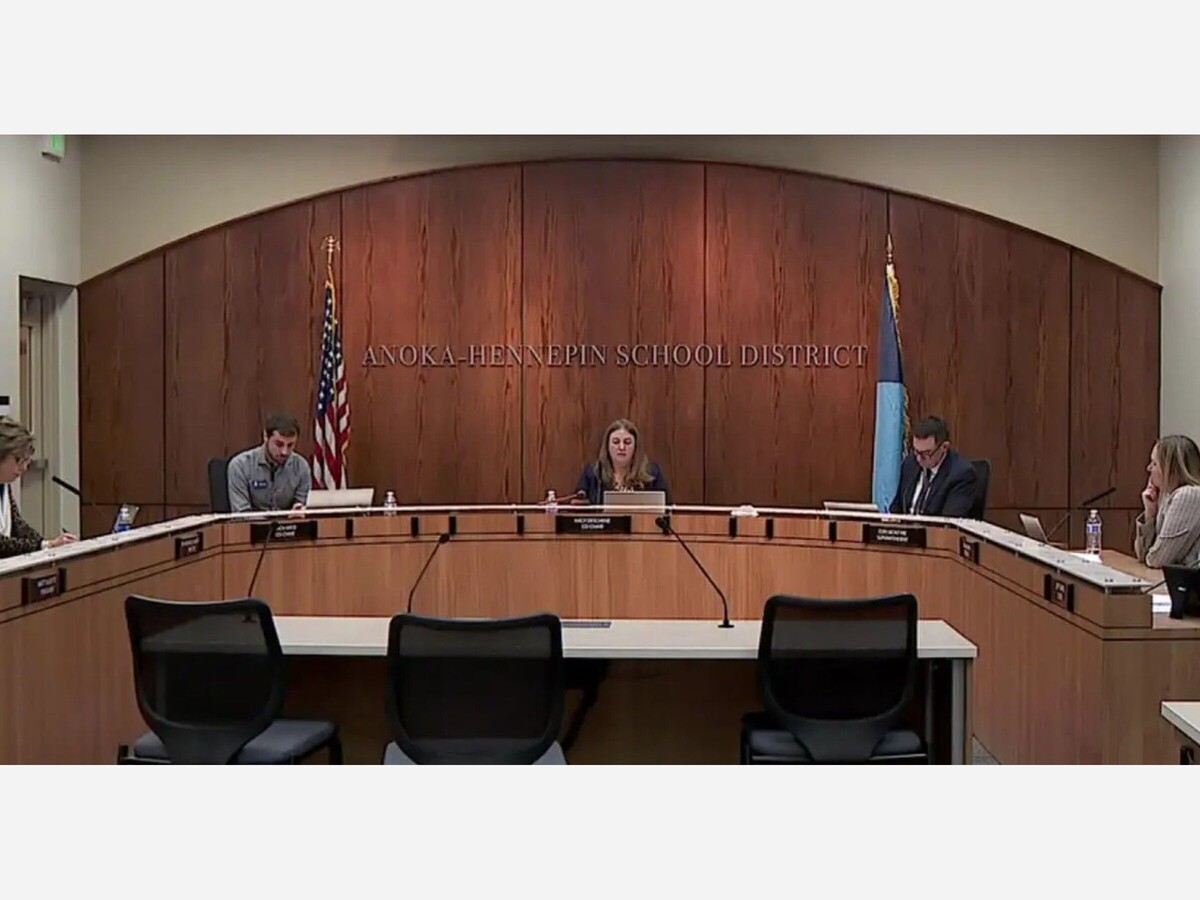



The discussion unfolded against the backdrop of several federal executive actions issued earlier in 2025 addressing transgender student participation in athletics and ideological content in K-12 classrooms. After reviewing the potential legal implications, the board ultimately chose not to alter district policies, concluding that the federal directives would likely face prolonged litigation and that immediate compliance could place the district in conflict with Minnesota law.
For the Anoka-Hennepin School District, the largest public school system in Minnesota with more than 36,000 students across 13 north-metro communities including Anoka, Coon Rapids, Andover, Blaine, and Champlin, the decision represented more than a procedural pause. It illustrated the increasingly complex legal terrain that school districts must navigate as education policy becomes a battleground for federal, state, and local authority.
The Anoka-Hennepin School District has long been one of Minnesota’s most closely watched educational institutions due to both its size and its political visibility. District decisions frequently resonate beyond the north metro, shaping statewide conversations about curriculum standards, student rights, and school governance.
The March 3 session was held as a work session, meaning board members gathered primarily to review legal guidance, ask questions, and assess potential implications rather than take binding action.
Administrators briefed the board on a series of federal policy moves that had triggered uncertainty among school districts nationwide.
Board members reviewed several federal initiatives issued in early 2025 that addressed two major policy areas: transgender participation in sports and the teaching of race-related concepts in schools.
Among the directives discussed were:
Executive Order 14190: “Ending Radical Indoctrination in K-12 Schooling.”
The order directed federal agencies to examine whether school districts receiving federal funding were promoting curricula related to Critical Race Theory or Diversity, Equity, and Inclusion programs that the administration characterized as ideological instruction.
Athletics Participation Guidance (“Sports Ban” directive).
Federal guidance accompanying the administration’s interpretation of Title IX indicated that schools permitting transgender female athletes to compete on girls’ teams could risk losing federal education funding.
Department of Education “Dear Colleague” letters.
These communications advised school districts that allowing transgender students to access sex-segregated spaces such as locker rooms or athletic teams based on gender identity could violate the administration’s interpretation of Title IX.
Together, these directives created immediate questions for school districts nationwide about compliance, funding, and legal exposure.
For Anoka-Hennepin administrators and board members, the central problem was not simply whether the federal directives existed, but whether complying with them would violate state law.
Minnesota’s legal framework provides explicit protections for gender identity through the Minnesota Human Rights Act, which prohibits discrimination based on gender identity in education and other public settings.
In February 2025, Minnesota Attorney General Keith Ellison issued guidance stating that Minnesota schools remained obligated to follow state anti-discrimination law, regardless of new federal executive orders.
The result was a clear legal collision.
|
Authority |
Policy Position |
Potential Consequence |
|
Federal Executive Orders |
Restrict transgender participation in girls’ athletics and certain curricular content |
Possible loss of federal education funding |
|
Minnesota State Law |
Protect gender identity and allow participation consistent with gender identity |
Potential state lawsuits or enforcement action |
School officials recognized that adopting federal guidance immediately could expose the district to litigation under state civil rights law.
At the time of the discussion, Minnesota schools were already operating under a statewide framework regarding transgender student participation in athletics.
Since 2014, the Minnesota State High School League has allowed transgender students to participate in sports consistent with their gender identity through an eligibility review process involving schools and families.
Many districts, including Anoka-Hennepin, align their local policies with those guidelines to maintain consistency with statewide athletics governance.
District administrators emphasized during the work session that altering district policy without statewide alignment could create operational confusion for athletic programs and expose the district to legal challenges.
After reviewing the competing legal pressures, the board concluded that immediate policy changes would be premature.
Several factors shaped the board’s decision.
Ongoing litigation.
Multiple lawsuits had already been filed nationwide challenging federal directives related to education policy and funding restrictions.
Preliminary court rulings.
Federal courts had begun issuing temporary injunctions in some cases involving federal attempts to restrict diversity programs tied to federal funding.
Legal liability.
District officials warned that changing policy to comply with federal directives could trigger lawsuits from parents or advocacy groups under Minnesota’s Human Rights Act.
Maintaining the existing policy framework, board members reasoned, would allow courts to resolve the conflict between federal and state law before the district made a potentially unlawful policy shift.
One board member described the situation as a “legal standoff between state and federal authority,” with school districts caught in the middle.
The Anoka-Hennepin debate reflects a broader national pattern in which education policy has become a focal point of federal-state tensions.
Questions about curriculum, gender identity, and athletics participation have increasingly moved from school board meetings to courtrooms, where judges must interpret the boundaries of civil rights law, federal funding authority, and state anti-discrimination protections.
For local districts, the uncertainty often translates into a cautious approach.
School systems must balance federal requirements tied to billions of dollars in education funding with state civil rights statutes that carry their own enforcement mechanisms.
By the end of the March 3 work session, the Anoka-Hennepin School Board had reached a clear conclusion: maintain the current policies and monitor legal developments.
District leaders indicated that the issue would likely return to the board if federal courts issued definitive rulings or if new guidance emerged from the Minnesota Department of Education.
Until then, the district will continue operating under existing policies aligned with Minnesota law and statewide athletics guidelines.
For now, the board’s decision reflects a cautious strategy shared by many school districts across the country: allow the courts to settle the legal battle before rewriting local policy.
In the increasingly polarized landscape of American education policy, the March 3 meeting underscored a reality that many school districts are discovering simultaneously.
Sometimes the most consequential decision a school board can make is to wait.



Patchy rain nearby, with a high of 64 and low of 46 degrees. Sunny for the morning, clear overnight.