Image
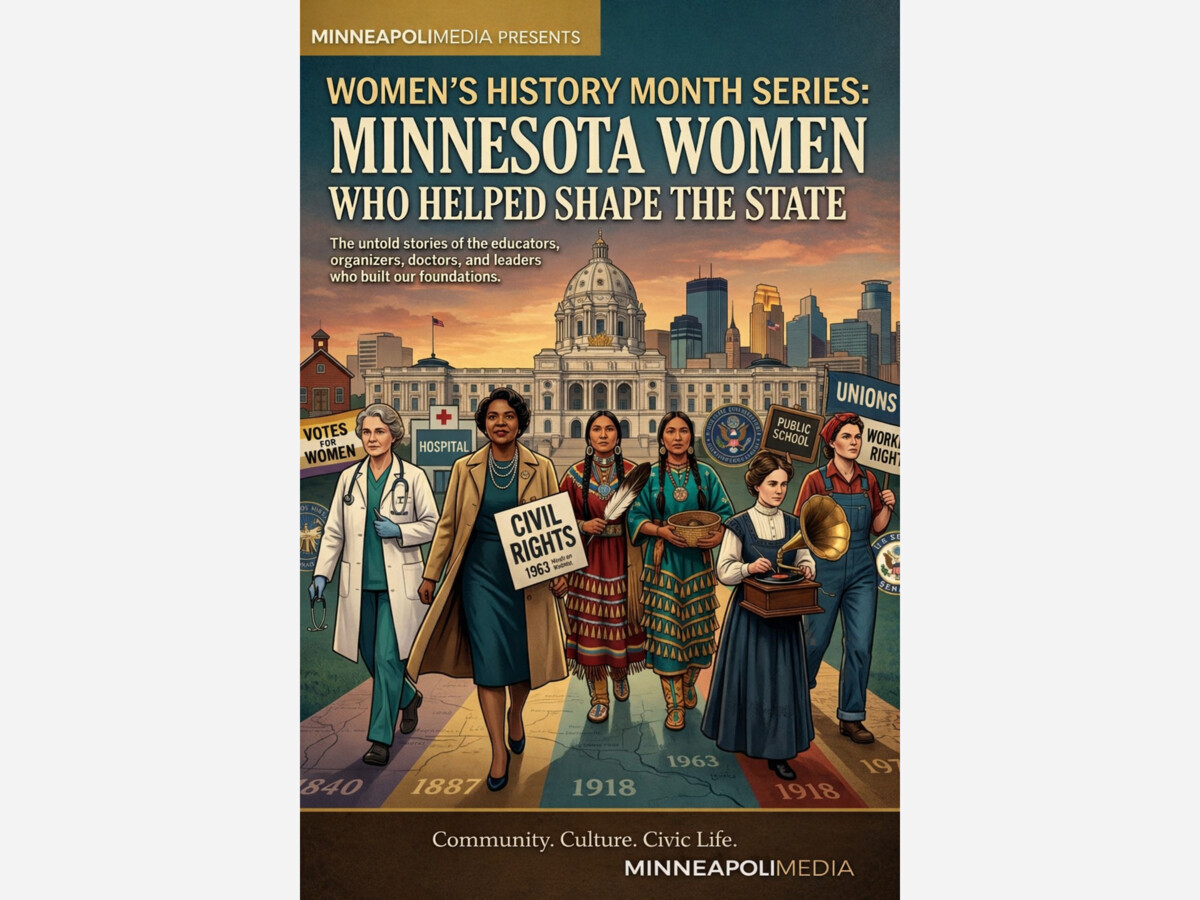



Long before the state became known for its civic institutions, its public schools, its political traditions, and its reputation for community engagement, women across this region were already shaping the foundations on which those institutions would stand. They did it in classrooms and clinics, in labor halls and church basements, in cultural archives and civil rights campaigns. Often they did it without the recognition history later afforded their male contemporaries.
Yet removing their work from the story of Minnesota and the state that remains would be almost unrecognizable.
Women’s History Month invites a simple but necessary correction. The story of Minnesota cannot be told honestly without acknowledging the women who expanded the meaning of citizenship here. Some challenged the state’s institutions from the outside. Others transformed them from within. All helped enlarge the promise of Minnesota.
Their influence stretches back to the earliest chapters of the region’s history.
Before Minnesota became a state in 1858, Dakota and Ojibwe women already held vital roles in the social and economic life of their communities. Historical records describe them as cultivators, gatherers, artisans, and keepers of social order within their societies. Their authority in household and community life reminds us that women’s leadership in this region predates the state itself. The idea that women only recently began shaping Minnesota is not just inaccurate. It ignores the deeper roots of leadership in this land.
As the territory began to take shape in the nineteenth century, another generation of women stepped into roles that would influence the civic development of the young state.
Education has always been central to Minnesota’s identity, and women were among its earliest architects.
One of the most notable figures was Harriet Bishop, who arrived in St. Paul in the 1840s. Bishop helped establish the city’s first public school and worked as a teacher, reformer, and writer during the early years of Minnesota’s development.
Her work illustrates a broader truth about the nineteenth century. Women across the North provided much of the labor that built early public education systems. In Minnesota, that meant shaping the intellectual and civic habits of future generations long before women themselves enjoyed equal political power.
Teaching was not simply employment. It was institution- building.
If education formed one pillar of Minnesota’s early civic life, healthcare and social reform formed another.
Martha Ripley helped expand both. Ripley was one of Minnesota’s early women physicians and the founder of the Maternity Hospital in Minneapolis. Her career also included active involvement in the movement for women’s suffrage.
Ripley’s work represented a powerful fusion of medicine and social reform. At a time when both fields were dominated by men, she insisted that the health of women and families was a public concern worthy of institutional attention.
Her efforts helped reshape how healthcare and women’s rights intersected in Minnesota’s public life.
The twentieth century brought new struggles over equality and access, and Minnesota women again stood at the center of those fights.
Few figures illustrate that more clearly than Anna Arnold Hedgeman. An educator, writer, and civil rights advocate, Hedgeman became a national figure during the civil rights era. In 1963 she served as the only woman on the organizing committee for the historic March on Washington for Jobs and Freedom.
Her presence there mattered.
The March on Washington is often remembered through the speeches of men, but Hedgeman understood that the movement for freedom required the leadership and participation of women as well. Her career spanned decades of advocacy in education, politics, and civil rights, making her one of Minnesota’s most consequential voices for equality.
Hedgeman helped remind the nation that democracy must continually widen its circle.
While Hedgeman helped shape national civil rights conversations, another Minnesota woman was transforming the state’s labor and political landscape.
Nellie Stone Johnson was a force within both the labor movement and Minnesota’s Democratic–Farmer–Labor political tradition. Born into a family of farmers in northern Minnesota, Johnson became one of the most important labor organizers in the state during the twentieth century.
She fought for fair wages, workers’ rights, and expanded opportunities for African Americans in Minnesota. Her organizing work extended into hotel and restaurant unions in the Twin Cities, helping bring women and minority workers into the broader labor movement.
Johnson’s life offers a powerful reminder that democracy is not only tested at the ballot box. It is also tested in workplaces, union halls, and the everyday struggle for economic dignity.
Her work helped push Minnesota toward a more inclusive economic future.
Another giant in Minnesota’s civic history approached change through education and institutional leadership.
Josie Johnson spent decades shaping the University of Minnesota’s commitment to diversity, equity, and inclusion. Her work within the university helped expand access to education and opportunity for communities historically excluded from higher learning.
Johnson understood that institutions often change slowly. But she also understood that change within them can reverberate across generations.
Universities educate the future leaders of a state. To reshape those institutions is to reshape the future itself.
Women also began to cross new thresholds in formal political power.
In 1978, Muriel Humphrey became the first woman to represent Minnesota in the United States Senate when she was appointed to fill the seat of her late husband, Hubert Humphrey.
Her time in office was brief, but her presence mattered symbolically and historically. Representation alters the boundaries of what citizens believe is possible. When women enter spaces of power from which they were once excluded, those spaces begin to change.
Milestones like Humphrey’s appointment mark the gradual widening of democratic participation.
States are not shaped only by laws and elections. They are also shaped by culture and memory.
Frances Densmore devoted decades to recording and documenting Native American music and cultural traditions. Her work produced thousands of recordings and numerous publications that preserved elements of Indigenous cultural heritage for future generations.
Cultural preservation is a complicated and often contested field, but Densmore’s efforts reflect an understanding that the identity of a place lives not only in its institutions but also in its stories, songs, and traditions.
History survives when someone chooses to record it.
The women who helped shape Minnesota did not all pursue the same paths. Some built schools. Others built hospitals. Some organized workers. Some transformed universities. Some entered national politics. Some preserved culture and memory.
But together they expanded the boundaries of what Minnesota could be.
They made it more educated.
More democratic.
More inclusive.
More aware of its responsibilities to its citizens.
This is what shaping a state truly means. Not simply participating in its history, but changing its direction.
Women’s History Month is therefore more than a moment of recognition. It is a reminder that the civic life of Minnesota has always depended on people willing to push its institutions toward their better selves.
Many of those people were women.
Some became famous. Many did not.
Yet the influence of both groups runs through every part of the state’s modern identity.
Minnesota’s schools.
Its labor traditions.
Its civil rights struggles.
Its political institutions.
Its cultural archives.
All bear the imprint of women who believed the state could be more just, more open, and more humane than it had been before.
Minnesota did not build itself.
Women helped build it.
And the story of that work is still unfolding.
MinneapoliMedia
Community. Culture. Civic Life.



Sunny, with a high of 78 and low of 42 degrees. Sunny for the morning, clear overnight.