Image
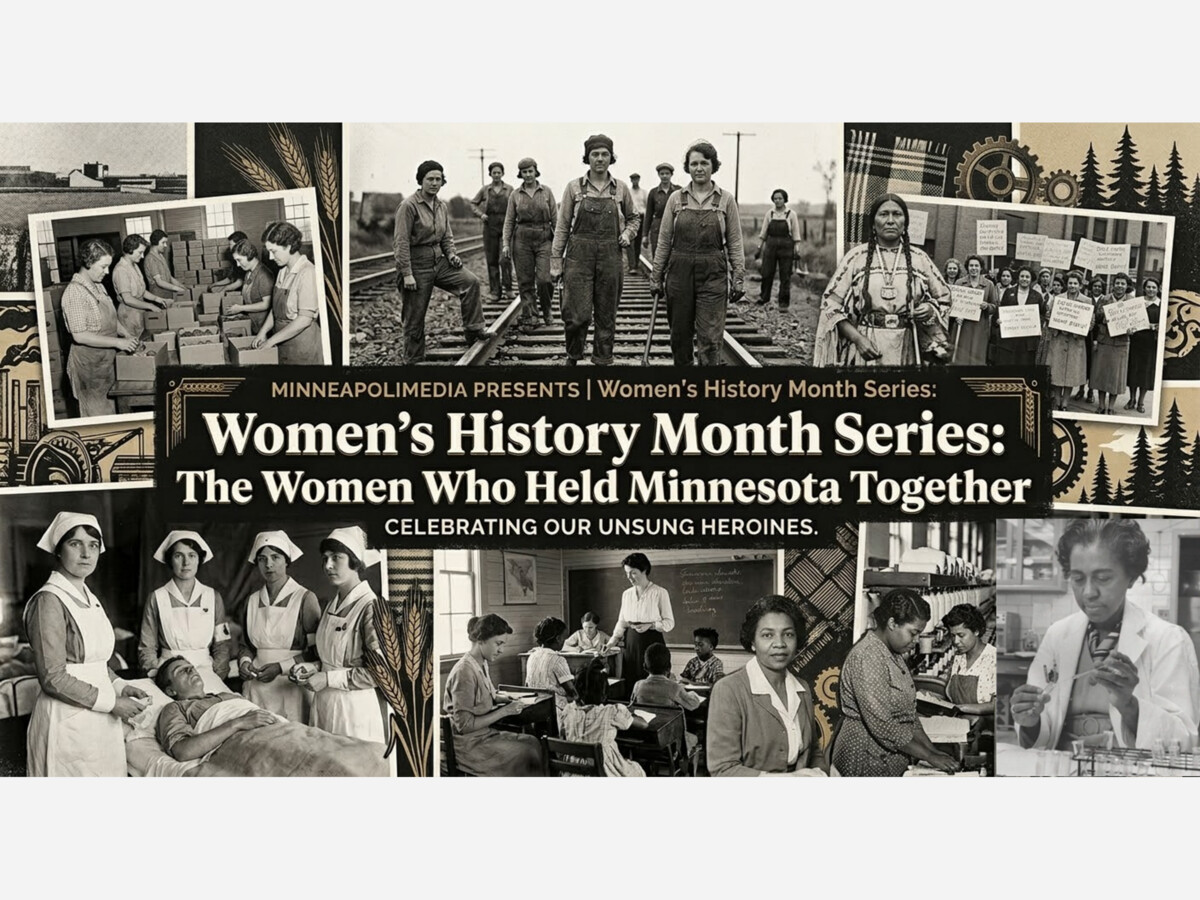



Every state tells a story about itself.
Minnesota often tells a story of civic virtue. It speaks proudly of its schools, its community organizations, its labor traditions, and its long reputation for public engagement. These are real achievements, and they form an important part of the state’s identity.
But the truth behind those institutions is more complicated than the public mythology sometimes suggests.
Communities do not build themselves. Schools do not sustain themselves. Justice does not advance automatically through the natural course of events. Institutions become meaningful only when people insist that they serve everyone, not just the fortunate few.
In Minnesota, that insistence has often come from women.
Many of them worked outside formal political power. Many organized in churches, neighborhood groups, union halls, and civil rights organizations. Many were African American women who confronted systems that were not designed with them in mind.
Yet through persistence, organization, and moral courage, they helped reshape Minnesota into a state more open to opportunity and dignity for all its residents.
Their work is not merely part of Minnesota’s history.
It helped create the Minnesota we know today.
African Americans have lived in Minnesota since the earliest days of the region’s development. But presence did not mean equality.
For much of the twentieth century, African American families in Minnesota faced barriers in housing, employment, education, and political representation. Discriminatory housing practices confined many Black residents to particular neighborhoods. Employment opportunities were limited. Political leadership positions were rare.
In the face of those barriers, African American communities built institutions that provided support, advocacy, and cultural identity.
Churches became anchors of social life.
Community centers provided educational programs, youth development, and social services.
Civil rights organizations challenged discriminatory practices in housing and employment.
And at the center of many of these efforts were women who understood that the survival and advancement of their communities required both organization and courage.
Few figures embody this tradition more powerfully than Nellie Stone Johnson.
Born in northern Minnesota in 1905, Johnson grew up in a farming family that valued education and hard work. She would go on to become one of the most influential labor organizers in the state and a major force within Minnesota’s Democratic–Farmer–Labor political tradition.
Johnson understood that civil rights were inseparable from economic justice. She helped organize hotel and restaurant workers in the Twin Cities and advocated for fair wages and working conditions for employees who had long been marginalized within the labor market.
Her work extended into broader civil rights campaigns as well. Johnson played a role in efforts to secure fair employment and fair housing laws in Minnesota during the mid-twentieth century.
She also made political history by becoming the first African American elected official in Minneapolis.
Johnson’s career reminds us that community building often begins with the determination to make institutions serve those they once excluded.
Another towering figure in Minnesota’s civic history is Josie R. Johnson, often referred to as the “First Lady of Minnesota Civil Rights.”
Johnson played a central role in the struggle for fair housing and educational equity in the state. Her work extended into leadership within the University of Minnesota, where she became the first Black member of the university’s Board of Regents.
Her influence helped push the institution toward greater inclusivity at a time when higher education across the United States was grappling with its own history of exclusion.
Johnson’s legacy illustrates a powerful truth about community leadership.
Sometimes change comes through protest and public pressure. Other times it comes through the patient work of transforming institutions from within.
Both forms of leadership require courage.
Minnesota’s influence on the national civil rights movement is often overlooked, yet figures like Anna Arnold Hedgeman helped bring the state’s leadership onto a larger stage.
Hedgeman was an educator, writer, and political activist whose career spanned several decades. She became the first African American woman appointed to the cabinet of a New York mayor and later played a critical role in organizing the 1963 March on Washington for Jobs and Freedom.
Notably, she was the only woman on the organizing committee for that historic demonstration.
Hedgeman understood that social movements require both vision and discipline. Her work helped ensure that women were represented in a movement often dominated by male leadership.
Her Minnesota roots remain a reminder that the state’s civic tradition has long been connected to national struggles for justice.
As the twentieth century drew to a close, Minnesota saw new milestones in political representation.
Sharon Sayles Belton made history in 1994 when she became the first African American and the first woman elected mayor of Minneapolis.
Her election reflected changes that had been building for decades through the work of community leaders and civil rights advocates.
Sayles Belton’s leadership focused on issues such as economic development, public safety, and community engagement.
Her presence in the mayor’s office signaled that the political landscape of Minnesota was evolving.
Representation does not erase inequality overnight. But it does change the boundaries of what citizens believe is possible.
While some women achieved public prominence, many others worked outside the spotlight.
Across Minnesota, African American women built youth mentorship programs, organized neighborhood associations, led church ministries, and established cultural institutions that preserved community identity.
They helped young people navigate school systems.
They organized food drives and housing assistance programs.
They created safe spaces where families could gather and support one another.
These acts rarely made headlines.
But they strengthened communities in ways that policy alone could never accomplish.
Community leadership often begins with simple acts of responsibility toward neighbors.
And over time, those acts accumulate into institutions that transform cities and states.
The women who held Minnesota together did not all pursue the same paths.
Some organized labor movements.
Some fought for civil rights legislation.
Some reshaped universities.
Some entered political office.
Others strengthened communities through grassroots leadership.
Together, they expanded the promise of Minnesota.
They made it more democratic.
More inclusive.
More conscious of the responsibilities that come with freedom.
Their work reminds us that a state’s character is not determined solely by its laws or political leaders.
It is also determined by the people who insist that those laws and institutions serve the entire community.
Women’s History Month invites reflection not only on the past but also on the responsibilities of the present.
Minnesota’s civic tradition did not emerge by accident. It was built through decades of organizing, advocacy, education, and community leadership.
African American women played a critical role in that process, often confronting barriers that would have discouraged others.
Yet they persisted.
They built institutions where none existed.
They challenged systems that excluded their neighbors.
They mentored the next generation of leaders.
And in doing so, they helped make Minnesota a place where broader possibilities could take root.
Their work continues to shape the state today.
The schools their communities built are still educating children.
The civil rights victories they fought for still protect citizens.
The institutions they strengthened continue to serve Minnesota’s people.
This is the legacy of community builders.
They do not merely participate in history.
They help create it.
MinneapoliMedia
Community. Culture. Civic Life.



Sunny, with a high of 78 and low of 42 degrees. Sunny for the morning, clear overnight.