66° and Overcast
Image
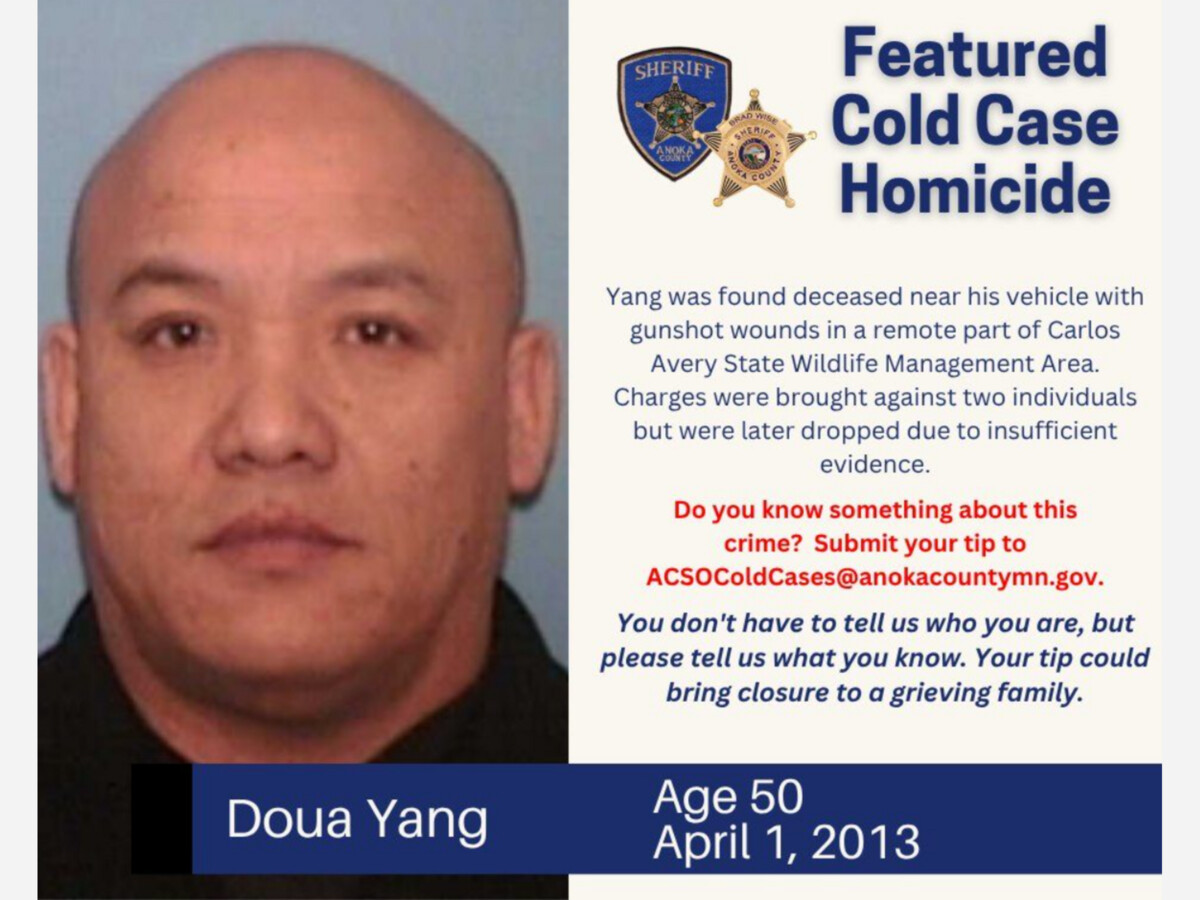



On April 1, 2013, deputies from the Anoka County Sheriff's Office responded to a secluded area within the Carlos Avery State Wildlife Management Area in Columbus, Minnesota. There, near his vehicle, they discovered Yang’s body.
He had been shot multiple times.
The location, isolated and largely shielded from public view, offered little in the way of immediate answers.
From the outset, investigators understood that the circumstances surrounding Yang’s death did not fit a simple narrative.
According to case details, Yang was found lying beside his vehicle in what has been described as a remote cul-de-sac within the wildlife area. Despite the violence of the attack, certain details stood out.
Personal belongings remained intact.
More than $700 in cash was still on his person. His keys had not been taken. These details suggested that robbery was unlikely to have been the primary motive, shifting investigative focus toward more personal or targeted explanations.
Yet even as questions narrowed, definitive answers remained out of reach.
As detectives worked to reconstruct Yang’s final hours, attention turned to his digital activity.
Investigators obtained records showing that Yang had been active on Facebook shortly before leaving his home the night of the killing. Messages reviewed through a search warrant indicated he had been communicating with an account later identified as belonging to a woman named Nou Zong Lee.
What followed drew scrutiny.
According to investigative records, the account associated with Lee was deactivated the day after Yang’s death. At the same time, Yang and several others were removed from her online connections. Additional digital activity—including a search for Yang’s name on Ancestry-related platforms before his identity had been publicly released—was later cited in charging documents.
For investigators, the digital trail offered direction.
For prosecutors, it was not enough.
In the months following the homicide, authorities arrested and charged two individuals in connection with Yang’s death.
But the case never reached trial.
The Anoka County Attorney’s Office ultimately dismissed the charges, citing insufficient evidence to meet the legal threshold required for prosecution.
The decision underscored a central tension in criminal investigations: the gap between suspicion and proof.
While investigators may assemble a theory of the case, prosecutors must demonstrate that theory beyond a reasonable doubt. In Yang’s case, that burden could not be met with the evidence available at the time.
The result was a case that had briefly moved toward resolution before returning to uncertainty.
The setting of the crime continues to shape the investigation.
The Carlos Avery State Wildlife Management Area spans thousands of acres of wooded terrain, with limited infrastructure and minimal surveillance. It is a place where movement can go unnoticed and where evidence, once lost, is difficult to recover.
Such environments complicate even the most thorough investigations.
In cases like Yang’s, the absence of definitive physical evidence can stall even the most persistent efforts.
Today, Yang’s case is part of the ongoing work of the Anoka County Sheriff's Office Cold Case Homicide Unit, which has renewed its call for public assistance.
Recent years have brought new tools and resources to such investigations.
In late 2023, the department received federal funding—reported at approximately $1.15 million—to apply modern forensic techniques to older cases. These advancements include enhanced ballistic analysis, improved DNA testing capabilities, and expanded data integration methods.
Investigators are hopeful that evidence once considered inconclusive may yield new insights under updated technology.
Equally important is the role of the public.
Cold case investigators emphasize that new information often comes not from laboratories, but from people—individuals who may have withheld details, misunderstood their significance, or only now feel able to come forward.
The Sheriff’s Office is urging anyone with information about Yang’s death to contact investigators.
Officials stress that even small details—memories of vehicles in the area, conversations, or observations from that night—can help reconstruct a timeline that has remained incomplete for more than thirteen years.
For the public, the case surfaces briefly each year, often around its anniversary.
For Yang’s family, the timeline is continuous.
Each year without resolution is not simply a passage of time, but an extension of uncertainty.
Law enforcement officials often describe cold cases not as inactive, but as unresolved. Files remain open. Evidence is preserved. Leads are revisited.
What changes is not the importance of the case, but the visibility of it.
The facts that can be established are clear.
A man left his home.
He traveled to a remote area.
He was shot and killed.
What remains unclear is why.
And who.
More than a decade later, those questions continue to define the case of Doua Yang.
MinneapoliMedia | Community. Culture. Civic Life.



Patchy rain nearby, with a high of 66 and low of 53 degrees. Overcast in the morning, partly cloudy in the afternoon, clear in the evening, patchy rain nearby overnight.