72° and Clear
Image
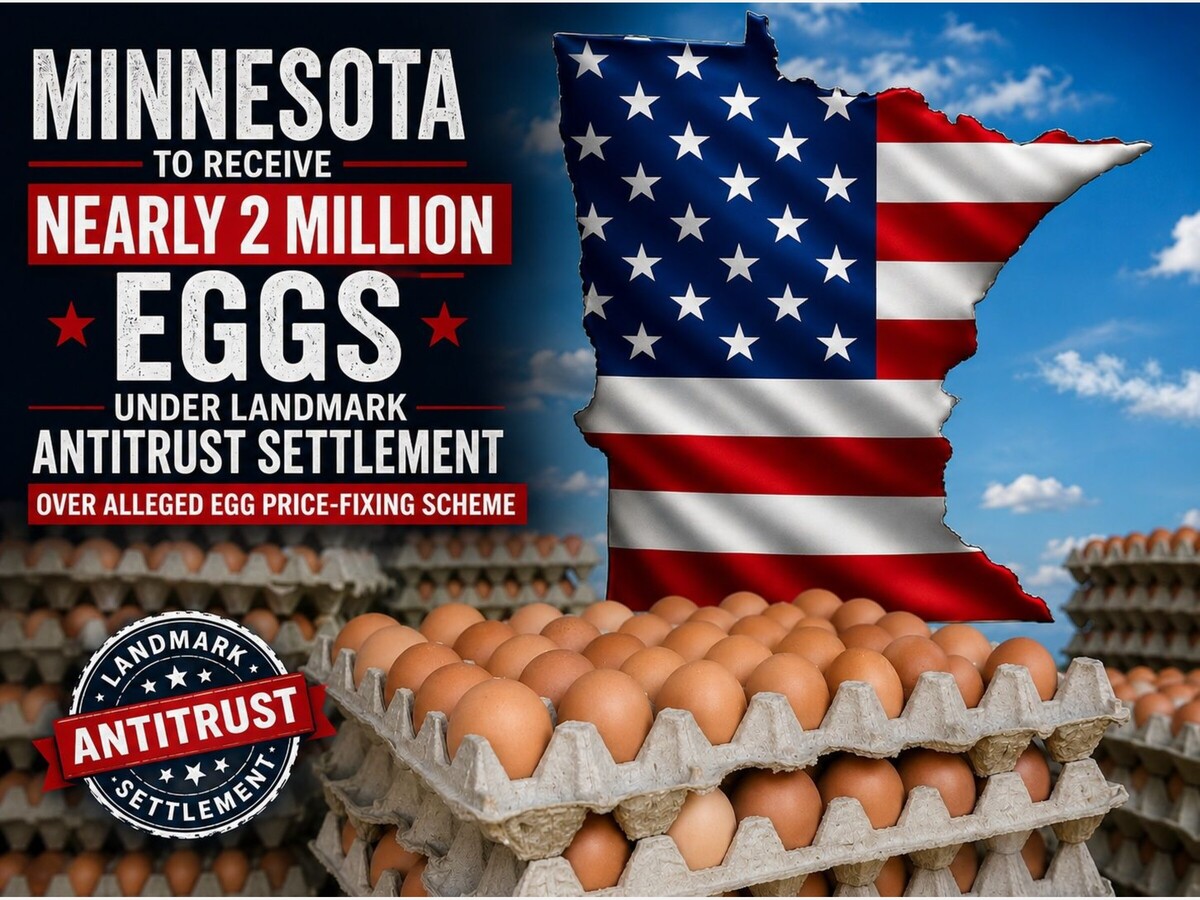



SAINT PAUL, MN (July 3, 2026) Minnesota will receive approximately 2 million eggs for distribution through food shelves and community organizations after Attorney General Keith Ellison joined the U.S. Department of Justice and a bipartisan coalition of 16 other states in securing a sweeping antitrust settlement with three of the nation's largest egg producers accused of conspiring to inflate wholesale egg prices.

The proposed settlement, announced this week, resolves a civil antitrust lawsuit alleging that Cal-Maine Foods, Versova Management Company and Hickman's Egg Ranch coordinated bidding practices over nearly three years to manipulate a key industry pricing benchmark used throughout the nation's egg market.
If approved by the federal court, the agreement will require the companies to provide 53 million grocery-quality eggs to food banks and nonprofit organizations across the United States and pay $3.3 million to the participating states. Minnesota's allocation includes roughly 2 million eggs, which state officials say will be distributed to food banks and community organizations serving families experiencing food insecurity.
For Minnesota, the settlement delivers both immediate food assistance and a broader statement about market accountability at a time when many households continue to grapple with elevated grocery costs.
"As I travel Minnesota, I hear all the time from folks who are struggling to afford rising food prices," Attorney General Ellison said in announcing the agreement. "Corporations should be competing against one another for your business, not colluding with one another to keep prices high. Unlawful and unethical behavior like this is a big part of the reason for that."
According to the complaint filed jointly by the Department of Justice and the participating states, the alleged conduct occurred between June 2022 and March 2025, when executives from competing egg producers allegedly exchanged confidential communications to coordinate bids submitted to Urner Barry, an industry price-reporting service whose daily quotations are widely used by grocery retailers, wholesalers, restaurants and food distributors when negotiating egg purchases.
Federal and state investigators allege the companies deliberately submitted synchronized, artificially high bids designed to influence Urner Barry's benchmark pricing index, thereby raising wholesale prices that ultimately affected consumers nationwide.
Investigators cited internal communications obtained during the investigation, including a December 2022 email in which the chief executive of Hickman's Egg Ranch allegedly urged executives at competing companies to submit "strong bids, early and often." Authorities contend that coordinated bidding activity followed, contributing to higher published market quotations.
The lawsuit further alleges that daily benchmark prices declined significantly after the companies learned they were under federal antitrust investigation, a development investigators argue is consistent with the alleged coordination ending once government scrutiny intensified.
The alleged conspiracy unfolded during one of the most volatile periods in the modern egg market.
Highly pathogenic avian influenza devastated commercial poultry flocks across the United States, sharply reducing the nation's egg supply and driving prices upward. Feed costs, transportation expenses and broader inflationary pressures also contributed to rising prices.
Federal investigators acknowledge those legitimate market forces but contend they do not fully explain the extraordinary increases observed during the period covered by the lawsuit. Instead, the complaint alleges that unlawful coordination among several of the industry's largest producers further amplified wholesale prices.
Nationally, the average retail price of a dozen Grade A eggs reached a record $6.23 in March 2025, according to federal consumer price data, making eggs one of the most visible symbols of rising grocery costs for American households.
Under the proposed agreement:
The donated eggs will be distributed through food banks and nonprofit organizations across the participating states. Minnesota officials say approximately 2 million eggs will be directed to food shelves and community partners serving residents throughout the state.
Although the companies agreed to resolve the litigation, none admitted violating antitrust laws or acknowledged liability.
Cal-Maine Foods said it continues to deny the allegations and maintains its business practices complied with the law. Versova likewise denied wrongdoing. Representatives for Hickman's noted that the conduct alleged in the lawsuit predates the company's acquisition by MTQ USA in late 2025.
The companies have also pointed to unprecedented market conditions during the period in question, including widespread outbreaks of avian influenza, higher grain and feed costs, labor shortages and transportation expenses, as significant contributors to elevated egg prices.
In addition to the financial payments and food donations, the settlement imposes a series of compliance measures intended to strengthen competition and deter future violations.
The companies must immediately cease any coordinated bidding or pricing communications with competitors. Each producer is also required to establish a formal antitrust compliance program, appoint an internal compliance officer responsible for overseeing adherence to competition laws, train employees on antitrust requirements and submit compliance certifications to the participating states and the Department of Justice.
State and federal officials said the measures are designed to increase transparency and reinforce lawful competition in one of the country's most important agricultural markets.
Minnesota joined attorneys general from Arizona, California, Colorado, Connecticut, Florida, Hawaii, Iowa, Maryland, New York, North Carolina, Ohio, Pennsylvania, Texas, Utah, Vermont and Wisconsin, together with the U.S. Department of Justice, in bringing the enforcement action.
The proposed settlement has been filed in federal court and remains subject to judicial approval.
For Minnesota families, the agreement carries both immediate and longer-term significance. In the coming months, roughly 2 million eggs will begin moving through the state's network of food banks and community organizations, providing a fresh source of protein to households facing food insecurity while underscoring the state's effort to hold corporations accountable for conduct that allegedly undermined fair competition and increased the cost of a staple food found in kitchens across the country.
MinneapoliMedia | Community. Culture. Civic Life.



Sunny, with a high of 86 and low of 63 degrees. Patchy rain nearby for the morning, partly cloudy for the afternoon, clear for the evening,