57° and Cloudy
Image




On a cold February morning in Minneapolis, a quiet but consequential act of civic infrastructure will unfold inside the Minneapolis American Indian Center. Attorneys from Mid-Minnesota Legal Aid will set up on the second floor, ready to meet community members where they are, literally and figuratively, offering free legal assistance on some of the most destabilizing issues facing households today.
The clinic will take place Wednesday, February 11, from 10:00 a.m. to 3:00 p.m., at MAIC, 1530 East Franklin Avenue. It is part of an ongoing partnership that brings civil legal advocacy out of distant offices and into trusted community spaces, reducing barriers tied to cost, transportation, and familiarity with the legal system.
At stake are the legal pressures that most often determine whether a family remains housed, an Elder keeps access to health care, or a past mistake continues to block employment and stability.
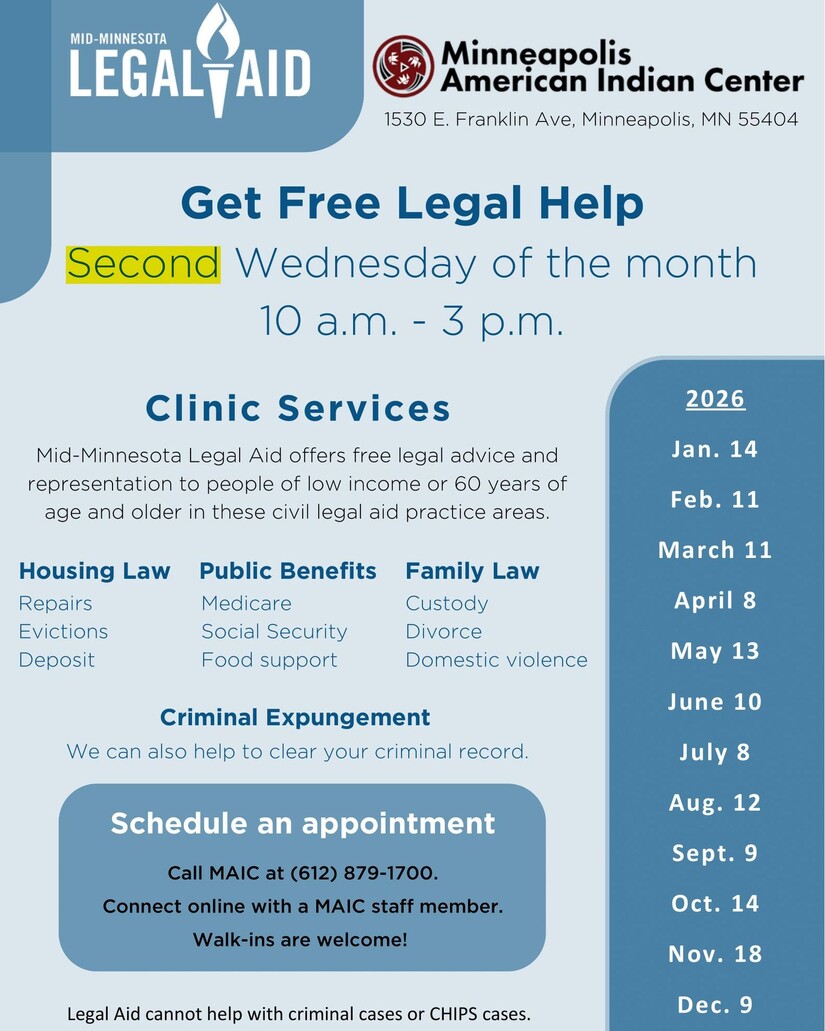
Attorneys and legal staff from Mid-Minnesota Legal Aid will provide advice and brief services across several core areas of civil law, with a focus on prevention, stabilization, and long-term access to opportunity.
Housing law assistance will include help addressing eviction threats, unsafe or uninhabitable living conditions, unresolved repair issues, housing discrimination, and disputes over security deposits. With housing instability continuing to ripple across Minneapolis, these interventions often make the difference between displacement and resolution.
Public benefits guidance will focus on individuals facing denials, reductions, or terminations of essential supports such as Social Security, Medical Assistance, SNAP food support, and Unemployment Insurance. For many households, these benefits function as the final safeguard against crisis.
Family law services will center on cases involving domestic violence protections, child custody, and divorce, particularly when safety or custody concerns are present. Legal Aid staff emphasize that these matters are handled with confidentiality and care, recognizing the vulnerability often involved.
Criminal expungement assistance will help eligible individuals begin the process of sealing past criminal records, a legal step that can dramatically improve access to employment, housing, and education. In Minnesota, expungement has increasingly been recognized as an economic and public safety tool, not merely a legal remedy.
The clinic does not provide representation in criminal defense cases or CHIPS cases, focusing exclusively on civil legal matters.
Mid-Minnesota Legal Aid offers services at no cost to Minnesotans who meet specific eligibility criteria:
Community members are strongly encouraged to schedule an appointment in advance by calling (612) 879-1700, though walk-ins are welcome and will be seen as capacity allows. Upon arrival, visitors should check in at the front desk on the first floor and will be directed to the second-floor Receptionist’s Office, where the clinic is held in a private and accessible setting.
To make the most of their time with an attorney, participants are advised to bring relevant documents such as lease agreements, benefit denial letters, court paperwork, or agency correspondence.
The legal clinic is part of a standing monthly schedule, with Mid-Minnesota Legal Aid hosting clinics at MAIC on the second Wednesday of each month throughout the year. That regularity matters. It signals not a one-time outreach effort, but a sustained commitment to embedding legal support within community institutions that residents already know and trust.
In a city where access to justice often depends on proximity, literacy, and resources, the February 11 clinic represents something quieter but more durable: a reassertion that legal protection is not a privilege reserved for those who can navigate the system alone, but a public good that must be brought, consistently, to the people who need it most.
For many who walk through MAIC’s doors next Wednesday, the conversation upstairs may be brief. Its impact, however, could last far longer.



Patchy rain nearby, with a high of 74 and low of 56 degrees. Sunny for the morning, clear overnight.