Image
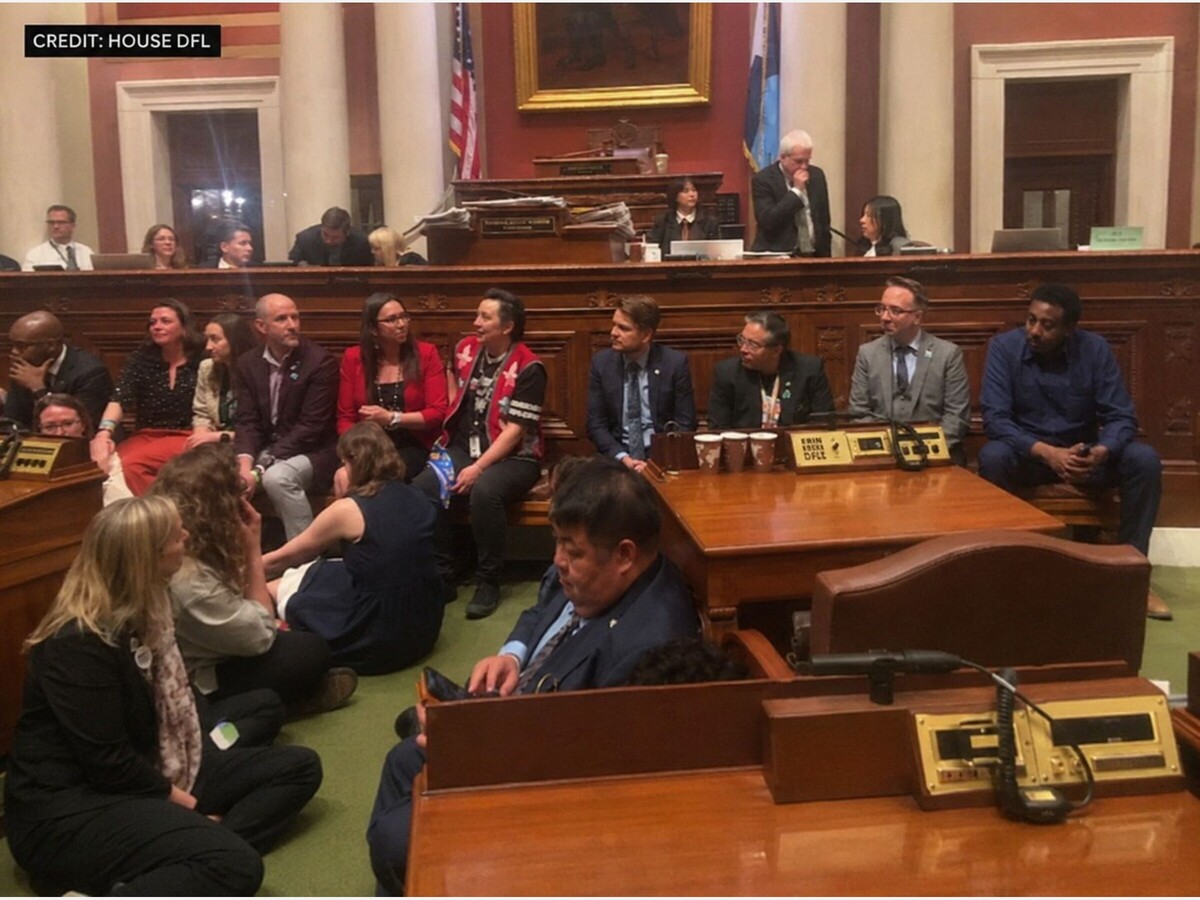



ST. PAUL, MN (May 16, 2026) Beneath the marble columns and dim chamber lights of the Minnesota House of Representatives, Democratic lawmakers remained on the House floor overnight Friday, refusing to leave as the final weekend of the 2026 legislative session unfolded around them.
Sleeping bags, blankets, laptops, coffee cups, and stacks of legislative papers lined portions of the chamber floor in what had transformed from a routine late-session debate into one of the most emotionally charged standoffs at the Minnesota Capitol in recent memory.
At the center of the confrontation is SF 4067, a sweeping gun violence prevention package that passed the Minnesota Senate earlier this month on a razor-thin 34-33 party-line vote. The legislation would ban the future sale of semiautomatic military-style assault weapons, ghost guns, and high-capacity magazines while also establishing a statewide anonymous threat-reporting system intended to identify potential acts of violence before they occur.
But the legislation now sits trapped inside an unprecedented political reality: a Minnesota House evenly divided between 67 Democrats and 67 Republicans, where procedural deadlock has become one of the defining features of the 2026 session.
The House faces a constitutional adjournment deadline Sunday night.
For Democrats participating in the sit-in, the protest is about forcing a public vote on legislation they argue has become morally urgent after the politically motivated attacks of June 14, 2025, that stunned Minnesota and reverberated nationally.
Federal prosecutors allege that on that morning, a heavily armed gunman, identified as Vance Boelter, carried out targeted attacks against Democratic lawmakers and their families. Authorities say the gunman first went to the Champlin home of Sen. John Hoffman and his wife, Yvette Hoffman, wounding both before traveling to Brooklyn Park, where House Speaker Emerita Melissa Hortman and her husband, Mark Hortman, were shot and killed outside their home.
The attacks profoundly altered the emotional landscape of the Capitol.
During Thursday’s floor debate, Rep. Kristin Bahner, DFL-Maple Grove, spoke visibly shaken while rejecting Republican criticism that Democratic efforts amounted to political theater.
“I’m tired of the implication that this vote is about theatrics,” Bahner said. “This vote isn’t about theatrics for me.”
Investigative findings later revealed that Bahner’s home was also included among locations connected to the gunman’s movements that day, though she was not present at the time.
For lawmakers like Rep. Huldah Momanyi-Hiltsley, DFL-Brooklyn Park, who now represents the community formerly represented by Hortman, the sit-in carries both legislative and symbolic weight. Momanyi-Hiltsley remained inside the chamber overnight alongside roughly a dozen Democratic colleagues after House Republicans blocked an attempt to suspend chamber rules and force a vote on HF5140, legislation similar to the Senate proposal.
Under Minnesota House Rule 4.30, suspending standard House procedures to bring a bill directly to the floor requires a two-thirds supermajority vote, meaning Democrats would have needed at least 23 Republicans to join them in the evenly divided chamber. That threshold proved unreachable after more than six hours of debate Thursday night.
“We deserve a real debate and vote on this bill,” Rep. Mike Freiberg, DFL-Golden Valley, said during floor remarks. “No theatrics. No stalling. Just an actual conversation about a path forward for Minnesotans with actions to match.”
The legislation itself represents one of the most expansive firearm restriction packages introduced in Minnesota in decades.
According to legislative language and Senate debate summaries, the proposal would broaden the legal definition of prohibited semiautomatic military-style assault weapons by targeting specific tactical features, including detachable magazines paired with pistol grips, thumbhole stocks, or barrel shrouds. The bill would also criminalize the manufacture, possession, or transfer of unserialized “ghost guns,” including firearms assembled from kits or 3D-printed components.
In addition, the proposal would establish a statewide anonymous threat-reporting clearinghouse intended primarily for schools and public safety agencies to help identify warning signs connected to planned violence or mass casualty threats before attacks occur.
Republican leaders, however, argue the legislation raises substantial constitutional, due process, and procedural concerns that require full committee review rather than emergency floor maneuvers during the closing hours of session.
House Majority Leader Harry Niska, R-Ramsey, acknowledged the trauma lawmakers continue carrying from last year’s attacks but argued the emotional gravity of the issue cannot replace standard legislative process.
“Difficult policy issues like this have to go through a normal committee process,” Niska said during Thursday’s debate. “And especially when we’re talking about bills criminalizing people with major constitutional questions, with major due process questions. This bill is not ready, no matter how urgent the problem is, to pass.”
Republican leaders have emphasized that multiple components of the legislation were previously considered in committee earlier this session and failed to advance within the evenly divided House structure.
The divide reflects broader national tensions surrounding gun legislation in the aftermath of recent Supreme Court rulings expanding Second Amendment protections while states simultaneously attempt to address mass shootings, political violence, and the growing availability of unserialized firearms.
According to the nonprofit Giffords Law Center, multiple states currently maintain bans or restrictions involving assault-style weapons or high-capacity magazines, though many continue facing active court challenges.
Inside the Capitol Friday, however, the debate had become about more than policy language alone.
It had become a confrontation over grief, institutional power, public accountability, procedural control, and whether extraordinary violence demands extraordinary legislative action.
The sit-in also exposed the fragile mechanics of governing within Minnesota’s evenly split House, where virtually every major policy dispute this session has required painstaking bipartisan negotiation simply to move legislation forward.
As lawmakers entered the final hours before constitutional adjournment, it remained unclear whether Republican leadership would allow a vote on the gun legislation or whether the sit-in would produce any procedural breakthrough.
Still, Democratic lawmakers occupying the chamber insisted the protest itself carried value, even absent immediate legislative success.
For now, the Minnesota House floor has become both a functioning legislative chamber and a symbolic protest site, where lawmakers continue debating not only the future of gun policy in Minnesota, but also how a state still processing political violence chooses to respond when fear, grief, constitutional rights, and public safety collide under the Capitol dome.
MinneapoliMedia | Community. Culture. Civic Life.

Sunny, with a high of 86 and low of 49 degrees. Sunny in the morning, clear overnight.