68° and Clear
Image
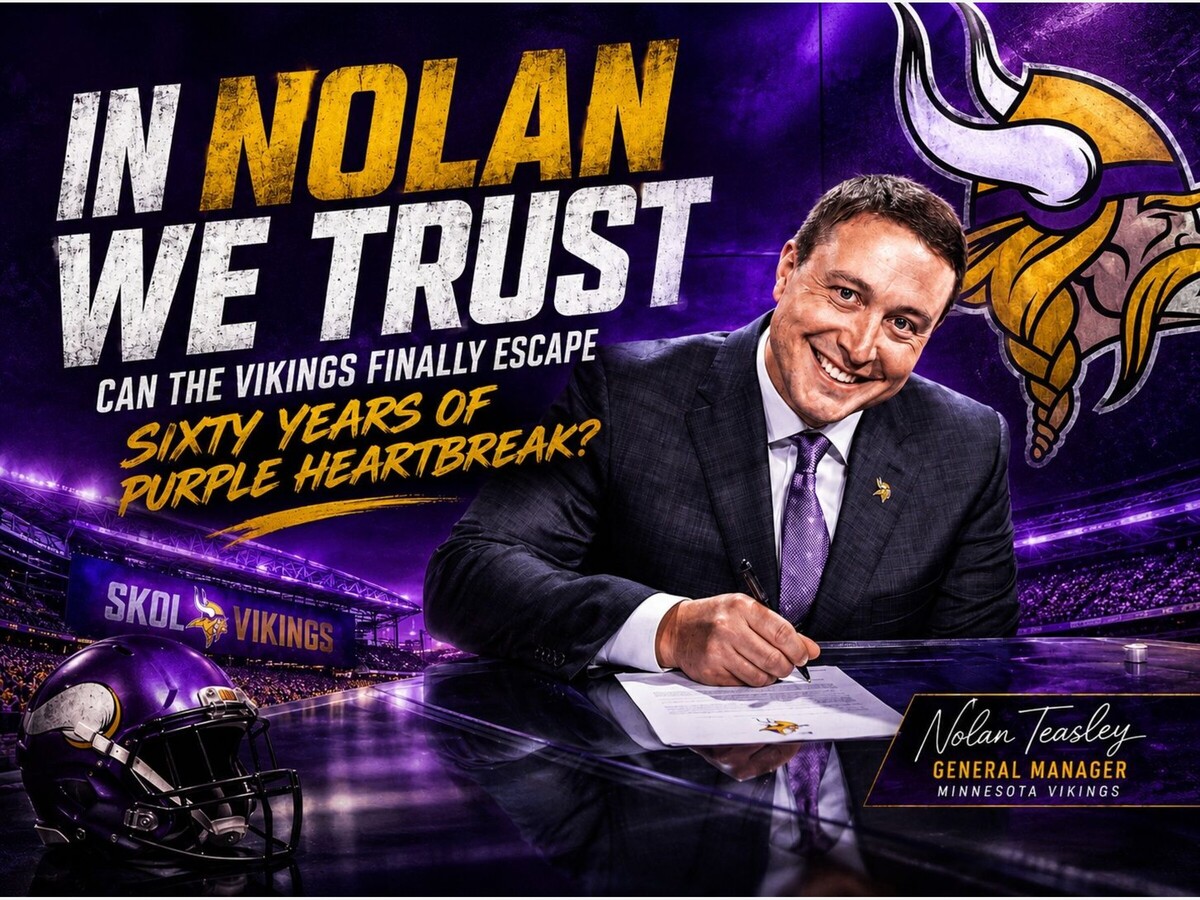



To the casual observer, it was standard corporate football speak. Every new general manager arrives carrying an identical binders worth of ambition. Every new head coach offers an optimized blueprint. Every fresh season arrives promising that this time will be different.
In Minnesota, however, football promises do not exist in isolation. They arrive carrying history.
The Minnesota Vikings are not merely an NFL franchise. They represent one of the most agonizing, fascinating paradoxes in American professional sports. They are an elite, blue-blood organization that has spent more than six decades proving it knows how to build a winning football team, while simultaneously spending those same six decades proving how difficult it is to finish the job.
The Vikings are not defined by prolonged losing, institutional incompetence, or localized irrelevance. Their identity is rooted in something far more complicated. They have mastered nearly every structural requirement necessary to reach the sport’s highest peaks except the final step.
That final step has haunted generations of legends. It haunted Bud Grant, Fran Tarkenton, and Alan Page. It haunted Randy Moss and Adrian Peterson. It haunted Brett Favre, Mike Zimmer, and Kirk Cousins.
Now, that institutional burden waits for Nolan Teasley.
Across professional sports, fans and analysts prefer simple binary categories. There are winners and losers. Champions and pretenders. Dynasties and disasters.
The Vikings fit none of these descriptions comfortably.
Only a handful of NFL organizations have maintained the level of sustained competitiveness Minnesota has achieved since entering the league in 1961. The Vikings rank among the winningest franchises in professional football history. They have produced Hall of Fame icons across multiple generations. They have secured division championships in every modern era, reaching conference title games under different ownership groups, completely altered coaching staffs, and entirely rewritten roster constructions.
For most fan bases, such a résumé would be celebrated without qualification. In Minnesota, that history is viewed through the lens of an aching void.
Four Super Bowl appearances. Four losses. An absence that has stretched past half a century.
That absence is not simply a footnote in a media guide; it is a foundational component of the regional sports identity. Hopeless franchises rarely suffer this way. Hopeless franchises do not routinely field championship-caliber rosters, nor do they consistently place themselves within striking distance of immortality. The Vikings have repeatedly done exactly that, which is precisely why the localized disappointments continue to echo so loudly across decades.
The foundation of this collective psychology was forged during the late 1960s and 1970s. Under Hall of Fame Head Coach Bud Grant, the organization became a national model of relentless consistency. Between 1968 and 1980, Minnesota captured eleven division championships. The legendary Purple People Eaters became a symbol of Minnesota football itself. Alan Page revolutionized defensive line play with a historic combination of speed and intellect. Carl Eller brought a fierce, physical edge. Jim Marshall became the gold standard for durability and locker room leadership, while Gary Larsen completed a defensive front that terrorized opposing offenses.
Behind them stood Fran Tarkenton, whose creativity, improvisational vision, and mobility forever altered the geometry of the quarterback position long before modern dual-threat players became the standard.
These were not merely good football teams. They were dominant, championship-caliber rosters. Yet the ultimate triumph never materialized. The losses were not just defeats; they were profound, systematic lessons in misfortune.
In Super Bowl IV, Minnesota turned the football over five times against Kansas City. In Super Bowl VIII, Miami physically controlled the line of scrimmage, dictating the game on the ground. In Super Bowl IX, Pittsburgh suffocated the offensive game plan entirely. In Super Bowl XI, Oakland overwhelmed the Vikings from start to finish.
The individual details varied, but the final outcome remained static. The Vikings could conquer the arduous path to the biggest stage, but they could not conquer the stage itself.
Over time, this pattern reshaped the cultural contract between the franchise and its supporters. While other fan bases developed confidence through repeated championship success, Minnesota developed a learned caution, a localized skepticism, and an innate belief that even the most brilliant moments might contain the seed of future catastrophe.
This mindset did not emerge because the community lacked faith; it emerged because history repeatedly validated their hesitation.
The decades that followed the Purple People Eaters only reinforced the lesson. The franchise never faded into chronic failure. Instead, they consistently remained close enough to greatness to keep the collective dream alive. That perpetual proximity is what made the inevitable structural fractures hurt so deeply.
The 1998 Vikings remain one of the most explosive, gifted rosters in NFL history. Their offense, directed by a resurgent Randall Cunningham and ignited by rookie sensation Randy Moss, changed how defensive coordinators across the league viewed coverage models. Minnesota finished the regular season 15-1, appearing completely destined for a Lombardi Trophy.
Then came Gary Anderson. No single player symbolized mechanical reliability more completely. Anderson had not missed a field goal or an extra point all season. Not one. Yet with the Vikings on the doorstep of securing a Super Bowl berth late in the NFC Championship Game against Atlanta, his 38-yard attempt sailed wide. The Falcons rallied, Minnesota fell in overtime, and an entire generation of fans was left with an permanent sports trauma.
A decade later, the 2009 squad assembled another elite roster. Brett Favre delivered a remarkable late-career performance, Adrian Peterson was in his physical prime, and an experienced defense controlled the trenches. They advanced to the NFC Championship Game against New Orleans, enduring a punishing, physical contest filled with turnovers and momentum swings. With an opportunity to drive for a game-winning field goal late in regulation, Favre rolled to his right and threw across his body, resulting in an interception that remains permanently etched into franchise lore. The Saints advanced; the Vikings went home.
The pattern resurfaced during the Mike Zimmer era. Zimmer established defensive identity and structural stability, yet the defining milestones remained frustratingly elusive. The 2015 Wild Card playoff loss to Seattle ended when Blair Walsh missed a short, routine field goal in freezing conditions.
Two years later, the Minneapolis Miracle produced one of the most iconic, euphoric moments in NFL history when Stefon Diggs caught a walk-off touchdown from Case Keenum. For a brief moment, it felt as though destiny had finally corrected itself. The Vikings stood exactly one victory away from becoming the first team in NFL history to host a Super Bowl in their own stadium. Instead, Philadelphia delivered a cold, 38-7 reality check the following week.
Even the recent past offers stark reminders of how fragile success can be in this league. In 2022, under first-year head coach Kevin O'Connell, the Vikings engineered a spectacular 13-4 campaign, posting an astonishing 11-0 record in one-score games. While the achievement highlighted a resilient locker room culture, it masked severe, underlying defensive weaknesses that were immediately exposed at U.S. Bank Stadium during a Wild Card loss to the New York Giants.
The 2023 season evaporated the moment Kirk Cousins suffered a torn Achilles tendon. The following year brought structural and emotional hurdles that extended far beyond the football field, as first-round quarterback J.J. McCarthy suffered a season-ending injury before his rookie campaign could truly begin, and rookie cornerback Khyree Jackson tragically lost his life in a summer car accident.
Through every era, through every transition, the theme remained unchanged. The Vikings were never hopeless, but they could not find a way to finish the journey.
This is the exact historical and emotional landscape Nolan Teasley inherits. Crucially, he is not taking over a complete, ground-up rebuilding project. He inherits a roster that already features Justin Jefferson, the premier offensive weapon in professional football. He inherits a highly respected head coach in Kevin O'Connell, a stable salary cap architecture managed by executive vice president of football operations Rob Brzezinski, and a fan base that remains intensely loyal despite decades of emotional scar tissue.
The challenge facing Teasley is not teaching this franchise how to become competitive; the organization has already mastered that. The challenge is transforming competitive relevance into sustainable, championship durability.
Teasley’s professional background suggests he is uniquely equipped for this specific assignment. Rising from a scouting intern in 2013, after writing letters to all 32 NFL teams, he spent thirteen seasons climbing the personnel ranks with the Seattle Seahawks, eventually serving as Assistant General Manager under John Schneider. During his tenure in the Pacific Northwest, the Seahawks secured nine playoff berths, reached three Super Bowls, and captured two championships, including a Lombardi Trophy this past February.
The hallmarks of those Seattle teams were continuous roster evolution, intense internal competition, and remarkable depth. Late-round draft choices and undrafted free agents routinely transformed into core contributors because the front office focused on finding specific player traits that matched the coaching staff's schematic needs.
Historically, many of Minnesota's most successful teams have depended heavily upon elite star power. When those stars remained healthy and productive, the Vikings looked unstoppable. When adversity struck, the margin for error completely vanished.
Championship organizations operate with a different philosophy. They are built around systems rather than individuals, emphasizing structural redundancy. The best front offices construct rosters that can absorb key injuries, survive poor performances, and continue functioning at an elite level when circumstances become difficult. Teasley’s stated objective of building the deepest roster possible indicates a desire to transition depth from a roster insurance policy into a core organizational identity.
Furthermore, Teasley’s introductory remarks highlighted an explicit commitment to institutional alignment. Many NFL front offices break down because decision-makers operate with conflicting agendas. Scouts prioritize one set of physical traits, analytics departments emphasize another, and the coaching staff operates within a different schematic reality.
Successful organizations build a unified consensus. Teasley outlined a clear three-pillar framework for player evaluation and acquisition: a process guided by traditional evaluation, anchored by data, and completed by the coach’s specific vision for the player. By ensuring that he, Kevin O'Connell, and Rob Brzezinski operate out of a shared organizational philosophy, the Vikings are attempting to construct a front-office infrastructure strong enough to withstand the volatile nature of the modern NFL.
For decades, the standard response to Minnesota's championship drought has been a search for a singular savior. The community has looked for a singular quarterback, a legendary coach, a transcendent draft pick, or a high-profile free agent to break the curse.
Yet championship continuity rarely emerges from singular solutions. It emerges from infrastructure. It emerges from disciplined, process-driven decision-making sustained over time.
The Vikings' historic vulnerability has never been a lack of high-end talent; it has been organizational fragility. It has been the tendency for an entire era to unravel because of one ill-timed injury, one unexpected turnover, one missed kick, or one defensive breakdown in January.
Nolan Teasley cannot erase the Super Bowl losses of the 1970s. He cannot change the trajectory of Gary Anderson’s kick, nor can he pull back Brett Favre’s rolling interception in the Superdome. He cannot rewrite the history of the NFC Championship Games that slipped away.
What he can do is construct an organization resilient enough to avoid repeating those structural failures. His significance does not lie in a promise of a championship, but in his evident understanding of the fundamental question facing this franchise. The question is not how to build a good football team; the Vikings have built dozens of them. The question is how to build a football operation capable of surviving the exact moments that have historically broken Minnesota at the summit.
History offers no guarantees, and the NFL landscape is filled with highly regarded executives who arrived with impressive credentials only to depart with unmet expectations. The margin for error remains microscopic, and the regional expectations are immense.
Yet, for all the uncertainty that surrounds the future, one fact remains undeniable: the Minnesota Vikings continue to matter. They continue to inspire investment, generate civic pride, and convince millions of people that the upcoming year might finally be the year. That persistence speaks volumes about the durability of the fan base and the enduring power of sporting possibility.
Now, another chapter begins at the TCO Performance Center. The executives are new, the strategies have evolved, but the mandate remains unchanged: bring a Lombardi Trophy to Minnesota and transform six decades of "almost" into "finally."
Whether Nolan Teasley succeeds where so many talented leaders have fallen short remains to be seen. But as his tenure officially begins, he inherits both the profound burden and the spectacular opportunity that come with guiding one of professional sports' most fascinating franchises. The path forward is not attempting to outrun sixty years of heartbreak. The path forward is building an organization so strong that heartbreak no longer gets the final word.
MinneapoliMedia | Community. Culture. Civic Life.



Sunny, with a high of 94 and low of 67 degrees. Sunny during the morning, clear overnight.