59° and Sunny
Image
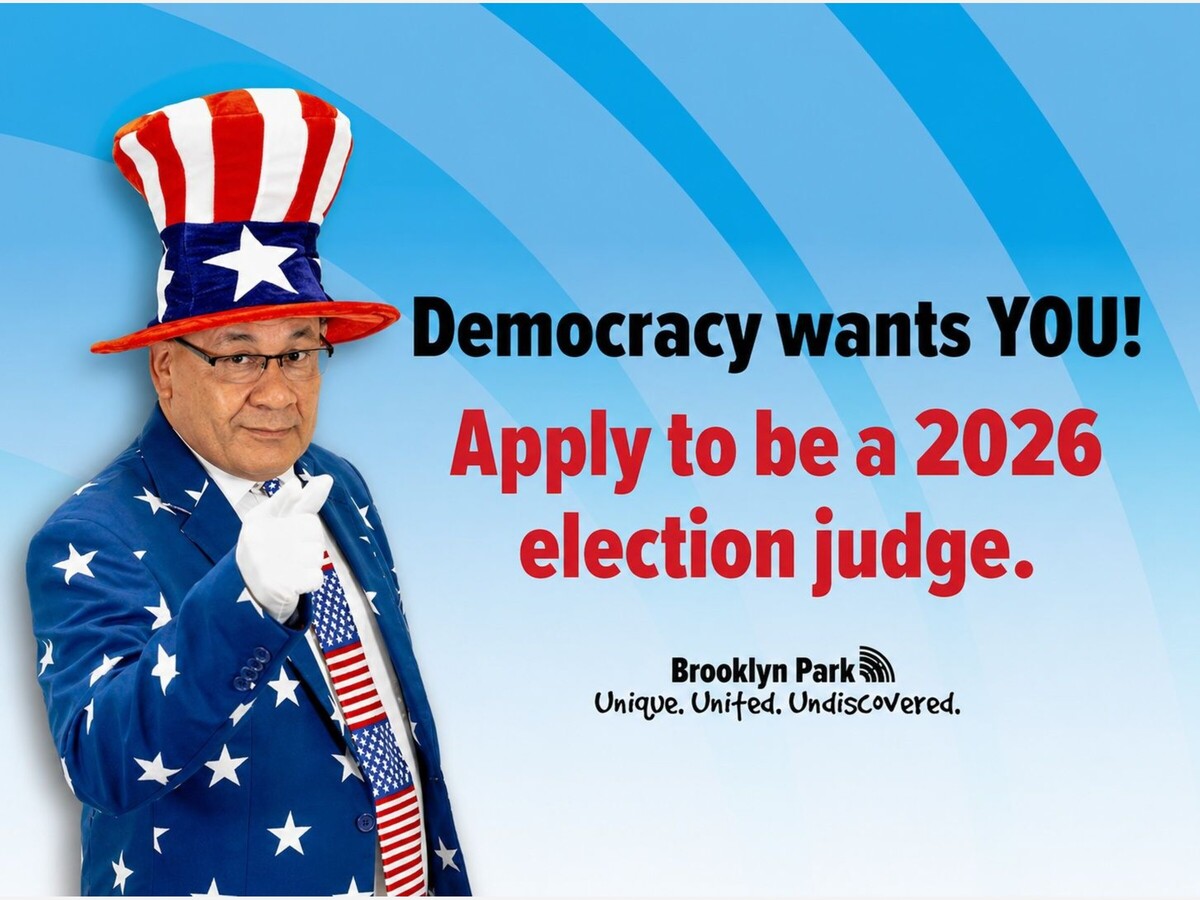



As Minnesota's sixth-largest city prepares for the August primary and November general election, officials seek residents willing to help administer voting, process registrations, and safeguard one of democracy's most essential functions.
BROOKLYN PARK, MN (June 9, 2026) Long before the first ballot is cast, before campaign signs appear at polling places, and before election results begin scrolling across television screens, a different process is already underway inside city halls across Minnesota.
It is the work of recruiting, training, and deploying the thousands of citizens who make Election Day possible.
In Brooklyn Park, the state's sixth-largest city, officials have begun that effort in earnest, opening applications for election judges who will staff polling locations during the August primary and November general elections.
The recruitment campaign, administered through the Brooklyn Park City Clerk's Office, seeks residents willing to serve as the frontline workforce of Minnesota's election system. Their responsibilities will range from opening polling places before dawn and verifying voting equipment to processing voter registrations, assisting residents with ballots, and certifying results after the polls close.
"There is no better way to learn about the election process than working as an election judge while serving your community," the city said in announcing the application period.
For Brooklyn Park, a city of more than 86,000 residents and one of Minnesota's most culturally and linguistically diverse communities, the effort is more than routine administrative preparation. It is a critical component of maintaining public confidence in the democratic process.
While voters typically spend only a few minutes inside a polling place, election judges often commit an entire day, and several hours of training beforehand, to ensuring elections run smoothly.
They are responsible for some of the most visible and consequential functions of election administration.
Before voting begins, judges prepare polling locations by assembling voting stations, placing required state election notices, organizing voter rosters, securing ballot boxes, and testing tabulation equipment to confirm all vote counters begin at zero.
Once polls open, judges become the public face of the election.
They verify voter eligibility, check in registered voters, process Minnesota's same-day voter registrations, issue ballots, provide instructions on proper ballot completion, and assist voters requiring accommodations because of language, disability, or other accessibility needs.
After polls close, the work continues.
Election judges secure ballots, close voting equipment, reconcile voter participation totals, certify precinct results, and prepare official materials for delivery to election headquarters.
The integrity of the election depends on each step being completed accurately and according to state law.
Minnesota law establishes strict eligibility standards designed to preserve impartiality and public trust.
To qualify as an election judge, applicants generally must be United States citizens, eligible to vote in Minnesota, and able to read, write, and speak English.
State law also prohibits certain conflicts of interest.
Individuals may not serve if they are candidates appearing on the ballot within their precinct. Similarly, spouses, parents, children, and siblings of candidates are prohibited from serving in precincts where those candidates are running. Additional restrictions prevent immediate family members from serving together as judges in the same precinct.
Beyond statutory requirements, election officials often seek applicants who demonstrate strong attention to detail, basic mathematical proficiency, customer-service skills, and comfort working with computers and electronic voting systems.
Because Brooklyn Park residents collectively speak dozens of languages, multilingual applicants are particularly valuable. Election officials routinely emphasize that language diversity among election judges helps improve voter access and communication throughout the city.
No election judge is permitted to handle ballots or voting equipment without first completing mandatory training.
Brooklyn Park's election judges participate in approximately three hours of paid instruction prior to Election Day. The curriculum covers election law, voter eligibility requirements, polling place procedures, ballot security, accessibility accommodations, electronic poll books, voting equipment operation, and emergency response protocols.
Training sessions for the 2026 election cycle are expected to occur during the summer before the August primary.
Experienced judges may also receive assignments involving absentee ballot processing, post-election reviews, recount procedures, and other specialized election functions.
Election officials note that Minnesota's election system places particularly significant responsibilities on judges because the state allows Election Day voter registration, a process requiring additional verification and documentation procedures that are not available in many other states.
The city is also accepting applications through Minnesota's Student Election Judge Program, which allows qualified 16- and 17-year-old students to participate in election administration.
To qualify, students must be United States citizens, residents of Hennepin County, enrolled in a Minnesota high school or approved home-school program, and maintain good academic standing. They must also obtain written permission from both a parent or guardian and a school administrator.
The program has become an increasingly important recruitment tool for election offices statewide.
Beyond helping address workforce needs, officials say the initiative gives students an unusually direct view into how elections function. Rather than learning about democracy solely through textbooks, participants observe voter registration, ballot processing, election security procedures, and civic participation firsthand.
For many students, it represents their first formal experience with public service.
Serving as an election judge requires a substantial time commitment, particularly for workers assigned to full-day shifts beginning before sunrise and extending until all election-night responsibilities have been completed.
Recognizing that challenge, Minnesota law provides specific employment protections for election judges.
Employees appointed to serve are entitled to take time away from their regular jobs without penalty if they provide their employer with at least twenty days' written notice before Election Day.
Employers may offset wages by the amount earned from election service, and state law allows businesses to limit simultaneous absences to protect operational needs. Election officials can also provide documentation verifying service hours and compensation when requested by employers.
The protections reflect Minnesota's longstanding recognition that elections depend upon citizen participation not only as voters, but also as administrators.
Election administrators across Minnesota have faced increasing challenges in recruiting and retaining poll workers in recent years.
Many longtime election judges who served for decades have retired, while growing election complexity has increased the demand for trained personnel capable of navigating evolving technologies and procedures.
Brooklyn Park's recruitment effort reflects a broader statewide reality: elections are not self-executing.
Behind every ballot cast stands a network of trained citizens who arrive before dawn, remain after the polls close, and carry out the often unseen work that allows democratic institutions to function.
For residents interested in civic service, election judging offers a rare opportunity to move beyond observing government and participate directly in its operation.
As preparations for the August primary and November general election continue, city officials are encouraging residents to consider becoming part of that process.
Applications for election judges and student election judge trainees are currently being accepted through the City of Brooklyn Park's election services portal.
Position: Election Judge
Elections: August 2026 Primary and November 2026 General Election
Administered By: Brooklyn Park City Clerk's Office
Training: Mandatory paid training required
Eligibility: Must meet Minnesota election judge qualifications
Student Program: Available for eligible 16- and 17-year-old students
Application Portal: brooklynpark.org/elections/election-judges
For many residents, Election Day lasts only a few minutes. For election judges, it is a full day of public service dedicated to ensuring that every eligible voter has the opportunity to participate in one of democracy's most fundamental acts.
MinneapoliMedia | Community. Culture. Civic Life.

Mist, with a high of 74 and low of 59 degrees. Mist during the morning, overcast in the afternoon, mist overnight.