 72° and Patchy rain nearby
Image
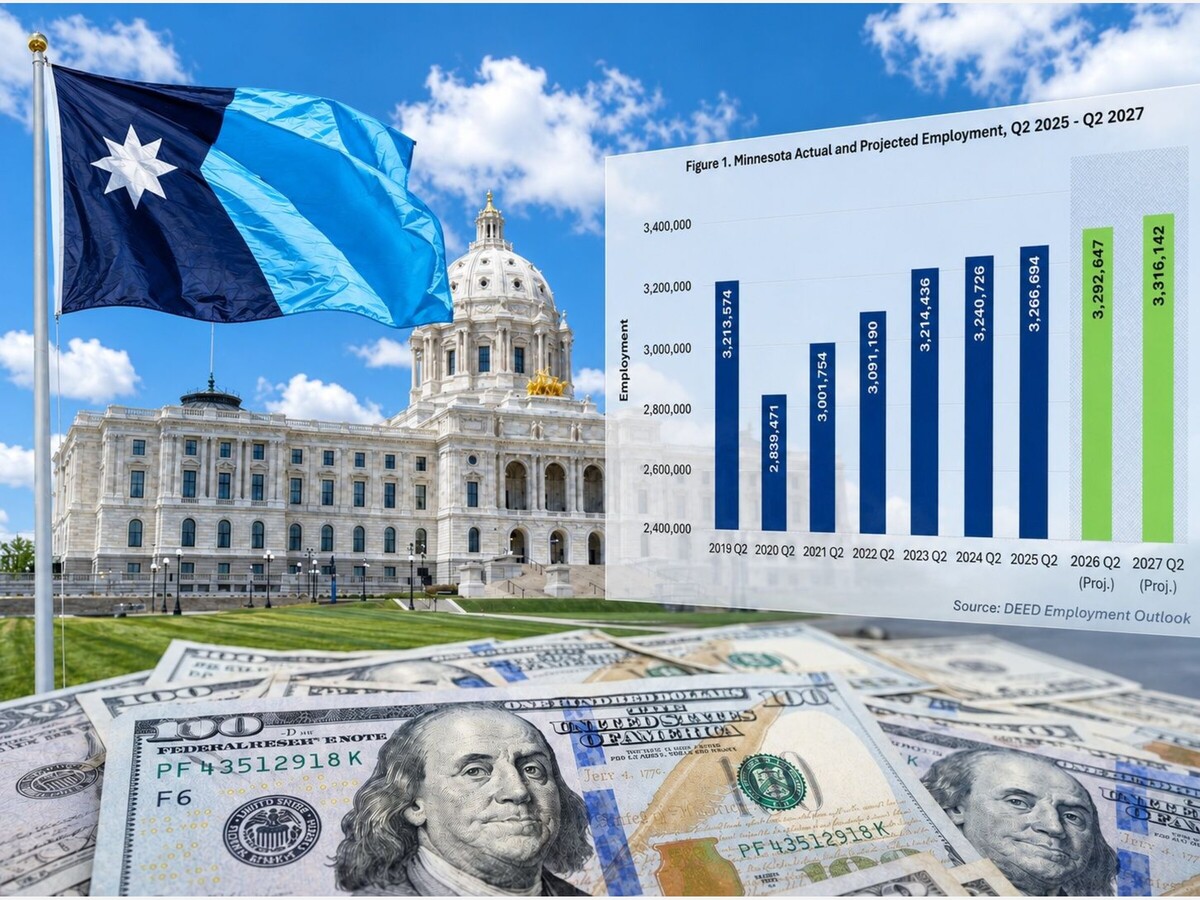



The state added 13,200 jobs in June, extending an impressive three-month recovery. Under DEED Commissioner Matt Varilek’s steady stewardship, Minnesota has reason for confidence, but retirements, immigration enforcement and declining labor-force participation demand an equally serious response.
ST. PAUL, MN (July 22, 2026) Minnesota’s latest employment report deserves more than the passing acknowledgment ordinarily given to a monthly release of government statistics. It deserves recognition as evidence of an economy that has absorbed a difficult opening to the year and begun to regain its footing.
Minnesota employers added 13,200 nonfarm payroll jobs in June, an increase of 0.4%, according to the Minnesota Department of Employment and Economic Development. It was the third consecutive month of job growth following employment losses from January through March, the period coinciding with the federal immigration enforcement campaign known as Operation Metro Surge.
Private employers accounted for an even larger gain of 14,600 jobs. Government employment declined by 1,400, bringing the statewide net increase to 13,200. Over the past year, Minnesota added 51,132 payroll jobs, an increase of 1.7%, while private-sector employment grew by 1.8%. National employment increased by only 0.3% over the same period.
These are strong figures. They challenge the familiar claim that Minnesota has become economically inhospitable or incapable of producing meaningful private-sector expansion. Businesses do not add 14,600 workers in one month because they have lost faith in the economy. They hire because patients need care, customers are placing orders, production must increase and employers believe sufficient demand exists to justify another paycheck.
Yet the report is not an invitation to triumphalism. It is a reminder that Minnesota is experiencing two economic stories at once.
The first is a welcome story of job creation, business resilience and recovery from a disruptive beginning to 2026.
The second is more troubling. Minnesota’s labor force is shrinking. Inflation has again overtaken wage growth. The state’s unemployment rate remains above the national rate. Retirements are removing experienced workers faster than Minnesota can readily replace them, while federal immigration actions have frightened workers away from job sites, businesses and commercial districts.
A responsible economic reading must hold both realities together.
The composition of June’s growth is encouraging.
Educational and health services added 7,800 jobs, an increase of 1.2% in one month. Professional and business services added 3,500. Manufacturing gained 2,800. Leisure and hospitality added 2,700, while other services gained 1,300.
This was not an expansion confined to a single industry or an isolated public project. Hospitals, care providers, manufacturers, restaurants, hotels and professional-service firms all contributed.
The healthcare gains are particularly consequential. Minnesota’s aging population is increasing demand for nurses, personal care attendants, technicians, therapists, support staff and other workers across the care economy. Employment growth in that sector represents both economic activity and a response to an essential human need.
Manufacturing’s addition of 2,800 jobs is also important. Minnesota’s industrial economy remains exposed to tariffs, supply-chain uncertainty, energy costs and fluctuations in national demand. Hiring under those conditions indicates that at least some employers are expanding production or filling positions that could no longer remain vacant.
The 2,700-job increase in leisure and hospitality suggests a return of confidence among employers whose businesses depend heavily on consumer movement and discretionary spending. That matters after immigration enforcement activity and the fear surrounding it reduced foot traffic in parts of the Twin Cities earlier in the year.
There were losses. Trade, transportation and utilities shed 2,000 jobs. Government employment fell by 1,400. Construction lost 1,100 jobs, and information declined by 400.
Even here, perspective is necessary. Construction’s one-month loss should not be ignored, especially when contractors continue to report workforce difficulty. But Minnesota construction employment was still up by 8,474 jobs, or 5.5%, over the year. Manufacturing was up by 7,115 jobs, or 2.2%.
One uneven month does not cancel a strong annual trend. Neither should annual gains prevent state leaders from investigating emerging weakness.

At the center of Minnesota’s employment and economic-development apparatus is Commissioner Matt Varilek, whose public style has never depended on spectacle.
Varilek has been a quiet, unassuming and effective steward of an agency with a sprawling mandate. DEED is responsible not only for reporting labor statistics, but also for workforce development, business assistance, vocational rehabilitation, unemployment insurance, community development and programs intended to connect Minnesotans with economic opportunity.
No commissioner personally creates thousands of private-sector jobs, and government should not claim ownership of every position added by an employer. Those jobs are created by businesses, nonprofit organizations, healthcare institutions and entrepreneurs responding to demand.
But competent administration matters. Workforce programs matter. Business financing matters. Child care capacity matters. Training grants, apprenticeship pathways, small-business assistance and the patient coordination of employers, workers and communities all matter.
Economic stewardship is often most effective when it is least theatrical.
Varilek’s own response to the June report was appropriately measured. He called the gains good news for workers and businesses, then immediately pointed to the need to reverse the steady decline in Minnesota’s labor force by helping more people enter or return to employment.
That is the correct diagnosis. Celebrating the jobs without confronting the shortage of workers would amount to reading only half the report.
Minnesota’s labor-force participation rate fell by two-tenths of a percentage point in June to 67%. It was the seventh consecutive monthly decline.
That rate remains well above the national participation rate of 61.5%, reflecting Minnesota’s historically strong work culture, educational attainment and attachment to employment. But the comparison should not become an excuse for complacency. A declining Minnesota rate still means fewer residents are working or actively seeking work than the state’s demographic and economic needs require.
Retirement is a central reason.
A detailed DEED analysis of Minnesota’s workforce concluded that aging accounted for more than 96% of the state’s lack of labor-force growth between 2019 and 2023. The issue was not principally that younger Minnesotans had abandoned work. Participation increased among nearly every younger age group. The dominant change was the growing share of residents 55 and older, combined with lower participation as people moved into retirement.
This is not a moral failure. Minnesotans who have worked for decades and accumulated sufficient savings have earned the right to retire.
Economically, however, every retirement can produce a difficult replacement challenge. A departing machinist takes years of practical knowledge out of a factory. A retiring nurse removes clinical experience from a hospital. A construction supervisor carries away familiarity with projects, safety practices and crews. A small-business owner may close a viable enterprise because no successor is available.
Minnesota must therefore build a more flexible boundary between full-time employment and complete retirement.
Employers should be encouraged to offer phased retirement, part-time professional roles, seasonal work, job-sharing, remote assignments and mentoring positions. Older Minnesotans who want to remain engaged should not have to choose between a rigid 40-hour schedule and leaving the workforce altogether.
The state must also expand the pipeline behind them. That means apprenticeships, technical education, faster recognition of international credentials, affordable child care, reliable transportation and focused efforts to include people with disabilities, people emerging from incarceration and others who remain underrepresented in employment.
Minnesota does not have the luxury of leaving willing workers on the sidelines.

The effect of immigration enforcement must also be described with care and precision.
There is credible evidence that Operation Metro Surge disrupted Minnesota’s economy. DEED itself characterized the June gains as following job losses during the January-through-March operation. The Federal Reserve’s Beige Book documented reduced customer activity, employee absences, hiring problems and declining nonresidential construction activity associated with the enforcement campaign. A landscaping employer reported severe staffing pressure, while businesses in retail and food service experienced diminished foot traffic.
Immigrant workers are heavily represented in several Minnesota industries, including manufacturing, food production, hospitality, healthcare support, construction and agriculture. They are not peripheral to the state economy. They are part of the labor supply that allows factories to complete shifts, contractors to assemble crews, processors to operate production lines, restaurants to remain open and farms to plant, maintain and harvest crops.
But the available data do not support assigning a precise number of statewide job losses to immigration enforcement, nor do they establish that every worker who disappeared from a workplace was undocumented or permanently left Minnesota. Some workers may have been detained or removed. Others stayed home because they feared encounters with federal agents. Some businesses lost customers rather than employees. Some projects were delayed because subcontractors could not assemble crews.
Agricultural labor presents an additional measurement problem. The monthly figure of 13,200 covers nonfarm payroll employment. It does not provide a comprehensive count of farmworkers who stopped reporting to fields, dairies or agricultural operations. A claim that the June report fully captures agricultural disruption would therefore be inaccurate.
What can be said is serious enough: aggressive and highly visible enforcement created fear beyond the people specifically targeted. That fear affected legally authorized workers, citizens in mixed-status families, customers, students and business owners. When people are afraid to drive to work, enter a commercial district or report for a shift, the economic cost extends well beyond any individual arrest.
Minnesota cannot control federal immigration policy. It can document the economic consequences, protect lawful access to state services, assist disrupted employers and insist that enforcement be targeted, accountable and respectful of constitutional rights.
A state already losing workers to retirement cannot pretend that driving immigrant workers into hiding carries no economic price.
June’s report contains another warning. Consumer inflation reached 3.5%, exceeding state and national wage growth for a second consecutive month.
A job is indispensable, but employment growth alone does not guarantee that Minnesota families are getting ahead. If rent, groceries, healthcare, insurance and transportation costs rise faster than earnings, an employed household can still become poorer in practical terms.
The test of Minnesota’s economy is not simply how many names appear on payrolls. It is whether work allows people to afford housing, raise children, build savings and remain in their communities.
That requires attention to productivity, housing supply, child care, healthcare costs and access to training that leads to higher-paid work. It also requires caution in interpreting the monthly numbers.
The addition of 13,200 jobs does not, by itself, prove that productivity per worker is rising. Nor does a flat unemployment rate automatically mean previously discouraged workers are re-entering the market. Minnesota’s unemployment rate held at 4.4% in June, compared with 4.2% nationally, while the participation rate declined. Those measures indicate an economy creating jobs while still struggling to maintain the size and engagement of its available workforce.
The correct response is neither pessimism nor exaggeration. It is disciplined confidence.
Since 2019, Minnesota has added approximately 95,000 jobs, an increase of 3.2%, according to DEED. The state has gained more than 35,600 business establishments, while average weekly wages have risen by $334, nearly 30%, before adjusting for inflation.
Those figures do not describe an economy being extinguished by its public investments or regulatory structure. They describe an economy that remains capable of forming businesses, attracting capital and creating work.
June strengthens that conclusion. Minnesota added jobs at a considerably faster rate than the nation. Private employers led the advance. Growth extended across healthcare, professional services, manufacturing, hospitality and other services.
The skeptics were wrong to declare Minnesota economically spent.
But the loudest celebration must not drown out the quieter warning coming from the labor force itself. Employers can announce vacancies, but vacancies do not care for patients, frame houses, operate machinery or harvest food. People do.
Minnesota’s next economic chapter will depend on whether it can replace retiring workers, welcome new workers, reconnect people who face barriers to employment and give older residents more flexible ways to remain engaged. It will also depend on whether leaders are willing to acknowledge that immigration enforcement can function as a labor-market shock when its methods frighten whole communities away from economic life.
Matt Varilek’s restrained response to the latest report offers the right model. Recognize the achievement. Tell the truth about the weakness beneath it. Then return to the work.
Minnesota’s job growth is real. Its economic resilience is real. The opportunity before the state is real.
So is the workforce shortage.
The state must now demonstrate that it can approach the second challenge with the same steady competence that helped it reach this encouraging moment.
Sources: Minnesota Department of Employment and Economic Development, June 2026 employment report; DEED analysis of Minnesota’s labor-force and retirement trends; DEED, Signs of Stress: Minnesota’s Labor Market 2026; DEED, New Realities in the Metro Area’s Labor Market; Federal Reserve findings on economic disruption associated with Minnesota immigration enforcement, reported by Reuters


Sunny, with a high of 89 and low of 64 degrees. Sunny for the morning, clear for the afternoon and evening, patchy rain nearby overnight.











What an awful human being she is. Funny she did not talk about the women of color in her IT Department she put out on the street when she arrived because of the corrupt vendor she enjoys so much. Look at her ratings on rate-my-professors, it tells you everything you need to know about this narcissist.
So she literally killed one college in New Jersey and now is killing another one. St. Thomas is wiping the floor with what is left of St. Kate's, which is why I transferred there. And yes, I am a student of color.