72° and Clear
Image



Community Partnership Expands Public Access to Emergency Defibrillators at Sand Creek Athletic Complex and Riverwind Park
Now, city leaders hope it will also be a place where a life can be saved.
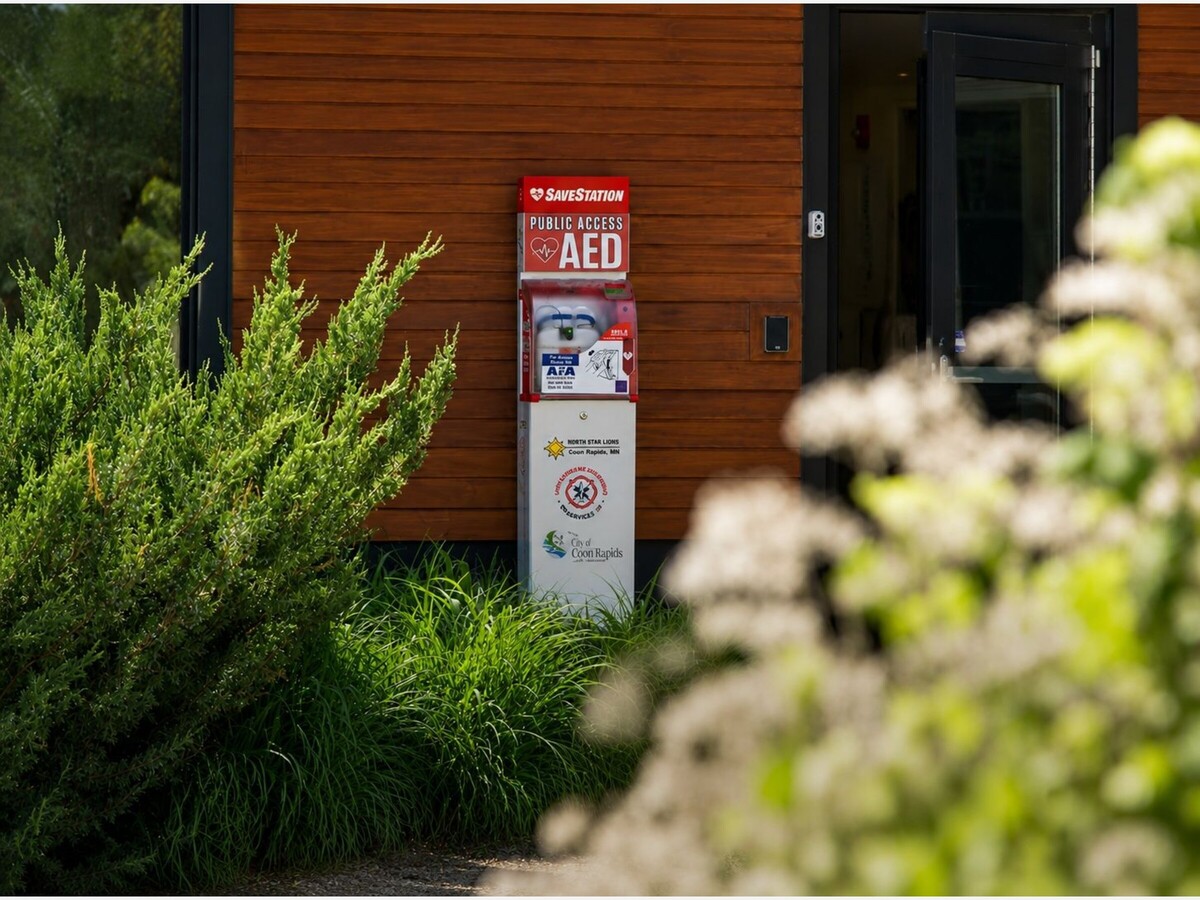
Officials from the City of Coon Rapids, members of the Coon Rapids Fire Department, community volunteers, and representatives from several local organizations recently gathered at Sand Creek Athletic Complex to celebrate the installation of new Automated External Defibrillator (AED) Save Stations at Sand Creek Athletic Complex and Riverwind Park.
The outdoor, climate-controlled stations provide free public access to life-saving AEDs twenty-four hours a day, seven days a week, ensuring that critical emergency equipment remains available long before first responders can arrive on scene.
The initiative represents the latest step in Coon Rapids' ongoing commitment to maintaining its designation as a Heart Safe Community, a public health model designed to improve survival outcomes from sudden cardiac arrest through widespread CPR education, emergency preparedness, and public access to defibrillation technology.
The two new stations, valued at approximately $15,000, were funded entirely through community partnerships involving the Coon Rapids Fire Community Fund, local organizations, and the Play for Patrick Foundation. The Coon Rapids City Council formally accepted the donation through Resolution 26-66 during its May 19, 2026 meeting.
The stations have been strategically placed at two of the city's busiest recreational destinations.
Sand Creek Athletic Complex serves as one of the community's premier sports and recreation facilities, hosting youth and adult athletic programs throughout the year. Riverwind Park similarly attracts families, recreational users, and community events, making both locations ideal sites for publicly accessible emergency equipment.
Unlike many AEDs that are stored inside schools, municipal buildings, or locked facilities that may be inaccessible after hours, the Save Stations are located outdoors and remain available to the public at all times.
For emergency responders, that accessibility can mean the difference between life and death.
According to the American Heart Association, survival rates decline rapidly when a person experiences sudden cardiac arrest. Medical experts estimate that the likelihood of survival decreases by approximately 7 to 10 percent for every minute that passes without CPR and defibrillation.
"The unfortunate reality is that with sudden cardiac arrest, minutes and even seconds make a difference," local fire officials said during the dedication ceremony. "Having AEDs accessible to the public before help arrives is a key link in the chain of survival."
Sudden cardiac arrest differs from a heart attack. While a heart attack occurs when blood flow to the heart is blocked, sudden cardiac arrest results from an electrical malfunction that causes the heart to stop beating effectively. Without immediate intervention, death can occur within minutes.
AEDs are specifically designed to restore a normal heart rhythm through an electrical shock when appropriate. Modern devices provide clear audio instructions that guide users step-by-step through the rescue process, enabling even individuals without medical training to assist during an emergency.
The Save Stations installed in Coon Rapids are engineered for Minnesota's challenging climate. Integrated heating and cooling systems help maintain proper operating temperatures throughout the year, protecting batteries, electrode pads, and sensitive electronics from extreme heat and cold.
The project's roots trace back to a tragedy that has transformed cardiac safety efforts across Minnesota.
The Play for Patrick Foundation was established after 14-year-old Patrick Schoonover suffered sudden cardiac arrest and died during a hockey tournament in 2014. In the years since, Patrick's family has become one of Minnesota's leading advocates for cardiac screening, emergency preparedness, and expanded public access to AEDs.
Through partnerships with schools, athletic organizations, municipalities, and community groups, the foundation has helped place defibrillators in locations across the state while raising awareness about the importance of early intervention during cardiac emergencies.
"This is a great partnership," representatives involved in the project said during the ceremony. "We're honored to be here together. We're saving lives and we're making a difference."
For Coon Rapids officials, the installation represents more than the addition of new equipment. It reflects a broader philosophy that public safety extends beyond police cars, fire trucks, and ambulances.
It includes ensuring that ordinary residents have the tools necessary to act during the critical moments before professional help arrives.
The Sand Creek installation marks the fourth outdoor AED Save Station established through the partnership, with organizers expressing hope that additional locations may be added in the future.
For the thousands of residents who visit Sand Creek Athletic Complex and Riverwind Park each year, the brightly marked cabinets may blend into the background of daily life.
But if a cardiac emergency occurs, they could become the most important piece of equipment in the park.
Because when a heart stops, emergency physicians say, survival is often measured not in hours or minutes, but in seconds.
MinneapoliMedia | Community. Culture. Civic Life.


Sunny, with a high of 95 and low of 70 degrees. Sunny during the morning, partly cloudy during the afternoon and evening, clear overnight.