72° and Clear
Image



June 19, 2026
On June 19, 1865, Major General Gordon Granger arrived in Galveston, Texas, accompanied by Union troops and carrying news that should never have taken two and a half years to arrive. The Civil War was effectively over. The Confederacy had collapsed. President Abraham Lincoln had signed the Emancipation Proclamation more than two years earlier on January 1, 1863. Yet approximately 250,000 Black men, women, and children remained enslaved across the fields and plantations of Texas.
When Granger issued General Order No. 3 that morning, announcing that all enslaved people were free, the declaration was not a new legal concept. Freedom had already been written into the law; what arrived in Galveston was the enforcement mechanism. It was the physical presence of federal authority capable of transforming a promise on paper into a reality on the ground.
This critical distinction remains at the absolute heart of Juneteenth. More than any other national observance, Juneteenth forces Americans to confront the distance between what the nation declares and what the nation executes. It reminds us that justice delayed is often justice denied, proving that legal declarations can exist in an institutional vacuum long before individuals experience their protection.
As Americans commemorate Juneteenth in 2026, celebrating its fifth year as a federal holiday, we must look beyond the legislation signed in Washington in 2021. To truly understand the gravity of the observance requires looking not only at one summer day in Texas, but at more than four centuries of structural development.
The long trajectory began in August 1619, when a ship carrying captive Africans arrived at Point Comfort in the English colony of Virginia. Over the next two and a half centuries, what began as a developing colonial practice evolved into one of the most powerful economic engines in the Western Hemisphere. Cotton plantations spread throughout the South, while tobacco, rice, and sugar industries grew dependent upon forced labor.
American financial institutions extended credit against human property, insurance companies insured enslaved individuals as corporate assets, and state governments enacted comprehensive legal codes that transformed human beings into commodities that could be bought, sold, inherited, mortgaged, and transferred. By the outbreak of the Civil War in 1861, approximately four million Black Americans lived in slavery: building wealth they would never own, cultivating land they could never claim, and producing an economic prosperity from which they were systematically excluded.
When Abraham Lincoln issued the Emancipation Proclamation, the document represented a profound ideological turning point, yet popular memory frequently simplifies its practical application. The proclamation did not immediately free every enslaved person in the United States. Its legal authority applied specifically to territories in rebellion against the Union, leaving slaveholding border states that remained loyal to the federal government untouched.
More importantly, its practical enforcement depended entirely upon Union military success. An enslaved person living deep within Confederate territory could not simply point to a federal decree and walk away from bondage: freedom followed the physical advance of Union troops. Where Confederate power remained intact, slavery remained stubbornly entrenched.
No geographic region illustrated this harsh reality more clearly than Texas. Because of its isolation and distance from the major military theaters of the war, Texas became a strategic haven for enslavers seeking refuge from advancing Union lines elsewhere in the South. Thousands of enslaved people were forcibly relocated to the state during the conflict, creating a tragic paradox: the farther the war progressed toward emancipation, the more enslaved people were concentrated in regions where emancipation remained completely unenforced.
For many enslaved Texans, freedom existed as a volatile rumor long before it became a fact. Word traveled through whispers, moving silently through church gatherings, work camps, and hidden family networks. Stories circulated that the Confederacy was fracturing, that Lincoln had acted, and that liberation had been declared, but rumors were powerless against armed local authority. Only the arrival of federal forces could dismantle the plantation regime.
When General Granger delivered General Order No. 3, he brought the sovereign enforcement necessary to validate those whispers. The order famously stated:
"The people of Texas are informed that, in accordance with a proclamation from the Executive of the United States, all slaves are free. This involves an absolute equality of personal rights and rights of property between former masters and slaves, and the connection heretofore existing between them becomes that between employer and hired labor."
History would quickly reveal that the promise of absolute equality was far easier to proclaim than to secure. Nevertheless, the immediate moment altered the course of human lives. For the men and women hearing the order, freedom meant something tangibly human: families desperately searching for relatives who had been sold away, the autonomy to decide where to reside, the right to negotiate labor terms, and the immediate establishment of independent churches, schools, businesses, and civic institutions.
By 1866, formerly enslaved Texans were already organizing annual gatherings to commemorate the anniversary of their liberation. These early celebrations extended far beyond recreation; they were vital acts of community formation, political education, and historical preservation. Formerly enslaved people understood a truth that successive generations would repeatedly rediscover: history forgotten becomes history vulnerable.
The dawn of Reconstruction offered historic possibilities for democratic expansion. Between 1865 and 1877, the nation attempted the monumental work of rebuilding both its physical infrastructure and its constitutional identity. Congress passed the 13th Amendment in 1865, formally abolishing slavery throughout the country, though it contained an exception clause: slavery remained legal as a punishment for a crime whereof the party had been duly convicted. This loophole would later serve as the legal foundation for systems that recreated forced labor under alternative names.
Concurrently, the 14th Amendment established birthright citizenship and guaranteed equal protection, while the 15th Amendment prohibited denying voting rights on the basis of race. Together, these amendments fundamentally transformed formerly enslaved people from property into full citizens under the law.
The political implications of this constitutional shift were immediate and profound. Black Americans voted in unprecedented numbers, electing Black representatives to state legislatures and sending Black senators and members of Congress to Washington. Communities prioritized literacy and education, which had been strictly criminalized under slavery. Families sought educational opportunities with remarkable determination, turning church basements into classrooms and sacrificing scarce resources to ensure their children learned to read. Literacy became deeply intertwined with personal dignity and independent citizenship.
However, this democratic progress encountered immediate, violent opposition. Paramilitary organizations like the Ku Klux Klan emerged across the South, utilizing strategic terror, intimidation, and assassination to undermine Reconstruction governments and suppress Black political participation. Polling places, civic leaders, churches, and schools became direct targets in a coordinated effort to restore the racial hierarchies previously maintained by chattel slavery.
By the mid-1870s, the federal government's commitment to protecting these constitutional rights began to fracture. Political fatigue grew in the North, economic crises diverted federal attention, and partisan compromises prioritized national sectional reconciliation over racial justice. The contested presidential election of 1876 resulted in a political agreement that effectively ended Reconstruction, withdrawing federal troops from the South and leaving Black citizens exposed to local state retaliation.
The collapse of Reconstruction cleared the path for Jim Crow: a legal architecture of racial subordination that relied upon statutory segregation, custom, and economic dependency rather than human ownership. Southern states enacted comprehensive segregation laws, separating schools, transportation, healthcare, and public spaces by race. The Supreme Court affirmed this doctrine in the 1896 case *Plessy v. Ferguson*, establishing the fiction of "separate but equal." In practical application, public resources were systematically diverted away from Black institutions to maintain strict power imbalances.
To circumvent the 15th Amendment, states implemented targeted voting restrictions, including poll taxes, subjective literacy tests, and grandfather clauses designed to exclude Black citizens while exempting white voters. Concurrently, the economic transition left millions trapped in sharecropping systems, where landless farmers cultivated fields owned by others in exchange for a share of the crop. Because landowners controlled credit, accounting, and market access, families were routinely trapped in artificial cycles of debt.
Furthermore, the southern criminal justice system utilized vagrancy laws under local Black Codes to arrest individuals without proof of employment. Through convict leasing arrangements, states leased incarcerated individuals to private corporations, mining companies, and railroads. This system generated immense public revenue while exploiting the 13th Amendment exception clause, serving as a brutal bridge of labor exploitation between the plantation era and the industrial age.
Faced with the constraints of Jim Crow and the persistent threat of racial violence, millions of Black Americans initiated one of the largest internal population movements in American history. Beginning around 1915 and extending into the 1970s, the Great Migration saw approximately six million Black citizens relocate from the rural South to urban centers across the North, Midwest, and West. Families arrived in cities like Chicago, Detroit, New York, Minneapolis, and Saint Paul, carrying their aspirations, cultural institutions, and community traditions with them.
This demographic shift effectively nationalized the tradition of Juneteenth. What had originated as a regional Texas commemoration was carried across state lines, integrated into northern church calendars, and promoted by Black newspapers, transforming a regional memory into a national symbol of resilience.
However, migrants quickly discovered that racial inequality was not uniquely southern; it simply assumed different structural expressions in northern urban environments. While statutory segregation was less common, economic and residential containment became deeply institutionalized, particularly through twentieth-century housing policies. Because homeownership served as the primary mechanism for American families to accumulate equity, access to housing credit directly dictated access to generational wealth building.
Beginning in the 1930s, federal agencies like the Home Owners' Loan Corporation and the Federal Housing Administration revolutionized the housing market by stabilizing mortgage lending. However, these agencies systematically implemented the practice of redlining, categorizing neighborhoods by racial demographics and drawing literal red lines around Black communities to signify high investment risk.
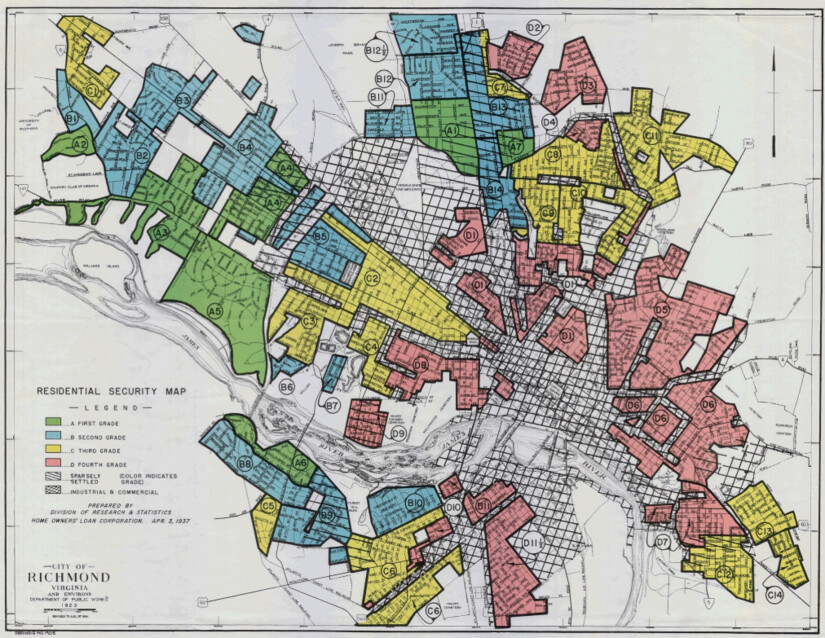 A historical Home Owners' Loan Corporation (HOLC) color-coded security map illustrating the institutional mechanics of redlining.. Source: Interim Archives / Getty Images
[Federal Redlining Map Grid: Lower-investment Black neighborhoods outlined in red / Higher-investment suburban neighborhoods highlighted in green and blue]
The long-term economic consequences of redlining extended far across generations. While families in subsidized suburban developments accumulated massive equity appreciation over decades, families trapped in redlined zones saw property values stagnate, mortgage financing dry up, and municipal infrastructure investments decline.
This wealth gap was further exacerbated by the unequal local administration of the G.I. Bill following World War II, which restricted many Black veterans from fully accessing home loans and higher education benefits. Wealth does not emerge in isolation; it accumulates over generations through institutional access, investments, and inheritance. When entire communities are locked out of capital access for decades, the economic footprint persists long after the discriminatory policies are officially repealed.
By mid-century, these systemic disparities sparked the modern Civil Rights Movement, an extraordinary mobilization of organized collective action that built upon generations of prior resistance led by attorneys, journalists, and labor organizers. Landmark judicial victories like *Brown v. Board of Education* in 1954 and sweeping federal statutes like the Civil Rights Act of 1964 and the Voting Rights Act of 1965 dismantled the formal statutory architecture of Jim Crow. Yet these legislative triumphs reinforced the exact lesson embedded within Juneteenth: statutory enactments require permanent institutional enforcement.
The subsequent decades demonstrated that rights secured on paper remain vulnerable without ongoing enforcement mechanisms. The 2013 Supreme Court ruling in *Shelby County v. Holder*, which invalidated the coverage formula for federal preclearance under the Voting Rights Act, initiated a modern wave of state legislative adjustments regarding voter identification, polling locations, and ballot access rules.
Simultaneously, the dramatic expansion of mass incarceration from the 1970s onward disproportionately impacted minority and low-income populations, generating intense sociological and policy debates regarding sentencing structures, policing models, and judicial equity. These modern legislative and legal battles prove that the central questions raised during Reconstruction remain completely unresolved in 2026.
Five years after the federal declaration of Juneteenth National Independence Day, the contemporary observance stands as a model of historical maturity because it rejects simplistic, triumphalist historical narratives. Thanks to decades of grassroots advocacy led by organizers such as Opal Lee, the federal designation did not create the holiday; it validated 156 years of community stewardship. The holiday's enduring symbols, from the Juneteenth flag designed by Ben Haith to the traditional red foods signifying resilience and West African cultural survival, serve as clear reminders that Black history is entirely inseparable from the broader American narrative.
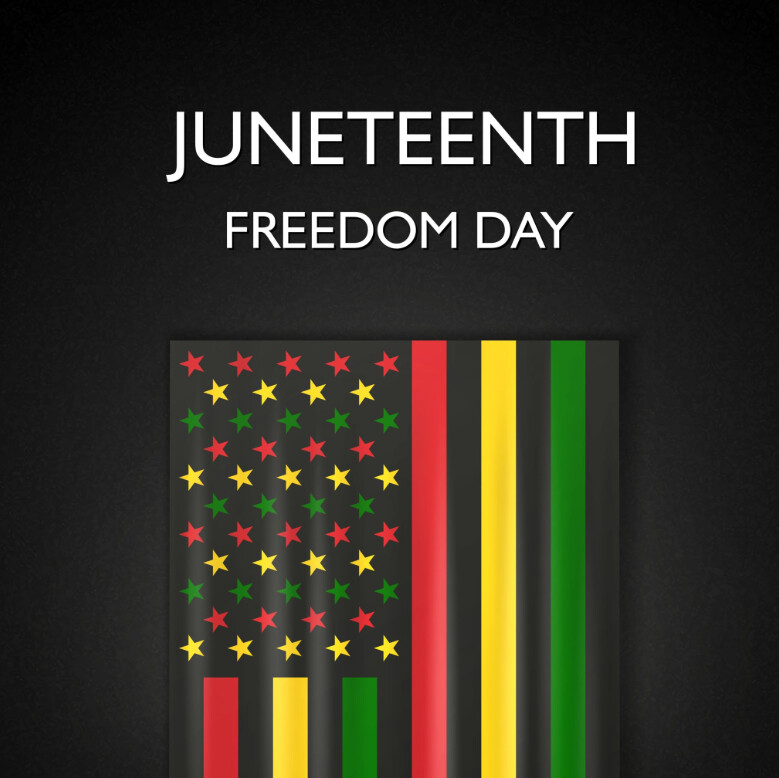 The symbolic elements of the modern freedom celebration flag.. Source: e-crow / Getty Images
[The Juneteenth Flag: A central white star surrounded by a bursting nova outline, set against a split field of red and blue, intentionally utilizing the national colors]
Juneteenth does not ask the nation to ignore its achievements, nor does it demand a permanent retreat into the past. Instead, it offers a rigorous framework for national self-examination. It explicitly illustrates that the concept of delayed freedom is a recurring motif across the American story: the Declaration of Independence asserted human equality while human bondage was legally protected; the Reconstruction Amendments guaranteed citizenship that was subsequently subverted by local statutes; and the civil rights protections of the twentieth century required decades of litigation to enforce.
The civic challenges facing the United States in 2026 are structurally distinct from those of 1865, yet the foundational questions remain identical: How shall economic opportunity be equitably distributed? How can public institutions guarantee uniform fairness under the law? What concrete obligations accompany true democratic citizenship?
Democracy is not a self-sustaining mechanism, rights are not self-protecting, and progress is never automatic. Each generation acts as the temporary steward of the nation's founding promises, bearing the explicit responsibility to shorten the distance between the ideals we articulate and the realities we deliver. The ultimate measure of American democracy lies in its capacity to ensure that freedom, once promised, is definitively and universally delivered to all.
MinneapoliMedia | Community. Culture. Civic Life.



Sunny, with a high of 95 and low of 70 degrees. Sunny during the morning, partly cloudy during the afternoon and evening, clear overnight.