Image



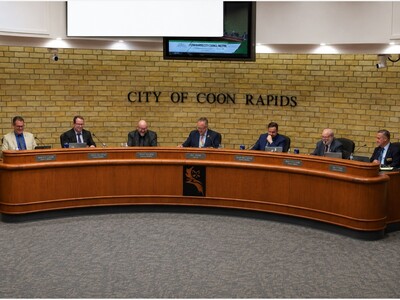
COON RAPIDS, MN Transportation infrastructure, water resource protection, election administration, and environmental stewardship converged during the Coon Rapids City Council's regular meeting on Tuesday, July 7, as council members approved a series of actions that will shape the city's physical infrastructure and municipal operations for years to come.
The evening's agenda reflected a city balancing long-term growth with immediate environmental challenges. Council members authorized multiple property acquisitions needed to keep the Trunk Highway 610 interchange project moving forward, approved a regional stormwater treatment partnership designed to improve water quality, formally adopted enhanced water conservation measures in response to ongoing drought conditions, and completed several actions necessary to prepare for Minnesota's upcoming primary election.
Among the meeting's most consequential actions were a series of real estate approvals supporting the long-planned Trunk Highway 610 interchange project, one of the region's most significant transportation investments.
The council approved temporary and permanent easements, warranty deed transactions, memorandums of agreement, and three separate purchase agreements involving properties along 93rd Avenue Northwest. These acquisitions provide the legal access and right-of-way necessary for continued grading, utility relocation, roadway construction, and associated public improvements tied to Project 18-14.
The Highway 610 interchange has been planned for years as a major transportation improvement intended to strengthen east-west mobility through northern Anoka County while improving connections between local streets and the regional highway system. Previous council actions have included utility easements, trail improvements, and additional property acquisitions supporting the broader interchange project.
City officials have consistently described the interchange as an investment expected to improve traffic circulation, enhance safety, and accommodate future residential and commercial growth throughout the surrounding corridor.
The Council also approved a Joint Powers Agreement with the Coon Creek Watershed District for the Bridgewater Biochar/Iron Enhanced Sand Filter Project, identified as Project 26-14.
The project represents a collaborative effort among the watershed district, the City of Coon Rapids, regional partners, and Clean Water Fund supporters to reduce pollutants before stormwater reaches Sand Creek and downstream waters connected to the Mississippi River watershed.
Unlike traditional stormwater ponds that primarily slow runoff, the Bridgewater filtration system combines engineered sand, iron filings, and biochar. As runoff passes through the filter media, the iron binds with phosphorus while the biochar captures significant amounts of E. coli bacteria commonly associated with urban stormwater runoff.
According to the Coon Creek Watershed District, the project is expected to reduce sediment, phosphorus, and bacterial pollution entering Sand Creek, helping improve water quality in both Sand Creek and downstream Coon Creek, waterways that have long been identified as impaired under state and federal water quality standards.
The project is one of several regional water-quality initiatives supported through Minnesota's Clean Water Fund, reflecting increasing emphasis on combining engineered infrastructure with watershed restoration strategies to address urban runoff before contaminants reach larger river systems.
Responding to persistent drought conditions and guidance issued by the Minnesota Department of Natural Resources, the Council approved enhanced municipal water conservation measures intended to reduce unnecessary water consumption during the height of the summer irrigation season.
Although portions of the Twin Cities have experienced intermittent rainfall this summer, water managers have continued to express concern about the cumulative effects of multiple years of below-normal precipitation and reduced groundwater recharge.
Coon Rapids relies entirely on groundwater drawn from municipal wells for its public drinking water supply rather than surface water from the Mississippi River. During periods of prolonged heat, lawn irrigation and other outdoor uses can substantially increase daily water demand, placing additional pressure on the municipal system.
Under the enhanced conservation measures, irrigation using city water is limited to the early morning hours between 4 a.m. and 9 a.m., while the city's long-standing odd-even watering schedule remains in effect. Properties with odd-numbered addresses may water only on odd-numbered calendar days, while even-numbered addresses are limited to even-numbered days.
City officials are also encouraging residents and businesses to reduce nonessential outdoor water use, including unnecessary washing of vehicles, buildings, and paved surfaces, while allowing limited exemptions for newly installed sod, recently planted landscaping, and new seedings requiring establishment. These measures are intended to reduce peak water demand while preserving adequate capacity for household needs and emergency fire protection.
The Council also completed several routine but essential election administration responsibilities ahead of Minnesota's August primary.
Members approved the appointment of election judges, established compensation rates, authorized the City Clerk to make necessary appointments and substitutions during the statutory pre-election period, and formally scheduled the canvass of election results for Friday, Aug. 14, at 7:30 a.m.
Election judges perform many of the core responsibilities required on Election Day, including checking in voters, verifying registration information, issuing ballots, assisting voters, and helping ensure compliance with Minnesota election law.
The Council also introduced an ordinance changing the street name within the Balfany Farms development and approved the sixteenth amendment to the city's service contract with the Center for Energy and Environment.
During council reports, members highlighted several upcoming community events, including the July 11 Touch-A-Truck event at Riverdale, the Summer Concert Series featuring The Holy Rocka Rollaz at Coon Rapids Dam Regional Park, the July 14 Summer in the City neighborhood gathering at Alder Park, and the Aug. 4 Night to Unite celebration, with registration closing July 10. Council members also thanked city staff, volunteers, police, firefighters, community organizations, and residents for helping make the city's Fourth of July celebration a success.
Council members also received an update on the Regional Trail Crossing Bridge, which will connect the Coon Rapids Regional Trail and the Coon Creek Regional Trail. City staff reported that final safety corrections are underway and that the bridge is expected to open to the public once the remaining equipment is installed, potentially within the coming weeks.
The meeting concluded at 8:35 p.m., capping an evening in which the Council advanced transportation infrastructure, strengthened environmental initiatives, reinforced responsible water management, and completed preparations for the city's role in administering Minnesota's upcoming primary election. Collectively, the actions underscore Coon Rapids' continuing effort to accommodate growth while investing in resilient public infrastructure and protecting the natural resources on which the community depends.
MinneapoliMedia | Community. Culture. Civic Life.



Sunny, with a high of 85 and low of 49 degrees. Sunny for the morning, overcast for the afternoon and evening, clear overnight.