55° and Patchy rain nearby
Image
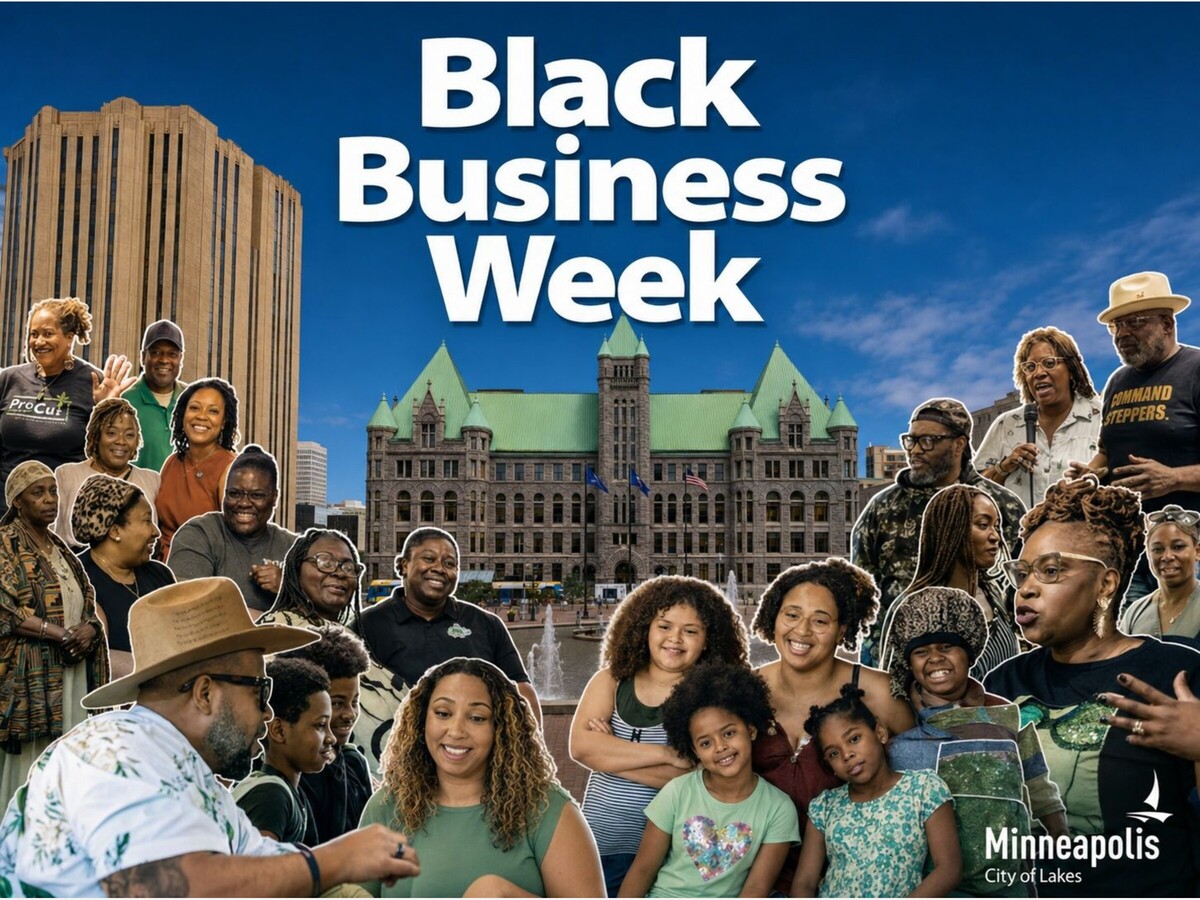



Customers, relatives, entrepreneurs, civic leaders and community supporters filled the new Nature’s Syrup Beauty flagship on July 29. Products created for curls, coils, textured hair and skin care lined the shelves. Outside the store, people struggled to make their way through the packed Baker Center Skyway.
For the first time since founding Nature’s Syrup Beauty in 2017, Pittman had a permanent retail location of her own.
“I started the business almost nine years ago at my kitchen table, and to be here today at our grand opening is almost surreal,” Pittman told MinneapoliMedia shortly after the ribbon-cutting. “The community showed up. They had this skyway jam-packed. People could not even walk by. The store was packed, people supported, and people saw the fruit of their own labor.”
The ribbon took seconds to cut; the journey consumed nearly a decade. That distinction must guide Minneapolis long after the ceremonial scissors are put away.
The applause matters. Public recognition matters. Markets, workshops, proclamations and ribbon-cuttings matter. Black entrepreneurs have operated for generations in an economy that frequently consumes their creativity while overlooking their companies. Creating a citywide occasion to recognize their work is not insignificant.
But recognition is not capital. Participation is not a contract. Certification is not revenue. Occupying commercial space is not the same as owning it.
The true measure of Black Business Week begins after the applause.
Minneapolis did not begin Black Business Week in 2021, as some recent accounts have incorrectly suggested. The city announced its first Black Business Week in July 2019, when Mayor Jacob Frey and then-City Council Vice President Andrea Jenkins introduced a program intended to showcase Black-owned businesses, expand professional networks and help entrepreneurs understand city procurement opportunities.
The first week was built largely around exposure, connections and access to information. Those objectives were appropriate, but even then, they pointed toward a deeper challenge. Minneapolis did not lack Black entrepreneurial ambition. It lacked equal access to the systems that determine which ambitions acquire capital, contracts, property and scale.
The city’s own 2019–2022 Strategic and Racial Equity Action Plan acknowledged the disparity. Drawing from a regional disparity study, the plan gave African American-owned businesses an index of 20 in professional and technical contracting. In municipal procurement, an index below 80 signals systemic underutilization. African American suppliers stood at 20. Minneapolis did not just fall short; it operated at a severe structural deficit.
The city established a goal of reaching at least 80 for African American, Hispanic American and Native American suppliers, committing to increase the number of businesses owned by Black, Indigenous and other people of color while improving their five-year survival rates.
Crucially, the city admitted a weakness that remains central today: Minneapolis collected information about who participated in business-support programs, but its tracking practices limited its ability to determine how well those programs worked. That was not an observation from an outside critic. It was the city’s own diagnosis.
By 2021, Minneapolis began producing more tangible evidence in commercial ownership. The city’s Commercial Property Development Fund, now named the Ownership and Opportunity Fund, distributed $4.5 million in loans across nine projects by October 2021, leveraging an estimated $25 million in private financing.
Among the recipients was Kenya McKnight Ahad, founder of the Black Women’s Wealth Alliance, who leveraged city and private financing to purchase the West Broadway building housing Breaking Bread Café. TRI-Construction co-owners Calvin Littlejohn and Lester Royal used the program to acquire a long-vacant building at 927 West Broadway for their headquarters.
These were not temporary sales spikes. Entrepreneurs who created community value were gaining ownership of the underlying real estate.
By 2025, the Ownership and Opportunity Fund reported supporting 23 projects since 2020, with approved loans ranging from $190,000 to $1.5 million covering 5% to 33% of project costs. Minneapolis backed this with another $3.5 million set-aside in 2024. That is evidence of public intervention producing physical assets. It is also proof that the work of economic advancement rarely fits inside a single commemorative week.
This year’s Black Business Week was larger and more institutionally connected than the 2019 original.
The official kickoff took place at the restored Coliseum Building on East Lake Street, a property damaged during the unrest following George Floyd’s murder and reopened in 2024 after a $30 million redevelopment. Its ownership group, including architect Alicia Belton, consultant Janice Downing, Du Nord Social Spirits owner Shanelle Montana and Redesign, now provides commercial and community space for historically excluded businesses. Belton and Downing also operate S.H.A.K.E., a coworking center inside the building. Their presence embodied a vital progression: Black entrepreneurs were not simply selling products at a temporary market; they were controlling the space where the city gathered.
The 2026 program reached entrepreneurs across varying operational stages:
Minneapolis also injected $200,000 into cultural business weeks via its Small Business Resiliency Fund to assist recovery from Operation Metro Surge impacts.
This evolution from showcase to technical network is real. But programs tell us what was offered, not what was achieved.
Minneapolis’ public materials document events, workshops and invitation lists. They do not provide a cumulative economic-impact report detailing what happened to participating businesses afterward.
The public record remains silent on vital questions:
This absence of public data does not prove Black Business Week failed. It proves Minneapolis has not publicly demonstrated cumulative results in a verifiable form.
Government cannot claim causation merely because it stood nearby when an entrepreneur succeeded.
Nature’s Syrup proves why that distinction matters. Pittman opened her flagship during Black Business Week, but the city did not spend nine years building her company; she did. Supported by her family, customers, the Neighborhood Development Center (which extended her first loan when conventional banks refused despite excellent credit), the Minnesota Black Chamber of Commerce, Chameleon Shoppes, and the GroundBreak Coalition, her outcome is an independent triumph.
The same applies to Soul Grain, founded by Liza Maya and Sylvia Williams. Since launching in 2022, the company scaled from pitch competitions into regional grocery placement across Kowalski’s, Whole Foods, and Fresh Thyme. Soul Grain’s progress represents the founders' grit and the specific advisers who backed them. It cannot be casually claimed by every city program that crossed its path.
At the other end of the spectrum are early-stage vendors testing demand at street markets without collateral or wholesale pipelines. A serious municipal strategy cannot treat an early market vendor, a regional retail brand, and a $30 million real estate equity group as interchangeable.
Minneapolis has deployed real tools: the $7 million Small Business Resiliency Fund, 23 commercial real estate projects through the Ownership and Opportunity Fund, and the Target Market Program reserving contracts up to $175,000 for local small businesses.
But the existence of a fund is not the same as equitable capital distribution.
Taxpayers and entrepreneurs deserve clear line-item visibility into how much capital reached Black-owned businesses, the ratio of debt versus forgivable equity, neighborhood geographic distribution, leveraged private investment, and long-term ownership retention.
Equally vital are denial patterns. Tracking who applied and was rejected reveals whether rigid credit criteria, collateral requirements, or technical assistance gaps continuously stall Black enterprises.
The same accountability applies to procurement. Certification is merely an entrance credential; it is not revenue. A certified business can still be sidelined by cash-flow lags, bonding requirements, or prime contractors who hoard subcontracting opportunities. Minneapolis must publish its true procurement metrics: What percentage of addressable city spending reached Black suppliers in 2021, 2025, and 2026? What was the median contract value? How long did vendors wait for payment? Did the city close its self-diagnosed disparity gap?
Beginning in 2027, Minneapolis should replace anecdotal summaries with an annual, audited Black Business Week Scorecard. Protecting confidential company data while requiring informed consent, this framework will measure actual economic movement across Minnesota:
|
Metric Category |
Specific Data Points Tracked Annually |
|
Capital & Real Estate |
• Debt, grant, and private equity dollars secured per business • Commercial properties acquired vs. temporary leases signed • Full approval vs. denial rates with primary barrier analysis |
|
Procurement & Revenue |
• Certification applications started vs. completed • Bids submitted, prime vs. sub-contracts awarded, and median dollar values • Average invoice payout timelines and Target Market utilization |
|
Long-Term Enterprise Growth |
• Voluntary direct sales totals from official week markets • Transitions from home production to commercial space • Net jobs created, retained, and 1-, 3-, and 5-year business survival rates |
Accountability is not hostility toward Black Business Week. It is how Minneapolis proves the initiative warrants continued public investment.
The challenge facing Minneapolis is not unique, but its response can be. Across Minnesota and throughout urban America, municipalities routinely mistake symbolic celebration for structural equity. They host markets, issue proclamations, and cite attendance figures while capital access remains constrained, commercial corridors gentrify around the very businesses that revived them, and municipal contracts flow along old networks.
Minneapolis has the tools, the institutional memory, and the entrepreneurial density to set a national standard. It can demonstrate that a city can honor Black enterprise without using Black entrepreneurs as decorative proof for unearned public outcomes.
To lead, city leaders must answer concrete questions:
These questions do not diminish what Minneapolis has built. They demand that the city treat Black economic development with the institutional rigor given to any multi-million-dollar infrastructure project.
At Nature’s Syrup, the ribbon has been cut. The speeches are over. The camera lights have dimmed.
Now comes the work that determines what the celebration meant.
Customers must return. Inventory must turn over. Rent, payroll, insurance, and vendor invoices must be settled. The company must convert the momentum of one crowded skyway into the durable revenue required to sustain a permanent downtown home.
That work will be quiet, grueling, and decisive.
The same truth governs Minneapolis.
The city has expanded its celebration, engaged regional partners, and invested in valuable real estate tools. Those steps deserve credit. But the future of Black business in Minneapolis will not be measured by the number of officials at a podium, the size of a street market, or the volume of applause when a ribbon falls.
It will be measured by who receives capital and on what terms. Who wins contracts and at what value. Who leases space and who owns the building beneath it. Who survives long enough to build generational wealth, employ neighbors, and anchor the Minnesota economy for decades to come.
Years from now, the test will not be whether Minneapolis staged a successful event in August 2026.
It will be whether Black entrepreneurs owned more property, held more capital, commanded more contracts, and wielded more economic power because the city kept working after the applause stopped.
The crowd has cleared.
The measure has begun.
STAY CONNECTED TO MINNEAPOLIMEDIA
Local stories matter. Subscribe free to MinneapoliMedia and receive independent news, community reporting and important updates from Minneapolis, the North Metro and communities across Minnesota.
SUBSCRIBE FREE: https://minneapolimedia.town.news/subscribe
MinneapoliMedia | Community. Culture. Civic Life.



Overcast, with a high of 67 and low of 50 degrees. Clear during the morning, overcast in the afternoon, clear for the evening, overcast overnight.