74° and Overcast
Image



By Tom Akaolisa, Editor
MINNEAPOLIS, MN (September 23, 2026). DeVelle Jackson did not enter his first extensive candidate interview pretending that the moment came naturally to him.
“A little tense,” he admitted shortly after joining the Google Meet conversation. “I had a long day, so I wish I had a little more time to prepare, but I didn’t want to miss this.”
Jackson could have canceled or asked to postpone the conversation until he had more time to prepare. Instead, he appeared tired, slightly apprehensive and determined to proceed without knowing the specific questions he would face.
That decision revealed something important about the 35-year-old Independent candidate for Minnesota’s Fifth Congressional District. Jackson is attempting one of the most difficult things in American politics: persuading voters to take seriously a candidate they have barely heard of, running without the machinery, money or inherited credibility of either major political party.
He is on the November 3 general-election ballot alongside DFL incumbent Ilhan Omar and Republican nominee John Nagel. The Minnesota Secretary of State lists Jackson as an Independent candidate, while the Federal Election Commission identifies Jackson for Congress 2026 as his principal campaign committee.
What Jackson does not yet possess is broad name recognition. He has never held public office. He does not have a large campaign organization, a major-party endorsement or a fundraising operation capable of matching his opponents. The FEC’s public candidate page currently displays no processed financial summary for his congressional campaign. After the interview, Jackson told MinneapoliMedia that his campaign had not crossed the $5,000 federal reporting threshold during the previous reporting periods. He described the campaign as a modest effort financed largely with his own money and said he expected to report for the current quarter. The FEC states that an individual running for federal office must register and file financial reports after raising or spending more than $5,000. Jackson’s precise fundraising and spending totals cannot be independently confirmed until the relevant report is filed and processed.
Jackson does, however, have a story, a developed platform and a conviction that public office should not be reserved for people who have spent their lives moving through established political institutions.
“I’m an ordinary individual,” he said. “I’m diligent. I’m tenacious.”
Those words, especially diligent and tenacious, appeared repeatedly during the interview. They are central to the case Jackson is building for himself.
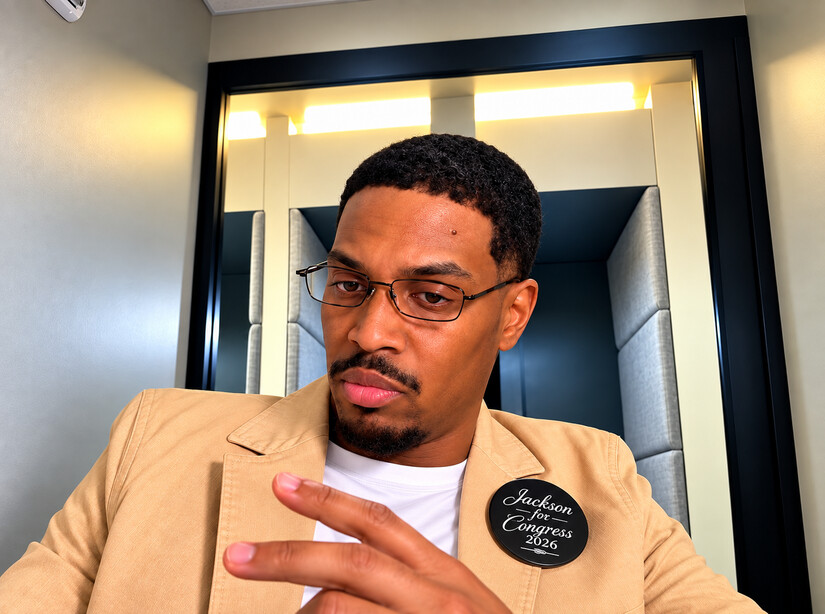
Jackson was born in Saint Paul and raised in Minnesota. His father was a carpenter who built his own home. His mother worked for the State of Minnesota for decades, including 22 years with the Minnesota Department of Health.
He attended Mounds View High School and later earned a bachelor’s degree in political science from the University of Minnesota Twin Cities. His campaign says he graduated with distinction and a 3.88 grade-point average.
His route to that degree was not linear. Before completing college, Jackson built a career in construction, beginning as a residential framing carpenter and working as a union roofer with Roofers Local 96 in Minnesota.
After moving to Atlanta, he joined Carpenters Local 225 and worked on major construction sites, including Mercedes-Benz Stadium. He later moved into field-engineering and assistant-superintendent responsibilities on high-rise and mixed-use developments, including the Phipps Plaza redevelopment and Nobu Hotel tower.
Jackson views construction as more than a biographical detail. He presents it as evidence that he understands work in which decisions carry direct consequences for budgets, schedules, livelihoods and physical safety.
Asked for one incident that demonstrated his readiness for Congress, Jackson resisted reducing years of experience to a single dramatic example.
“I don’t think one specific experience in particular fits the bill to say, ‘Hey, this person is prepared for Congress,’” he said. “I think it is the experience overall.”
Construction required him to work among people with different responsibilities, skills and interests, he explained. A project could not succeed unless those competing concerns were reconciled around a common result.
“You have to mitigate for people’s safety,” Jackson said. “You have to also be concerned with the budget and schedules, and then those decisions that you come to make in due time could have real consequences, whether it is for the safety of other individuals or for their livelihood.”
The comparison between a construction site and Congress has limits, which Jackson acknowledged. The country, he said, is “a lot more sophisticated than a building.” His larger point is that government, like a major project, depends on many interconnected systems and people whose work must ultimately hold together.
Jackson also believes Congress needs more members whose understanding of labor comes from performing it.
“It is very important that we have other types of people who work in Congress that are from different backgrounds, especially that working people in the community can relate to,” he said. “Those are the people who we are here to represent.”
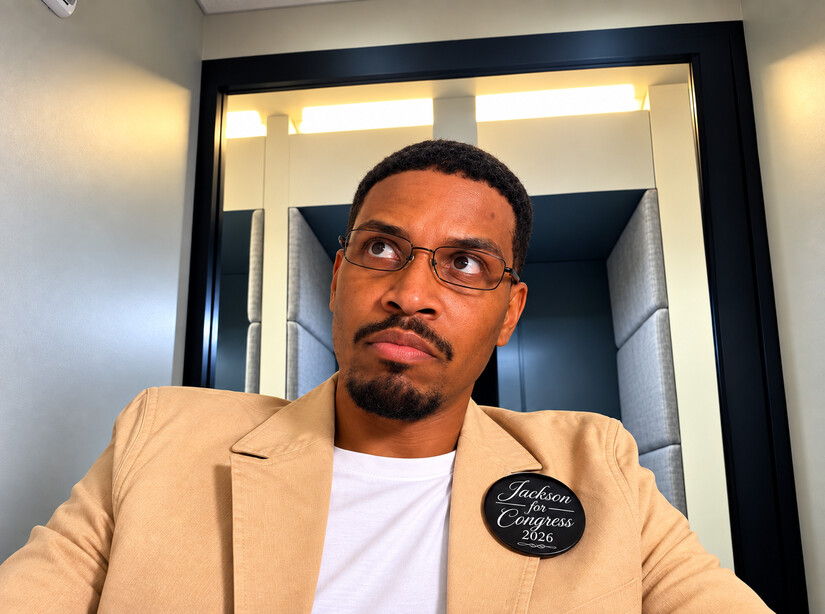
Jackson traces another part of his political development to faith and community service.
He described early involvement through his church community in Minnesota. In Atlanta, he spent four consecutive years volunteering at The King Center for Nonviolent Social Change, where he says he served as a docent, received Nonviolence365 training and supported programs associated with the King Holiday Observance, student leadership and the Beloved Community Awards.
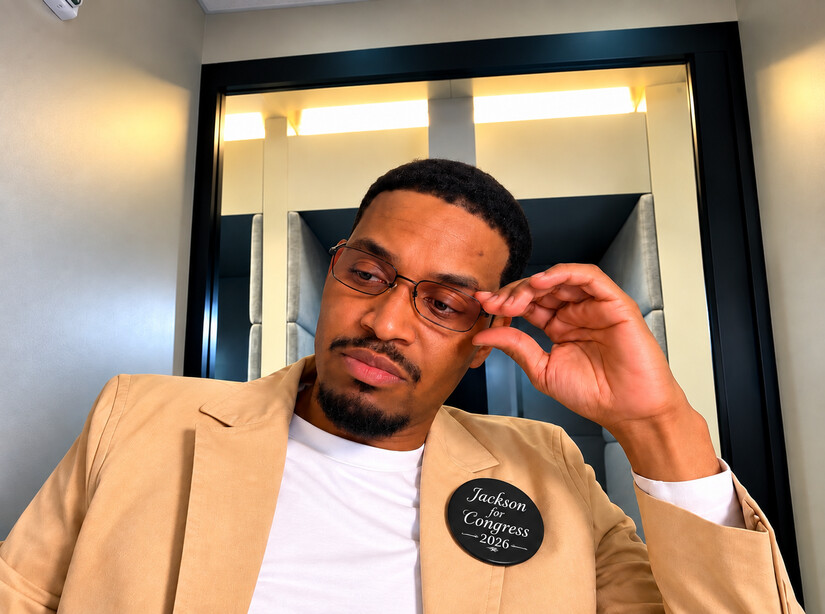
The experience taught him to understand nonviolence not as passivity, but as disciplined action intended to produce change.
“A leader is really built through service,” Jackson said. “I learned that firsthand being a part of The King Center campus for many years and learning a lot about the nonviolent philosophy for social change.”
Jackson said that experience eventually made participation alone feel insufficient. Marching and protesting remained valuable, but he began asking whether he had something else to contribute.
“When I see something affecting me or my community directly, and I think that I have something to offer, a way that I can take a stand for my people, I really feel obligated to do that,” he said.
The obligation he describes led him not toward a neighborhood board, city council or seat in the Minnesota Legislature, but directly toward Congress.

Jackson recently completed his political science degree and has never held elected office. That places a significant question before voters: Why should they entrust him immediately with federal legislation, national-security decisions, congressional oversight and the representation of an entire district?
Jackson argues that the relevance of experience depends upon the kind of experience being examined.
His studies focused on constitutional law, Congress, the presidency, the judiciary and America’s role in international affairs. His professional life taught him to coordinate people and decisions. His civic service taught him that leadership begins with responsibility to others.
He also rejects the assumption that every person seeking federal office must climb the same political ladder.
“Some people can be focused on something even if it seems too ambitious for some,” he said. “It might not be too ambitious for others.”
Jackson compared the leap, imperfectly but revealingly, to athletes who once moved directly from high school into the National Basketball Association. The point was not that Congress is a game or that academic preparation can replace governing experience. It was that some people, he believes, are capable of entering a demanding institution without following the route others expect.
Jackson referred to the House as the “lower chamber,” but he did not minimize its power. A representative votes on federal spending, war, regulation, civil rights and the laws affecting Americans far beyond one district.
He believes his qualifications lie in the combination of construction, education, civic service and what he describes as an ability to learn quickly.
“Somebody could experience something for 10 years and still not have the same type of takeaway from it that somebody who has only one year of experience in that same field or area,” he said.
Jackson’s answer did not eliminate the question of readiness. It clarified his response to it. He is not asking voters to overlook his lack of elected experience. He is asking them to judge whether other forms of preparation, character and judgment can compensate for it.
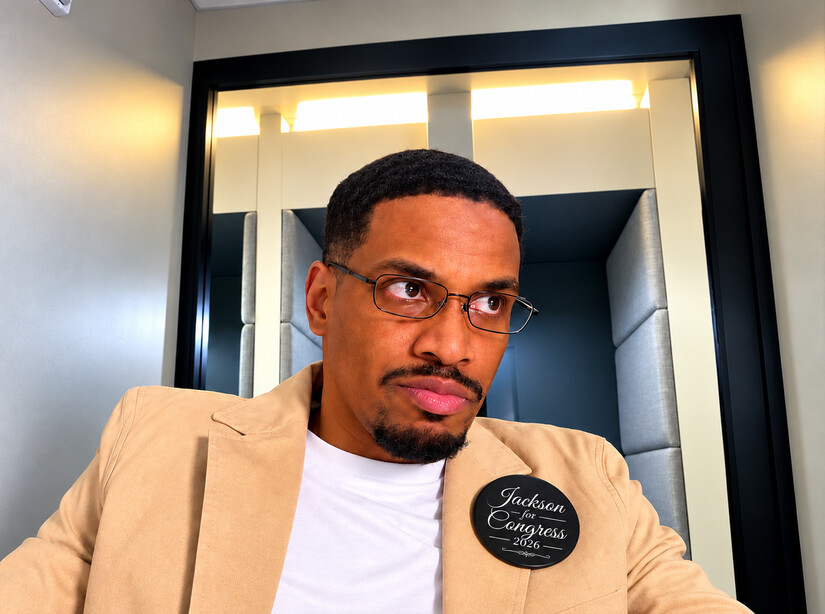
Jackson’s candidacy is built around independence from the two-party system. Yet if elected, he intends to caucus with House Democrats.
He said the arrangement would allow him to seek committee assignments, participate in markups, introduce legislation and function within the existing organization of the House. He also acknowledged that his platform aligns more closely with Democrats than Republicans and that the Fifth District has a long history of electing Democrats.
That raises an obvious question: What would make Jackson meaningfully Independent rather than functionally another Democrat?
Jackson said the evidence would be found in his votes, his reading of legislation and his willingness to criticize either party.
“I’m not going to vote based on the agenda,” he said. “I’m not going to read a memo that tells me how to vote on a bill. I’m going to do my best to have enough time to actually read through that bill line by line.”
If he opposed a provision, Jackson said, he would identify it publicly and explain his reasoning to constituents. He would not allow party loyalty to determine whether he pursued misconduct or exercised congressional oversight.
“There’s no party that’s going to suppress my voice or direct me in that manner,” he said.
The distinction Jackson draws is between caucus membership as an organizational necessity and party identity as a governing obligation. Whether that separation could survive the pressures of Congress is something only service in office could demonstrate. For Jackson, however, remaining outside the party is the point.
He imagines a future in which more Independents might be elected and eventually organize a caucus of their own. Until then, he considers cooperation with Democrats the most practical route to effectiveness.
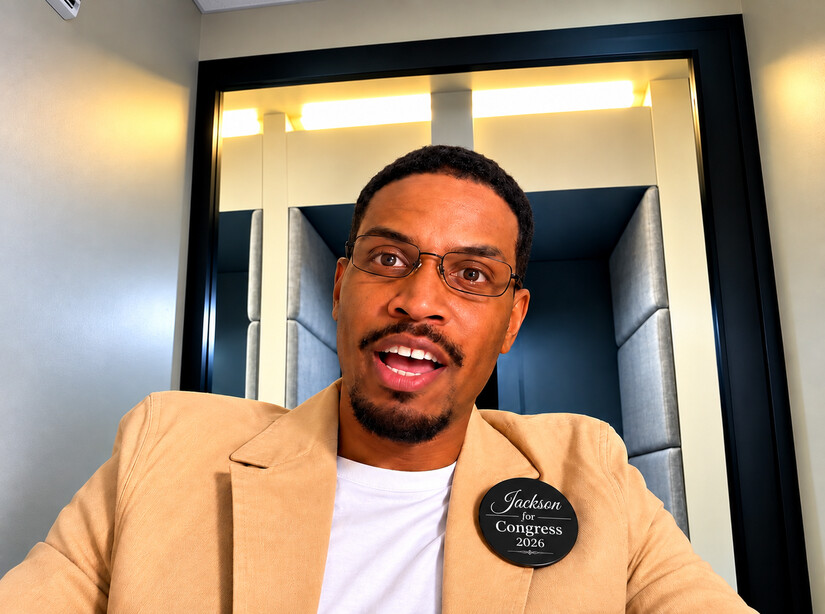
One of the most consequential questions of the interview concerned Jackson’s earlier federal candidacy.
FEC records show that DeVelle Lavaughn Jackson filed as an Independent candidate for the United States Senate from Georgia in July 2023. That record remains publicly accessible. The FEC does not display a financial summary showing campaign activity for the candidacy.
Jackson acknowledged that he does not enjoy having the Georgia filing repeatedly raised, but he agreed that it required explanation.
He said he was living and working in Georgia at the time, continuing his construction career and volunteering with The King Center. His growing dissatisfaction with both political parties led him to research what would be required to establish an independent or third-party political identity.
Jackson described the filing not as a fully developed campaign, but as an exploratory first step into the federal political system.
“It was never really to the point where I was testing the waters and raising any funds or anything,” he said. “It was one of those first steps of me feeling out how the system works.”
He said he spent considerable time communicating with the FEC and learning how federal candidacies, political parties and campaign regulations operate.
After the 2024 election, Jackson returned to Minnesota and completed the political science degree he had left unfinished. He said the election result and the political direction of the country intensified his desire to participate more directly.
Jackson then amended his federal records to reflect a candidacy for Minnesota’s Fifth Congressional District and completed the state process required to reach the ballot.
His explanation provides a clearer chronology than existed in his formal Minnesota biography: Georgia was where his interest in independent political organization became a federal filing; Minnesota became the place where he built an active congressional campaign.
For voters, the distinction matters. The filing was real, but Jackson says the Georgia effort never became a financed or operational campaign comparable to what he is attempting now.
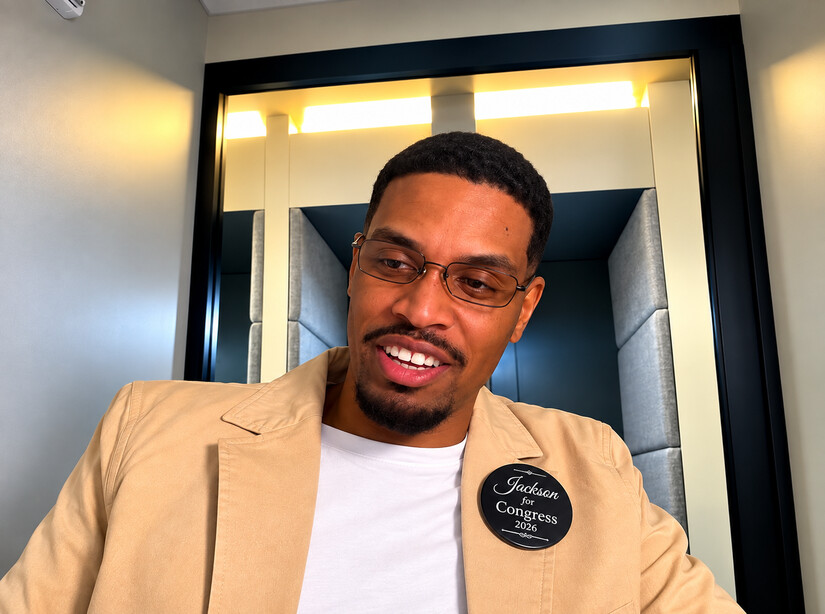
Jackson’s platform is broad. It includes stronger labor protections, affordable housing, expanded apprenticeships, transit-oriented development and a “Rich Tax” on billionaires and the ultrawealthy.
Asked what he would do first for a family struggling with rent, groceries, utilities and transportation, Jackson focused on three areas: changing the tax structure, reconsidering federal spending priorities and directing more public investment toward housing and infrastructure.
He argued that working people bear a disproportionate burden while the wealthiest Americans benefit from tax advantages unavailable to ordinary households.
Jackson also connected domestic affordability to foreign policy. Money committed to prolonged conflicts abroad, he argued, is money Congress cannot invest in healthcare, housing or other needs at home.
His response established a governing direction but did not provide a complete legislative formula. He did not specify the income or wealth threshold at which his proposed tax would begin, its rate or the amount of revenue it would generate. He was clearer about the principle: Congress should ask more of extreme wealth and place a greater share of federal resources behind the daily needs of working people.
Jackson’s healthcare proposal follows a similar philosophy.
He supports a universal guarantee centered on a portable national public option, while retaining Medicare, Medicaid, veterans’ care, employer and union plans, and private insurance. He said a public option should remain available when a person changes jobs, income levels or states and should help fill gaps left by existing coverage.
Jackson emphasized that coverage cannot be expanded responsibly without addressing the supply and cost of care.
“We need to pay a lot more attention to supply so that we can have more available when it comes to doctors, hospitals and whatever it is that we need in the healthcare realm,” he said.
He supports negotiated prices and increased investment in healthcare institutions and workers. He would finance the broader system by restructuring taxes and redirecting federal spending, including money now devoted to military activity abroad and what he considers excessive immigration enforcement.
The interview revealed a candidate with defined values and an extensive platform, but one still working to translate some of those commitments into fully costed legislation.
Jackson did not attempt to disguise that reality. He described his proposals as frameworks around which Congress and the public could begin a serious negotiation.
“Healthcare has been an issue cycle after cycle since I was younger than 20 years old,” he said. “It has become too performative of an issue. It is always an election-year talking point.”
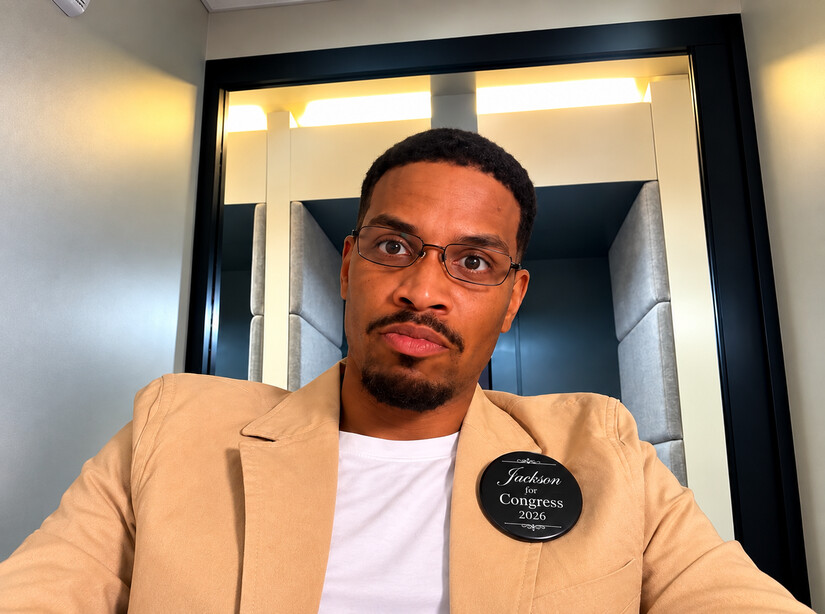
Jackson’s approach to firearms is an effort to hold constitutional protection and federal regulation together.
He said he believes the Second Amendment protects an individual right to possess firearms. He also supports universal background checks, safe-storage requirements and closing gaps that allow some private or gun-show transactions to proceed without the screening required of federally licensed dealers.
“If I believe in any part of the Constitution, I need to believe in all the rest of it, too,” Jackson said.
He questioned the federal rule under which a licensed dealer may generally proceed with a sale if a background check remains unresolved after three business days. Jackson argued that the system should instead be improved so complete checks can be returned promptly without transferring a firearm before the review is finished.
He also pointed to suicide as a major component of firearm deaths and said lawmakers must consider intervention before a weapon reaches someone who presents a danger to themselves or others.
Jackson was less specific about how federal policy should address distrust between police and communities, although he said gun restrictions and accountability must apply fairly to law enforcement as well as civilians.
“I’m from a community where we need to have stricter laws when it comes to the use of guns, period,” he said.

If Jackson occasionally searched for words while discussing economics or foreign policy, his energy changed when the conversation reached privacy and emerging technology.
His platform calls for restrictions on facial recognition, biometric databases, geofence searches, government purchases of privately collected information and Flock-style automated license-plate readers.
Jackson said the speed of technological development has left ordinary people with little understanding of how much information is collected about them, how long it is retained or how it may be combined with other records.
“We’re entering a state of mass surveillance,” he said.
He objected to government collecting information about everyone in anticipation that some of it might later become useful in an investigation. The constitutional process, he argued, should work in the opposite direction: establish a lawful basis for suspicion, seek a warrant and then conduct a targeted search.
“You can’t already be searching and recording people for the moment that you do need something,” Jackson said. “That violates everybody else’s privacy who didn’t do anything.”
His concerns extend beyond government. Retail cameras, cashless payment systems, wearable devices, social-media photographs and biometric technology are creating records that individuals may never see or meaningfully consent to, he said.
Jackson wants federal law to establish the right to know what information is being collected, restrict its sale and retention, protect children from biometric profiling and prevent agencies from purchasing commercial data to avoid constitutional warrant requirements.
“We need laws to protect us before this technology gets out of hand and we don’t have any ability to do anything,” he said.
Not every technological concern he raised during the conversation was accompanied by sufficient evidence to permit publication as fact. But his central policy concern was unmistakable: privacy protections should arrive before surveillance becomes so embedded in ordinary life that reversing it is practically impossible.
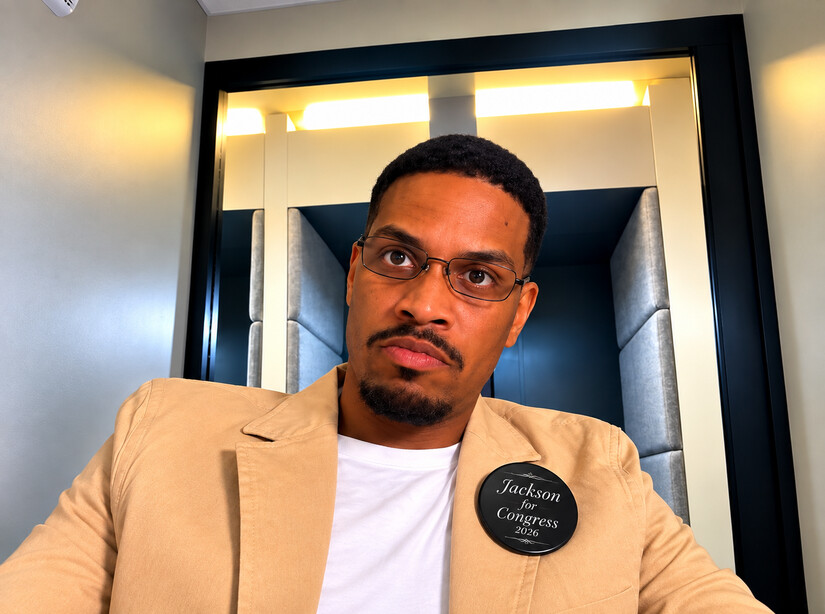
Jackson’s constitutional focus also shapes his foreign policy.
He said Congress has surrendered too much of its authority over war and federal spending to the executive branch. He would require military action to have a lawful basis, defined objectives and congressional authorization where the Constitution requires it.
Regarding Russia’s invasion of Ukraine, Jackson said sanctions can impose consequences without immediately expanding armed conflict. He would consider military assistance by examining who initiated the aggression, whether the aid is defensive and whether it contributes to stability rather than prolonging violence without a clear objective.
On Israel and Gaza, Jackson said the United States should not provide unconditional support when American weapons or money contribute to preventable civilian deaths. His campaign supports Palestinian self-determination and recognition of a Palestinian state governed by legitimate civilian institutions rather than Hamas.
“We can’t be complicit in the deaths of innocent human beings,” he said.
Jackson also affirmed the importance of NATO and longstanding alliances. He argued that the United States should preserve its international influence through consistency, restraint and respect for the countries whose cooperation strengthens collective security.
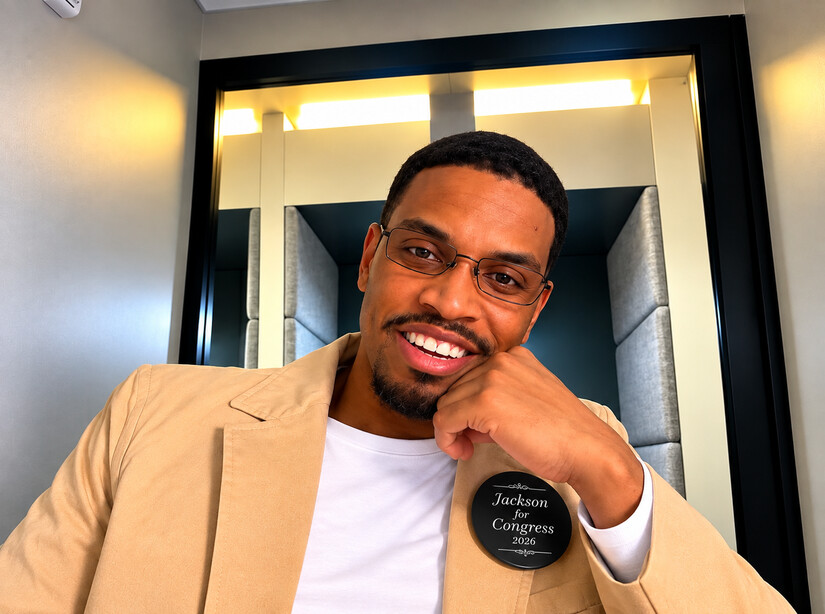
Jackson is trying to win in a district where recent general elections have overwhelmingly favored Democrats.
His theory of the race begins with that reality. He argues that a Democratic-leaning voter who is dissatisfied with Omar can support him without automatically handing the seat to the Republican nominee.
Jackson pointed to Omar’s close 2022 DFL primary against Don Samuels as evidence that a significant constituency has, at times, been willing to consider another candidate. That year, Omar defeated Samuels by approximately two percentage points. In 2024, Omar defeated him again by a wider margin.
Jackson also believes the general election gives him access to voters who do not participate in party primaries, including people who identify with neither party or who become engaged only when a broader ballot is before them.
His obstacle is visibility.
“It’s all about being able to overcome that obstacle of visibility and making people aware that I exist,” Jackson said.
His campaign’s own biography acknowledges limited name recognition, fundraising and volunteer capacity. Jackson does not pretend those constraints are insignificant. He believes every conversation, public appearance, policy statement and interview expands the number of people who know they have a third choice.
He is also explicit that he is competing primarily for voters who would otherwise lean Democratic. His promise to caucus with House Democrats is part of that argument.
Jackson’s electoral arithmetic during the interview was aspirational rather than predictive. He reasoned that even a substantial movement of Democratic voters toward his campaign would not necessarily place the Republican nominee in position to win. After the interview, Jackson put a number on his theory. He told MinneapoliMedia that he believes approximately 134,000 votes could be sufficient to win the three-candidate race. His calculation begins with approximately 67,000 voters he believes could be drawn from those who supported candidates other than Omar in the primary and from general-election voters seeking an alternative to Omar who do not wish to support a Republican. He believes greater visibility could help him attract the additional votes needed to reach his goal. The calculation is Jackson’s campaign projection, not a conclusion supported by public polling. The actual result will depend on turnout and the distribution of votes among all three candidates.
His answer to concerns about “spoiling” the race was direct.
“If you believe in me, you believe in my platform, you believe in giving me a chance, then you need to vote for me,” he said. “The only risk you take is not getting in your vote so I can make it to office.”
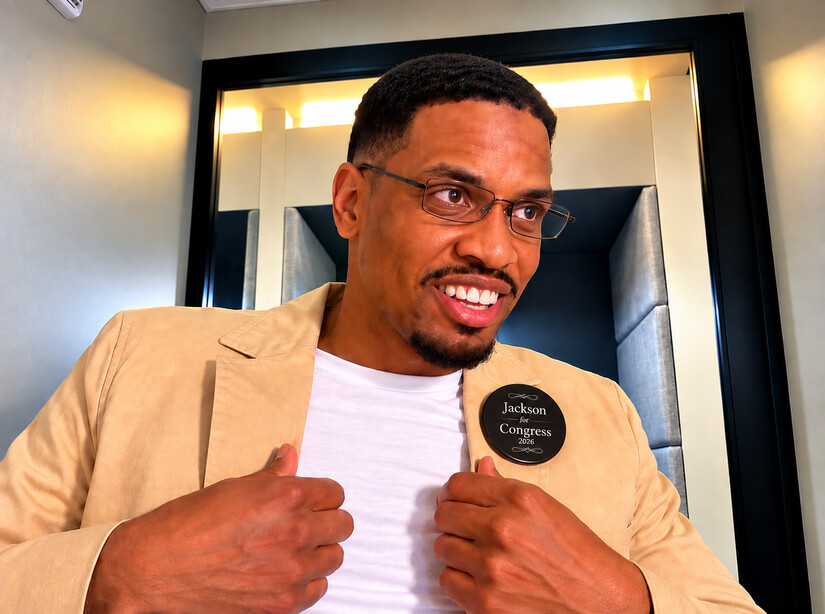
By the end of the interview, Jackson had answered questions about his qualifications, the Georgia filing, campaign finances, gun policy, healthcare, surveillance, war and the difficult mathematics of running as an Independent.
Some answers were precise. Others widened into the many subjects he had been studying and still wanted to explain. He sometimes stopped, reconsidered a phrase and started again. He repeatedly acknowledged that he was learning how to speak within the compressed, unforgiving environment of a political interview.
After the formal closing, Jackson returned to the nervousness with which he had begun.
He said he hoped the openness of the conversation would not be used to portray him negatively. He also acknowledged that a candidate for Congress must be prepared for difficult questions.
“I think I was still courageous enough to try to address most of your questions,” he said.
Then he offered perhaps the clearest description of how he understands his candidacy.
“Please don’t think I’m the same person today that I was yesterday,” Jackson said. “And don’t think I’m the same person tomorrow that I was today.”
Jackson is not presenting voters with a record accumulated through years in elected office. He is presenting them with work, study, service, ambition and the promise that he will continue developing under scrutiny.
He describes himself as diligent, tenacious and relentless. He wants to build an Independent political identity that lasts beyond one election and can cooperate with a congressional caucus without being absorbed by it.
Most voters in Minnesota’s Fifth District are only beginning to learn his name. Jackson understands that. His campaign now depends on whether he can turn that introduction into trust, and trust into votes.
What he wanted voters to remember was simple.
“I represent for them,” Jackson said. “I answer to them.”
The Candidate is MinneapoliMedia’s nonpartisan election series created to help voters understand the people seeking public office, the experiences that shaped them, the policies they are proposing and how they would exercise the power entrusted to them.
MinneapoliMedia does not endorse candidates or political parties. Participation in this series does not constitute an endorsement.

Local stories matter. Subscribe free to MinneapoliMedia and receive independent news, community reporting and important updates from Minneapolis, the North Metro and communities across Minnesota.
SUBSCRIBE FREE: https://minneapolimedia.town.news/subscribe
MinneapoliMedia | Community. Culture. Civic Life


Overcast, with a high of 63 and low of 48 degrees. Overcast in the morning, patchy rain nearby for the afternoon and evening, overcast overnight.