44° and Clear
Image



MINNEAPOLIS, MN (October 29, 2026).
Five days before Minnesota voters complete one of the most consequential elections in recent state history, felony charges arising from an August polling-place operation have placed election security back at the center of public debate.
Hennepin County prosecutors charged conservative activists James O’Keefe and Cam Higby on Wednesday with unlawful voting and identity theft. The charges stem from visits the men allegedly made to several polling places during Minnesota’s August 11 primary election.
According to the criminal allegations and video accounts of the operation, O’Keefe and Higby entered polling locations wearing disguises, used imitated foreign accents and presented themselves to election judges under the names of actual registered voters. Their encounters were recorded for videos intended to challenge Minnesota’s same-day voter registration and vouching procedures.
Neither man cast a ballot. Neither signed the oath required to complete the vouching process. Both deny committing a crime and maintain that their actions were part of an investigative journalism project designed to expose vulnerabilities in Minnesota election law.
Those facts matter. So does another central fact: an intention to make a video does not automatically excuse conduct that would be unlawful if performed without a camera.
The charges are allegations. O’Keefe and Higby are presumed innocent unless prosecutors establish their guilt beyond a reasonable doubt. Their motives, actions and legal defenses should be examined in court, where evidence can be challenged and Minnesota law can be applied to the specific conduct alleged.
That legal process should proceed without partisan intimidation, premature declarations of guilt or attempts to turn the prosecution into another social media performance.
The broader public question, however, should not be postponed. Minnesota must determine how far a political activist may go inside a polling place while claiming to test election integrity. It must also decide whether using another person’s identity becomes acceptable when the deception is recorded, edited and published as political content.
The answer should not depend on whether the activist is conservative, liberal or attached to any political organization. Polling places cannot become experimental stages where participants manufacture the misconduct they claim to be investigating.
The Hennepin County Attorney’s Office alleges that O’Keefe and Higby visited multiple precincts and gave election judges the names of registered voters without the knowledge or permission of those voters.
One video reportedly shows O’Keefe identifying himself as William Pomeranz, an actual registered voter. Prosecutors have stated that some names used during the operation belonged to deceased people and that at least one belonged to a voter who later appeared and voted normally.
This distinction separates the operation from a hypothetical conversation about election law.
Anyone may ask an election official how vouching works. A journalist may interview election administrators, examine public records, observe polling procedures within legal limits and test official claims through reporting. A news organization may create a hypothetical scenario and request that state officials explain how the system would respond.
Using the name of an actual voter inside a polling place is different. A real person’s identity carries legal rights and practical consequences. That person should not arrive to vote and discover that someone else has already used the person’s name as part of a political production.
Minnesota Statute 204C.14 states that an individual may not intentionally misrepresent the individual’s identity while applying for a ballot, depositing a ballot or attempting to vote through a voting system. A violation is a felony.
The identity-theft statute presents an additional question. Minnesota law prohibits using an identity that is not one’s own with the intent to commit, assist or facilitate unlawful activity. The applicable penalty can reach five years in prison, a fine of $10,000 or both, depending on the offense and findings.
Prosecutors will have to prove the necessary intent and establish that the men’s conduct satisfied every legal element. The defense will be entitled to argue that the operation stopped before an application was completed, that no ballot was issued and that the conduct was undertaken for journalistic purposes rather than to cast an illegal vote.
Those are legitimate legal disputes. They do not support the broader claim that no law could have been broken because no ballot was ultimately cast.
Minnesota’s unlawful-voting statute covers intentional identity misrepresentation in applying for a ballot. It is not limited to the act of depositing a completed ballot into a box. Whether the men reached the legal point at which their conduct constituted applying for ballots is one of the issues a court must decide.
The videos were promoted as a test of Minnesota’s vouching law, a system that has repeatedly been described by critics as allowing people to vote without identification.
That description leaves out essential safeguards and confuses proof of identity with proof of residence.
Minnesota allows eligible citizens to register at their polling places on Election Day. A person may establish residence through several methods, including a current Minnesota identification card, another approved photo identification accompanied by an acceptable address document, a valid registration at a previous address in the same precinct or confirmation from another registered voter.
Vouching applies to residence. It does not erase the identity-verification requirements imposed on the person registering.
A registered voter from the same precinct may accompany another eligible voter and sign an oath confirming that the person lives within the precinct. The voucher must personally know that the applicant resides there. One registered voter may vouch for no more than eight people, and a person who was registered through another voter’s voucher may not then vouch for someone else.
The person being registered must still provide identifying information, including a Minnesota driver’s license or identification number or the final four digits of a Social Security number. The registration is recorded and later verified through the statewide voter-registration system. Discrepancies can be referred to law enforcement.
The voucher’s oath is retained with the registration record. Knowingly signing a false oath carries potential criminal consequences.
Vouching has existed in Minnesota for more than 50 years. It is rarely used. According to the Secretary of State’s Office, fewer than 0.6 percent of ballots cast in the 2024 general election involved vouching. Approximately 71 percent of the people using the process were already registered voters who needed to update their names or addresses.
The procedure serves people whose legitimate residence may not match the address printed on an identification card. That can include residents of senior facilities, students, recently relocated families and people who have moved within a precinct.
Minnesotans may debate whether those safeguards are sufficient. Lawmakers may examine whether additional verification, clearer documentation or more frequent audits are needed. No election procedure should be treated as exempt from review.
A credible review, however, must describe the process accurately. It must examine actual evidence of fraud, administrative failures and wrongful voting. It cannot begin with the conclusion that vouching is fraudulent and then create a deceptive encounter to support that conclusion.
The operation was promoted as evidence that Minnesota’s election system could be manipulated. The public record available so far points toward a different conclusion.
Poll workers reportedly became suspicious of the men’s behavior. They documented the encounters, notified election administrators and helped initiate the investigation that eventually reached law enforcement and prosecutors.
No illegal ballot was cast through the operation. No fraudulent vote entered the count. The actual registered voters retained their ability to vote.
Those facts do not establish that every Minnesota election safeguard is perfect. They demonstrate that the workers encountered questionable conduct and responded.
Election security is not defined by the impossibility of anyone attempting deception. No public system can prevent every person from lying at the first point of contact. Security depends on procedures capable of detecting inconsistencies, recording what occurred, protecting legitimate voters and referring possible violations for investigation.
The men’s own conduct allegedly supplied the suspicious circumstances. Poll workers did not simply accept the disguises, accents and names without question and allow ballots to be cast. The process stopped before that happened.
A person who intentionally attempts to trigger security procedures cannot credibly point to the resulting investigation as proof that no security procedures exist.
This is why edited undercover video requires careful examination. Viewers see the portions selected by the publisher, often without the full sequence of questions, warnings, procedural checks and conversations among election workers. The video may produce a dramatic impression without showing how the system handles the encounter after the camera leaves.
The Secretary of State’s Office described the August video as heavily edited and said it displayed a misunderstanding of Minnesota election law. O’Keefe’s organization maintains that the participants presented an intentionally extreme scenario to determine how election workers would respond.
If the purpose was to test the response, the response is part of the result. Election workers reportedly noticed the conduct, alerted authorities and preserved the voting rights of the people whose names were used.
A fair presentation of the operation would acknowledge that outcome.
The case raises a difficult and important question about the limits of undercover reporting.
Undercover journalism has exposed genuine wrongdoing. Reporters have concealed their identities to document unsafe working conditions, discrimination, corruption, abusive institutions and conduct that powerful organizations sought to hide. Such reporting can serve an important public purpose when other methods cannot uncover the truth.
That history does not create a universal right to assume another private person’s identity, interfere with protected public processes or violate generally applicable laws.
The First Amendment protects freedom of speech and the press. It does not grant journalists an unrestricted license to trespass, steal records, commit fraud or use someone else’s identity in circumstances prohibited by law.
Courts will decide whether the conduct alleged here crossed a criminal boundary. The title “journalist” cannot answer that question by itself.
The distinction becomes especially important because O’Keefe and Higby were not documenting election fraud already taking place. Based on the allegations, they introduced false identities into polling places to see how far the deception would proceed.
That is closer to manufacturing the event than observing it.
A journalist investigating weak security at a government facility might attempt to enter an unauthorized area and document whether staff intervene. The resulting report would not automatically immunize the journalist from trespassing laws. Public interest could influence prosecutorial discretion, public judgment or a legal defense, but it would not erase the underlying statute.
The same principle applies here. The defendants may argue that their purpose was to inform the public and that the charges burden protected newsgathering. Prosecutors must still prove criminal intent. A court must consider the law and constitutional arguments without assuming that either side’s political description settles the case.
Calling the prosecution “lawfare” does not resolve those questions. Neither does describing the operation as journalism.
The conduct, evidence and statutory language must decide the case.
The operation included another disturbing feature that should not be treated as a minor theatrical choice.
O’Keefe and Higby wore clothing they presented as Muslim attire and reportedly used imitated foreign accents while entering polling places. The video’s title referred to wearing a “burqa” to expose election fraud.
A burqa has no connection to voter eligibility. A foreign accent does not indicate fraudulent intent. Muslim identity does not create an election-security threat.
The disguises did nothing to test whether a person lived in a precinct, possessed the right identifying information or could complete the required oath. They attached the image of election cheating to Muslims and immigrants through visual suggestion.
Minnesota Muslims should not be turned into props in a political video designed to provoke suspicion about elections. Muslim women who wear face coverings should not encounter additional distrust because activists used religious clothing as a costume for an alleged deception.
Election officials must verify every voter according to the same law. They cannot apply stricter suspicion to someone because of clothing, religion, race or accent. An operation that encourages viewers to associate Muslim appearance with fraud threatens that principle.
This does not form the legal basis of the charges. Offensive conduct is not automatically criminal, and the County Attorney has appropriately distinguished the disguises from the alleged identity and voting offenses.
It remains relevant to the public evaluation of the project. Investigative methods reveal something about the assumptions behind an investigation. Here, the use of Muslim imagery appears designed to heighten fear rather than produce information essential to understanding vouching.
Minnesota should reject that manipulation without allowing outrage over the disguises to substitute for the legal analysis. The criminal case must rest on conduct prohibited by statute, not on whether the defendants were offensive.
The political identities of the prosecutor and defendants should have no bearing on the evidentiary standard.
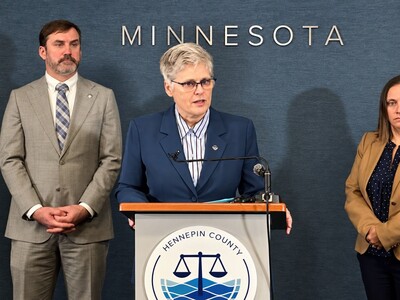
Hennepin County Attorney Mary Moriarty has stated that election protection is among her office’s highest priorities and that people engaging in unlawful election conduct will be held accountable. Critics have accused her office of pursuing political opponents.
The proper answer is transparency and rigorous legal process.
Prosecutors should make the charging documents and factual allegations readily available. They must disclose evidence as required, avoid inflammatory public statements and refrain from treating conviction as inevitable.
The state must prove that each defendant intentionally misrepresented his identity within the conduct covered by the unlawful-voting law. It must separately prove the required elements of identity theft, including the intent connected to the use of another person’s identity.
The defense must have a full opportunity to challenge whether the men applied for ballots, whether the alleged victims’ identities were legally used, whether the relevant statutes apply and whether constitutional protections affect the prosecution.
Neither man had entered a plea when the charges were announced. Their first appearances are scheduled for November 16. Until the proceedings establish otherwise, both remain legally innocent.
Responsible editorial judgment can condemn the alleged use of real voters’ identities and defend the enforcement of election laws while still respecting that presumption.
Minnesota should expect prosecutors to act when there is evidence of election-related misconduct. The same expectation must apply regardless of ideology. If progressive activists entered polling places under conservatives’ names for a hidden-camera campaign, the legal analysis should be identical.
Election law cannot change according to the political popularity of the accused.
Secretary of State Steve Simon has described polling places as “islands of calm.” That phrase identifies an essential feature of democratic participation.
Voters should be able to enter schools, churches, community centers and other polling locations without harassment, partisan confrontation or uncertainty about whether someone is covertly recording them for political entertainment.
Election judges are community members performing demanding public work. Many are retirees or volunteers serving long hours while applying complicated rules under intense scrutiny. They should not have to wonder whether every unusual question is part of an operation designed to embarrass them online.
This does not mean election workers should be shielded from legitimate observation or criticism. Minnesota permits partisan challengers, public oversight and legal processes for contesting election administration. Journalists may report from appropriate areas and request information from officials.
Accountability works best when it protects the process rather than disrupting it.
The proliferation of partisan video operations presents a growing threat because polling places offer irresistible content for organizations seeking outrage and attention. A short, edited confrontation can reach millions of viewers before officials have time to explain what actually occurred.
State and local election authorities should prepare workers for such operations without encouraging suspicion toward legitimate voters. Training should cover covert recording, identity misrepresentation, disruption and procedures for escalating concerns.
Officials should also release prompt, factual explanations when misleading videos circulate. Silence allows edited material to establish a narrative before the complete record becomes available.
Public confidence cannot be restored by demanding blind trust. It must be earned through transparent procedures, accurate information and consistent enforcement.
Minnesota should publish detailed post-election information about same-day registration, vouching, rejected applications, discrepancies, referrals and confirmed violations. Personal voter information must remain protected, but aggregate data can help the public evaluate whether the process functions as intended.
The Legislature should review vouching periodically, particularly as registration technology and residential patterns change. Election administrators should identify any vulnerabilities revealed through actual cases and recommend practical corrections.
That review must remain evidence-based. A staged encounter does not establish widespread fraud. A criminal charge does not prove that no vulnerability exists. Both assertions demand more evidence than political messaging usually provides.
Voters should also understand that a secure election system is composed of overlapping safeguards. Registration records, identification numbers, sworn statements, precinct lists, post-election verification, ballot accounting, audits and criminal enforcement work together.
No single interaction at a registration table represents the entire system.
The operation involving O’Keefe and Higby allegedly reached one part of the process and stopped before ballots were cast. Poll workers reported suspicious behavior, and investigators followed the evidence. That sequence supports confidence in the system’s ability to respond.
It does not justify complacency. Election security requires constant improvement because the methods used to challenge or disrupt elections continue to change.
Minnesota’s general election will take place Tuesday, November 3. The charges announced this week should not distract voters from participating.
Eligible voters should verify their registration, identify their polling places and learn what documentation they may need. People using same-day registration should consult the Secretary of State’s official guidance rather than relying on partisan videos or social media claims.
Election workers should continue applying the law impartially. Political organizations should instruct their supporters to observe established rules, report genuine concerns through appropriate channels and avoid confrontations that could intimidate voters.
O’Keefe and Higby will have their day in court. Minnesota voters should have theirs at the polls.
The timing of these charges makes restraint especially important. Prosecutors should not use the case to suggest that Minnesota elections face a broad conservative threat. Defenders of the accused should not use it to claim that every election safeguard is fraudulent or that every prosecution is partisan retaliation.
The state’s interests are larger than the political identities of two defendants.
Minnesota must protect legitimate voters, election workers, the integrity of registration records and the credibility of criminal law. It must also protect the defendants’ constitutional rights and insist that the charges be proved in court.
Those responsibilities are compatible.
The August operation was presented as an investigation of whether Minnesota’s election system could detect deception. According to the record now available, election workers encountered suspicious behavior, reported it and prevented the conduct from producing an illegal ballot.
The incident did not establish that vouching permits anyone to walk into a polling place, invent an identity and vote without consequence. It showed that using another voter’s name can create a record, trigger scrutiny and lead to investigation.
Whether the alleged conduct constituted two felonies must now be decided through the judicial system.
The defendants should not be convicted in editorials, press conferences or social media posts. They should also not be granted automatic immunity because they carried cameras and described themselves as journalists.
Minnesota’s election laws must apply to everyone. Its journalism protections must remain strong. Its Muslim communities must not be used as symbols of fraud. Its polling places must remain orderly, accessible and free from partisan disruption.
The public should resist every effort to turn this case into a simplistic contest between conservative journalism and progressive prosecution. The real issue is whether people may intentionally use the identities of registered voters inside polling places and then place the resulting footage into a political campaign against the election system.
That question deserves a serious legal answer.
Minnesota’s election workers appear to have passed the manufactured test placed before them. The defendants must now receive a fair hearing, prosecutors must meet the full burden of proof and the courts must determine whether the law was violated.
That is how an election system governed by law should respond. That is also how Minnesota should protect public confidence five days before voters decide the state’s future.

Local stories matter. Subscribe free to MinneapoliMedia and receive independent news, community reporting and important updates from Minneapolis, the North Metro and communities across Minnesota.
SUBSCRIBE FREE: https://minneapolimedia.town.news/subscribe
MinneapoliMedia | Community. Culture. Civic Life


Sunny, with a high of 55 and low of 41 degrees. Sunny for the morning, overcast for the afternoon and evening, clear overnight.