44° and Overcast
Image
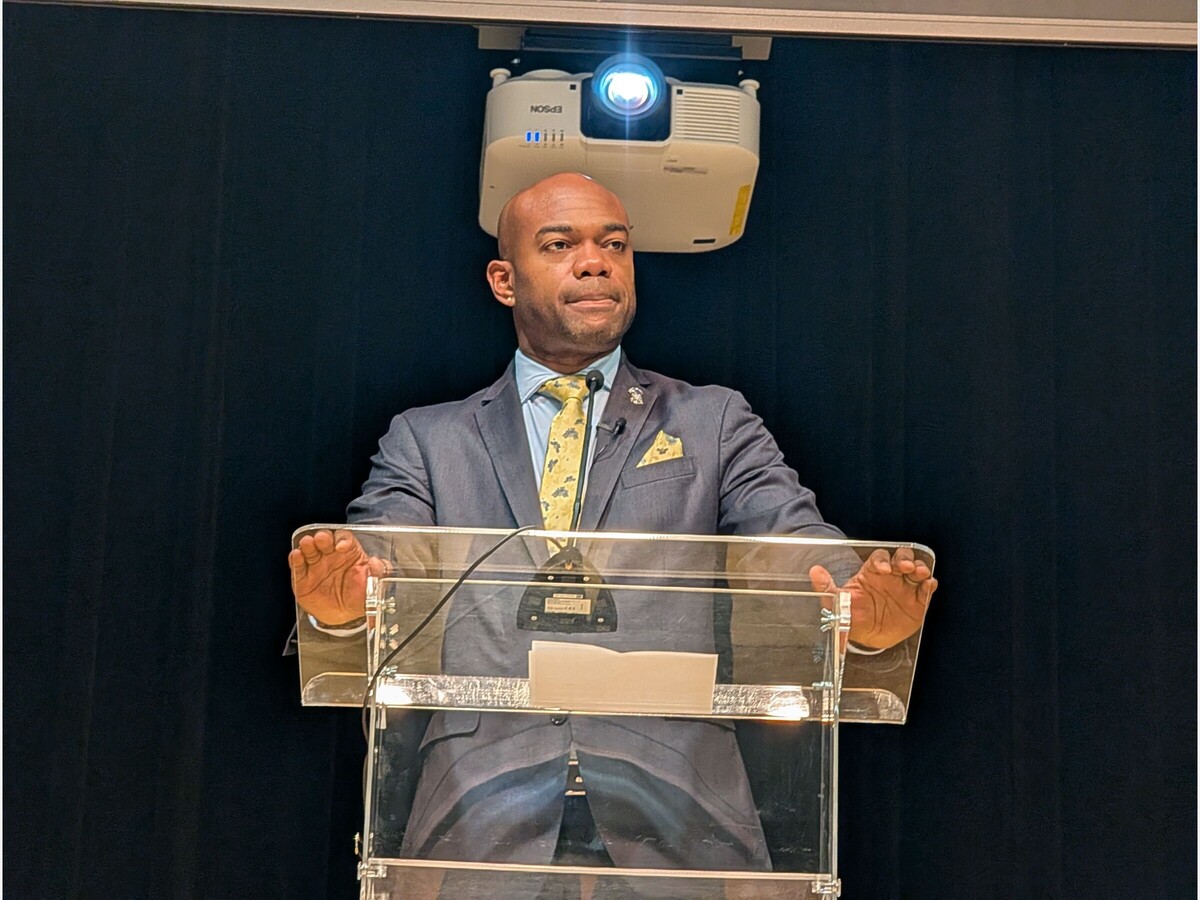



MINNEAPOLIS, MN (October 30, 2026).
Cedrick Frazier’s campaign for Hennepin County attorney rests on a proposition that has shaped much of his public career: public safety cannot be separated from public trust, and neither can be sustained if the legal system treats enforcement, prevention and fairness as competing obligations.
Frazier, a third-term state representative from New Hope, advanced from a five-candidate primary in August and will face former acting U.S. Attorney Anders Folk in the November 3 general election. The winner will take charge of Minnesota’s largest county prosecutor’s office at a time when Hennepin County remains divided over violent crime, juvenile prosecution, police accountability, immigration enforcement and the legacy of outgoing County Attorney Mary Moriarty.
The office carries responsibilities extending well beyond the courtroom. Its attorneys prosecute felonies committed by adults, handle juvenile cases, advise county government, enforce child-protection laws and represent the county in civil matters. Its decisions affect crime victims, defendants, police departments, social-service agencies and residents across 45 municipalities.
Frazier has never worked as a prosecutor. That is the most obvious question confronting his campaign and the issue his opponent has emphasized most directly.
Frazier argues that the office does not need another candidate defined exclusively by prosecutorial experience. He presents his background as a former public defender, Minneapolis Public Schools attorney, labor lawyer, suburban council member and state legislator as preparation for managing a complicated public institution whose work reaches beyond obtaining convictions.
His case to voters depends on whether they accept that broader understanding of the job.
Frazier grew up in the Englewood area on the South Side of Chicago. He describes a low-income community affected by gang activity, drug trafficking, incarceration and gun violence.
His campaign biography says he lost relatives and close friends to shootings and watched neighbors become trapped in cycles of incarceration. He has spoken publicly about losing his best friend in high school, an experience he says continues to influence his views on violence and accountability.
Those experiences have become central to his public-safety message. He does not present gun violence as a distant policy question or a problem that can be resolved through punishment alone. He describes it as a sequence in which unsolved shootings, fear of retaliation and mistrust of authorities allow violence to reproduce itself.
Education offered Frazier a route out of Chicago and into Minnesota. Nearly three decades ago, he enrolled at the University of Minnesota Morris, where he studied psychology and played football. Legislative records identify him as the founder and former president of what was then Minnesota’s only collegiate chapter of the NAACP.
He later earned a master’s degree in urban studies and local-government management from Minnesota State University, Mankato, and a law degree from William Mitchell College of Law, now Mitchell Hamline School of Law.
Minnesota became his permanent home. He and his wife, Stella, raised their three children in New Hope, the suburban community Frazier would eventually represent in municipal and state government.
The movement from Chicago to Morris, Mankato, Saint Paul, Minneapolis and New Hope gave Frazier experience in communities with different political, economic and demographic identities. His campaign portrays that range as an asset in a county containing both Minneapolis and a large ring of suburban communities that do not always share the same expectations of law enforcement or county government.
After law school, Frazier worked in the Hennepin County Public Defender’s Office. The position placed him inside the same county legal system he now seeks to lead from the prosecution side.
Public defenders represent people accused of crimes who cannot afford private counsel. Their role is to protect constitutional rights, test the government’s evidence and ensure that the state meets its burden before taking away a person’s liberty.
That experience did not involve directing prosecutions or supervising criminal investigations. It did expose Frazier to the effects of charging decisions, pretrial detention, plea negotiations and unequal access to legal resources.
His career later moved into public education. Frazier worked for Minneapolis Public Schools as director of equity and diversity and later in the district’s legal office. The work involved civil-rights compliance, employment matters, discrimination concerns, institutional policy and litigation affecting one of Minnesota’s largest school districts.
He joined Education Minnesota’s legal team in 2016. The organization represents teachers and other education professionals throughout the state. As a staff attorney, Frazier handled labor and employment matters involving collective-bargaining agreements, disciplinary proceedings, workplace rights and disputes between educators and school systems.
That record gives him substantial experience as an advocate and institutional lawyer. It does not give him the courtroom history of a career prosecutor.
Frazier does not dispute the difference. He argues that assistant county attorneys already possess the technical experience needed to charge and litigate cases. He views the elected county attorney’s responsibility as setting policy, managing personnel, securing resources and establishing relationships among prosecutors, police, victims and communities.
“We have line attorneys that will do the day-to-day work, enforcing the law, charging cases, prosecuting cases,” Frazier told MPR News. “My role as a leader will be to manage that office, get everybody going in the same direction.”
That answer identifies the central distinction voters must evaluate. Technical prosecution experience can matter greatly when assessing evidence, supervising trials and establishing office standards. Executive leadership also matters in an organization containing hundreds of attorneys and support employees.
The election asks voters which form of preparation they consider more important.
Frazier entered elected government in 2018 when he was appointed to the New Hope City Council, becoming the first African American to serve on the council.
His campaign highlights efforts to improve communication among residents, police and the city’s Human Rights Commission. Municipal office also gave him experience with budgets, housing policy, public safety and the practical limitations of local government.
In 2020, Frazier won election to the Minnesota House. He currently represents District 43A, which includes New Hope and Crystal. He is serving his third term and chose not to seek reelection in 2026 while campaigning for county attorney.
Frazier’s committee work has included public safety, judiciary policy, workforce issues and state budgeting. In October 2025, House DFL Leader Zack Stephenson appointed him DFL co-chair of the House Ways and Means Committee, making Frazier the first Black man to hold a chairmanship of that committee.
Ways and Means reviews the fiscal structure of legislation before finance bills reach the House floor. The position placed Frazier near the final stage of negotiations involving state spending, policy priorities and the compromises required by a closely divided Legislature.
His legislative record cannot be reduced to one political label. Frazier has supported significant criminal-justice reforms while also advancing measures involving firearm restrictions, shooting investigations and school-police policy.
That combination supports his argument that reform and enforcement do not have to operate in opposition.
Frazier’s most prominent legislative achievement is Minnesota’s Restore the Vote law.
Before the law changed, Minnesotans convicted of felonies remained ineligible to vote until completing every part of their sentences, including probation or supervised release. Because probation can last for years, people living and working in their communities could remain excluded from elections long after leaving prison.
Frazier served as chief House author of the legislation restoring voting rights during any period when a person is not incarcerated for the felony offense. The law also established procedures for notifying people that their voting rights had been restored and providing access to registration materials.
The change affected tens of thousands of Minnesotans.
Supporters argued that voting strengthens civic reintegration and that the previous system created confusion for residents, election workers and corrections officials. They also cited the law’s disproportionate effect on Black and Indigenous communities, which have experienced higher rates of criminal-justice involvement.
Opponents challenged the law in court and argued that restoration should occur only after a person completes the entire sentence. The legal challenge did not overturn the statute, and the law remains in effect.
Restore the Vote illustrates Frazier’s approach to justice. He distinguishes incarceration from permanent civic exclusion and views reintegration as part of public safety. Critics may regard that approach as too lenient toward people convicted of serious crimes. Frazier’s position is that accountability should have identifiable limits and that people living outside prison should be able to participate in the government whose laws they must follow.
Frazier was also a chief House author of legislation establishing extreme-risk protection orders in Minnesota.
The law allows a court to temporarily restrict a person’s access to firearms when evidence indicates that the person poses a significant danger to themselves or others. Family or household members and certain law-enforcement authorities may petition the court, which must evaluate the evidence under statutory standards.
Supporters describe the process as a preventive tool for situations in which warning signs appear before a shooting or suicide. Opponents have raised concerns about due process, evidentiary standards and the possibility that firearms could be removed before a full hearing.
Frazier’s county-attorney platform proposes using the office’s legal authority to support appropriate petitions when evidence demonstrates a serious risk. He connects that policy to his childhood experience with gun violence and his belief that government should intervene before warning signs become fatalities.
The law does not make the county attorney the sole decision-maker. Courts determine whether the legal standard has been met, and the process contains opportunities for review. The county attorney can still influence how frequently the office uses the statute, what evidence it requires and how it coordinates with law enforcement.
Frazier would enter office with a clear commitment to using that authority.
Frazier also chief-authored legislation reforming Minnesota’s aiding-and-abetting felony-murder law.
The previous framework could expose an accomplice to a murder conviction even when that person did not cause the death and did not intend that anyone be killed. Critics argued that the law swept too broadly and produced severe sentences for people whose involvement differed substantially from that of the person who committed the killing.
The reform narrowed the circumstances under which an accomplice can be convicted and created a process through which certain people sentenced under the previous law could petition for review.
The change did not eliminate liability for a person who causes a death while committing a felony. It focused on the culpability required to hold an accomplice responsible for the resulting murder.
Frazier cited racial disparities among people charged under the old doctrine. During legislative debate, he also emphasized that many affected defendants were young and had limited prior criminal histories.
The law demonstrates his willingness to revisit final convictions when lawmakers determine that a sentencing rule was unjust. It also presents a question relevant to his county-attorney campaign: how would his office balance retrospective reform with the expectations of victims’ families who believed a criminal sentence had concluded their case?
Frazier’s platform promises to place victims and survivors at the center of office policy. If elected, that commitment would be tested whenever reform and finality pull in different directions.
Frazier’s legislative record also includes a 2024 law clarifying the rules governing school resource officers.
Changes enacted in 2023 had produced disagreement over when officers could use physical restraints on students. Several law-enforcement agencies withdrew officers from schools while seeking clarification, and school districts faced uncertainty about campus safety arrangements.
Frazier sponsored the House legislation that clarified the standards. The law subjected school resource officers to the force restrictions applying to other peace officers, preserved limits on chokeholds and face-down restraints, established training requirements and directed the Minnesota Board of Peace Officer Standards and Training to develop a model policy.
The episode required negotiation among police organizations, educators, school administrators, disability advocates and legislators. It is relevant to Frazier’s campaign because it shows him working through a dispute involving both student protections and law-enforcement concerns.
His supporters cite the law as evidence that he can maintain reform principles while responding to operational problems raised by police departments. Critics can still question whether the compromise came quickly enough or satisfied every stakeholder.
The county attorney will need the same capacity for negotiation. Hennepin County contains numerous police agencies, each with its own leadership, local government and relationship with county prosecutors.
In 2026, Frazier sponsored the proposal that became the Minnesota Clearance Grant Program, an initiative intended to improve investigations of nonfatal shootings.
Police departments facing staffing shortages often prioritize homicides while nonfatal shootings receive fewer investigative resources. Frazier argues that this distinction can allow people responsible for serious violence to remain free, leave victims without answers and fuel retaliatory shootings.
The grant model supports coordinated teams of law-enforcement officers, prosecutors and crime analysts beginning their work soon after a shooting is reported. Supporters point to Saint Paul’s experience, where a coordinated approach was credited with increasing the clearance rate for nonfatal shootings from 37 percent to 71 percent in 2024.
Frazier has placed this strategy near the center of his county-attorney campaign. He proposes assigning specialized prosecutors and investigators to nonfatal shooting cases and working with police agencies to improve clearance rates.
The policy is more specific than a general promise to reduce gun violence. It focuses on the likelihood that a person who commits a shooting will be identified and held accountable.
Research on deterrence has often found that the certainty of apprehension matters more than adding severity to an already substantial sentence. Frazier’s proposal applies that principle by concentrating resources on solving cases rather than relying solely on longer punishments after an arrest.
He also supports Group Violence Intervention and hospital-based violence-interruption programs. These approaches identify the small number of people at highest risk of shooting or being shot, deliver clear warnings about legal consequences and connect participants with services intended to reduce their involvement in violence.
The effectiveness of such programs depends on implementation, credible community partners and sustained cooperation among police, prosecutors and service providers. Frazier would have to show that the programs produce measurable reductions rather than becoming loosely monitored grants.
Frazier has promised to establish a Victim and Survivor Advisory Council on his first day as county attorney.
The proposed council would give people affected by crime a formal role in advising the office on communication, services and policy. Frazier says victims should receive timely information about their cases and have access to culturally responsive therapy, counseling and relocation assistance.
The proposal responds to a persistent complaint about large prosecutor offices: victims can feel invisible once a case becomes a contest between the state and the defendant.
A criminal prosecution is brought in the name of the public, not as the victim’s private lawsuit. Prosecutors must consider evidence, law and the broader public interest. They cannot give victims authority to determine charges or sentences. They can provide information, listen to concerns and reduce the confusion families experience while navigating the process.
Frazier also supports making restorative-justice options available in selected lower-level cases when the victim chooses to participate. He says the process should allow victims to explain the harm, obtain answers and require the person responsible to acknowledge and repair that harm.
That position contains necessary limitations. Restorative justice should not be used to pressure victims into forgiving offenders or accepting less protection. It requires trained facilitators, informed consent and careful screening for coercion.
If established, the advisory council would need more than ceremonial meetings. Its membership, authority and recommendations should be public. The county attorney should be required to explain when the office accepts or rejects its advice.
Frazier promises to publish accessible information about charging decisions and hold regular community meetings throughout the county.
Transparency has become especially important after several controversies during Moriarty’s term, including disputes over juvenile charging, plea agreements, law-enforcement relationships and intervention by state officials in high-profile cases.
Public reporting can help residents understand how prosecutors use discretion. Useful data would include charging rates, declinations, dismissals, plea resolutions, diversion participation, racial disparities, case-processing time and outcomes by offense category.
Numbers alone cannot establish whether every decision was correct. They can reveal patterns that require explanation.
Frazier would also have to protect confidential information involving victims, juveniles and active investigations. Transparency does not permit the release of information that could endanger witnesses or compromise a fair trial.
His proposal will therefore depend on whether the office produces information detailed enough to permit scrutiny without turning individual cases into political displays.
Frazier’s platform treats wage theft and financial fraud as public-safety concerns.
Minnesota law recognizes intentional wage theft as a crime. These cases can be difficult to investigate because relevant evidence is often contained in payroll records, contractor arrangements and business accounts.
Frazier pursued legislation allowing county attorneys to issue administrative subpoenas for certain business records in wage-theft and financial-crime investigations. Earlier versions of the proposal encountered legislative resistance, including concerns about government authority and procedural safeguards. The authority was later incorporated into legislation with limitations governing relevance, probable cause and the types of records subject to a subpoena.
His campaign says the office would use that authority to pursue employers who intentionally withhold wages or misclassify employees to avoid payroll taxes, unemployment obligations and workers’ compensation requirements.
The position reflects his background as a labor attorney. It also expands the public conception of crime beyond street offenses.
A worker deprived of thousands of dollars in earned wages has suffered a real economic injury. Prosecuting those cases consistently would demonstrate whether Frazier’s pledge to apply the law without regard to wealth or status has operational force.
The office would also need investigators and prosecutors with experience in complex financial records. Campaign promises about corporate accountability will mean little without staff, training and measurable case results.
Frazier describes fentanyl as both a public-health emergency and a criminal enterprise.
His platform distinguishes between people living with substance-use disorders and traffickers who profit from dangerous drugs. He supports treatment and rehabilitation for users while promising aggressive prosecution of people who knowingly distribute fentanyl and drive organized criminal activity.
This distinction is widely accepted in general terms and difficult to apply in individual cases. A person with an addiction may also sell drugs. A low-level participant may possess a substantial quantity without directing the larger operation. Prosecutors must distinguish commercial trafficking from survival behavior while responding to overdose deaths and community harm.
Frazier has not proposed eliminating prosecution in drug cases. He argues that charging decisions should reflect a person’s role, risk and treatment needs.
The success of that approach would depend on access to treatment. A prosecutor cannot divert someone into a program that has no available bed, clinician or culturally appropriate service. Hennepin County would need coordination among courts, treatment providers, probation officers and county health agencies.
Frazier has made opposition to federal immigration enforcement one of the most forceful elements of his campaign.
He says the Hennepin County Attorney’s Office under his leadership would not assist U.S. Immigration and Customs Enforcement with civil immigration enforcement. He also promises to prosecute federal agents who violate Minnesota criminal law while operating within the county.
That pledge requires legal precision. Federal agents do not possess a general exemption from state criminal law, but questions involving federal authority, immunity and jurisdiction can be complicated. A county attorney must evaluate evidence and applicable law in each case rather than promise a predetermined prosecution.
Frazier’s position is that federal status should not place an agent above Minnesota law. He has cited allegations involving unlawful entry, false imprisonment, assault, property destruction and impersonation of local officers as conduct that could warrant state charges when supported by evidence.
Folk has also said federal agents who violate Minnesota law should be prosecuted. The disagreement concerns emphasis, background and the speed with which each candidate responded to recent federal enforcement activity.
Frazier has tried to make the issue a larger test of independence from the federal government. Folk, who served as a career federal prosecutor during Republican and Democratic administrations, argues that professional public service should not be treated as partisan allegiance.
The county attorney’s responsibility is ultimately narrower than either campaign’s rhetoric. The office must evaluate provable conduct under Minnesota law and proceed only when charges can be supported in court.
Folk offers voters a substantially different professional history.
He served as a military lawyer and federal prosecutor and later became acting U.S. attorney for Minnesota during the Biden administration. He participated in major federal cases and signed the civil-rights indictment of former Minneapolis police officer Derek Chauvin.
Folk has criticized the current Hennepin County Attorney’s Office for damaged relationships with law enforcement and what he considers an overly ideological approach to prosecution. He presents himself as the candidate with direct experience making prosecutorial decisions and supervising complex cases.
Frazier rejects the assertion that he would simply continue Moriarty’s administration. He says he would preserve reforms that work while rebuilding relationships with police and improving communication with victims.
Both candidates describe themselves as capable of combining enforcement with compassion. Their differences concern background, emphasis and the institutional culture they would create.
Folk has received support from several law-enforcement leaders and more centrist Democratic officials. Frazier has the DFL endorsement and substantial labor backing, along with endorsements from Attorney General Keith Ellison, U.S. Sen. Tina Smith, U.S. Rep. Ilhan Omar and other progressive leaders.
The office is elected on a nonpartisan ballot. The endorsement coalitions still provide voters with information about the constituencies and governing traditions surrounding each candidate.
Campaign-finance reports cited by MPR News showed Folk raising considerably more money than Frazier during the campaign. Frazier entered the final stage with the advantage of having placed first in the primary, receiving 87,447 votes, or approximately 36 percent. Folk received 55,610 votes, or about 23 percent. The three eliminated candidates collectively received more than 40 percent, leaving both finalists with substantial work to do.
Frazier’s lack of prosecutorial experience cannot be dismissed as a technical objection.
The county attorney must make decisions involving charging standards, evidence, plea agreements, trial strategy and the ethical obligations of prosecutors. The office also handles cases in which public pressure may conflict with what the evidence can prove.
An experienced prosecutor may bring a deeper understanding of those pressures on the first day.
Frazier offers a different argument. He says leadership of the office requires managing attorneys, setting policy, building coalitions and understanding how government decisions affect people throughout the system. His work has included criminal defense, civil law, public institutions, labor disputes, legislation and municipal government.
Voters must decide whether that breadth is sufficient preparation for leading prosecutors.
If elected, Frazier would need to appoint experienced criminal-law managers, retain capable career attorneys and resist pressure to make individual charging decisions according to political advantage. He would also need to demonstrate that his relationships with police agencies can survive disagreements over charging and accountability.
His legislative success suggests an ability to negotiate, manage policy and work through institutional conflict. It does not predict with certainty how he would perform as the county’s chief prosecutor.
No candidate’s résumé can do that.
Frazier organizes his public-safety philosophy around four concepts: prevention, intervention, accountability and rehabilitation.
Prevention includes firearm restrictions, youth services and community-based violence programs. Intervention includes focused work with people at immediate risk of participating in violence. Accountability includes prosecution, improved shooting investigations and consequences for violent offenders, employers engaged in wage theft and government agents who violate state law. Rehabilitation includes treatment, restorative justice in appropriate cases and reintegration after incarceration.
This framework is broader than a traditional conviction-centered model. It also creates a demanding standard by which a Frazier administration could be judged.
If violence rises, residents will expect more than explanations about long-term prevention. If diversion programs fail, the office will have to correct them. If victims feel ignored, the advisory council will not be enough. If relationships with police remain strained, campaign promises about collaboration will lose credibility.
A broad philosophy increases the number of responsibilities an administration accepts. Frazier is asking voters to trust that he can turn those responsibilities into a coherent operating system.
The 2026 election will determine more than who occupies the county attorney’s office. It will influence how Minnesota’s largest county defines prosecution after four years of conflict over reform, discretion and public safety.
Folk argues that the office requires a prosecutor capable of restoring professional discipline and law-enforcement confidence. Frazier argues that it requires a leader with experience across the legal system who can enforce the law while preserving reform and addressing the conditions that produce violence.
Frazier’s candidacy is rooted in a personal history shaped by Chicago gun violence, Minnesota education and legal work on behalf of defendants, school systems and workers. His legislative record includes restoring voting rights after incarceration, creating extreme-risk protection orders, narrowing accomplice liability in felony-murder cases, clarifying school-resource-officer policy and investing in the investigation of nonfatal shootings.
The same record will lead voters to different conclusions. Supporters see a practical reformer who understands both accountability and structural inequality. Critics may see a progressive legislator without the direct prosecution experience required for the office.
Frazier has not attempted to become Folk. His campaign asks voters to judge the county attorney as an executive, public lawyer and policy leader whose responsibility begins before a criminal case reaches the courtroom and continues after a sentence is imposed.
Whether Hennepin County accepts that definition will be decided November 3.
The choice will determine whether Cedrick Frazier’s next chapter takes him from the Minnesota House to the leadership of the state’s largest county prosecutor’s office, where his governing philosophy would no longer be measured by bills, speeches or campaign plans. It would be measured by cases, victims, employees, public confidence and whether Hennepin County becomes safer under his direction.

Local stories matter. Subscribe free to MinneapoliMedia and receive independent news, community reporting and important updates from Minneapolis, the North Metro and communities across Minnesota.
SUBSCRIBE FREE: https://minneapolimedia.town.news/subscribe
MinneapoliMedia | Community. Culture. Civic Life



Overcast, with a high of 55 and low of 40 degrees. Partly Cloudy in the morning, overcast in the afternoon,