59° and Light rain
Image
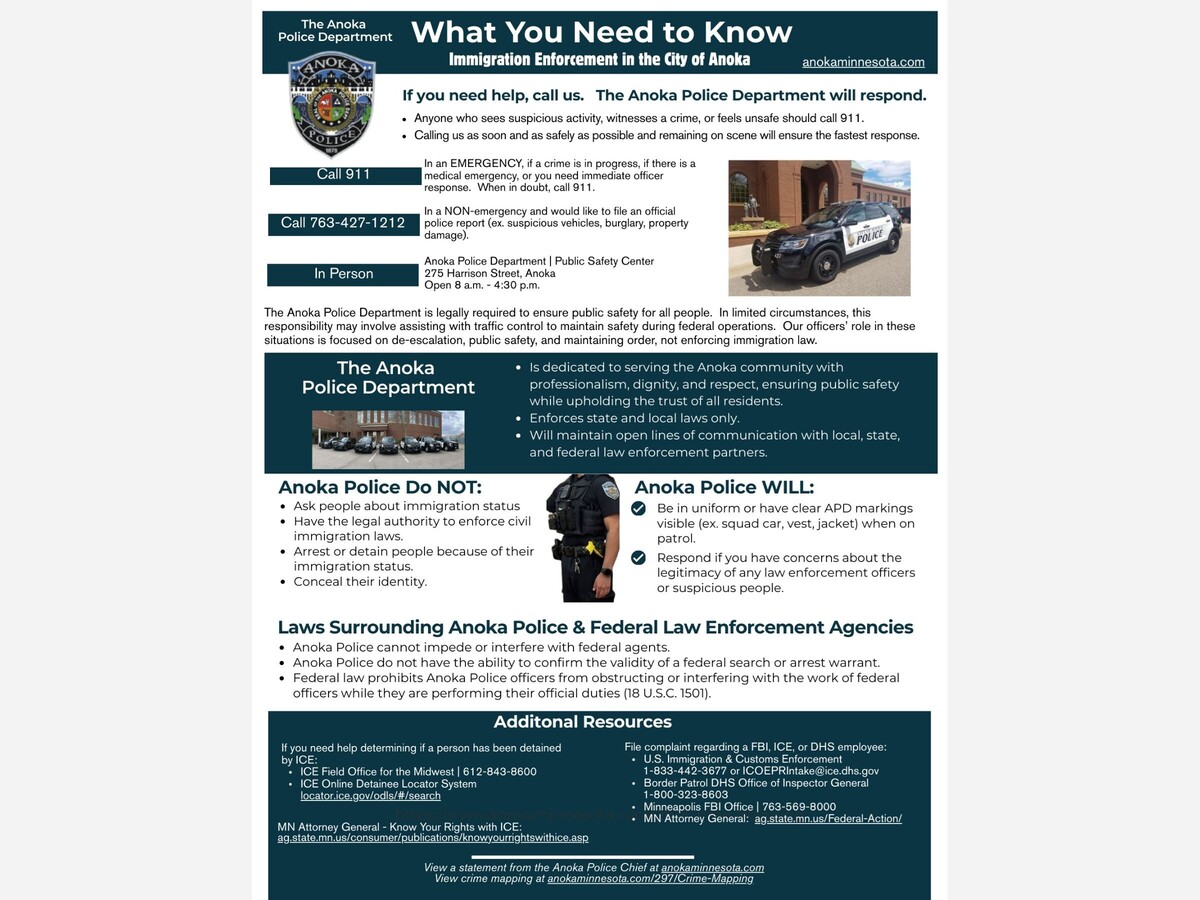



In response to heightened public concern and widespread questions about the presence and authority of federal immigration enforcement in Minnesota communities, the Anoka Police Department has released an official public information flyer titled “What You Need to Know: Immigration Enforcement in the City of Anoka.”
The document serves as a plain-language guide for residents, outlining what local police officers can and cannot do under the law, how the department interacts with federal agencies, and what resources are available to the public. Department officials describe the flyer as part of an effort to promote transparency, maintain public trust, and ensure residents understand their rights and local law enforcement’s legal responsibilities.
At the center of the flyer is a firm clarification: the Anoka Police Department enforces state and local laws only. Immigration enforcement, which is governed by federal civil law, falls outside the department’s authority.
The flyer emphasizes that the department’s legal obligation is to protect public safety for all residents, regardless of immigration status. In doing so, it draws a clear distinction between local policing functions and federal immigration operations carried out by agencies such as U.S. Immigration and Customs Enforcement.
To remove ambiguity, the document explicitly outlines what Anoka police officers do not do.
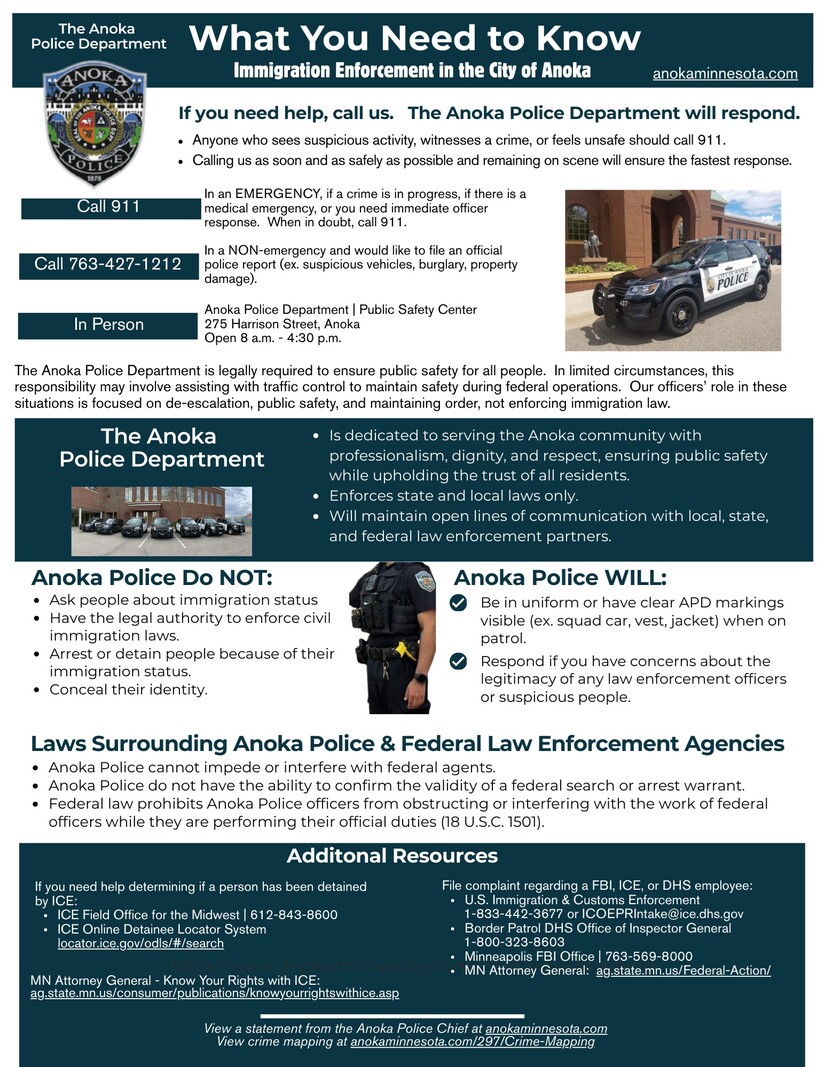
According to the flyer, Anoka police officers do not:
These restrictions reflect long-standing legal boundaries between municipal law enforcement agencies and federal immigration authorities, and are consistent with Minnesota policing standards and constitutional protections.
The flyer also outlines affirmative commitments the department makes to the community.
Anoka police officers will:
The department notes that any involvement during federal activity is narrowly focused on safety, not enforcement of immigration law.
The flyer addresses a common source of confusion: why local police may be present during federal enforcement actions even though they do not participate in immigration enforcement.
Under federal law, local officers are prohibited from interfering with federal agents performing official duties. The document cites 18 U.S.C. § 1501, which makes obstruction of federal officers a federal offense.
At the same time, the Anoka Police Department states that its officers do not have the authority to determine whether a federal arrest or search warrant is valid. That responsibility lies exclusively within the federal judicial system.
In short, the flyer explains that non-interference is a legal obligation, not an endorsement or expansion of authority.
The guide provides clear contact information for residents who need assistance or wish to report a concern.
The department encourages residents to contact police if they feel unsafe, witness a crime, or have questions about suspicious activity.
Recognizing that local police cannot resolve federal immigration issues, the flyer also directs residents to appropriate state and federal resources.
These include:
The document also lists complaint channels through the Department of Homeland Security Office of Inspector General for allegations involving federal agents.
Throughout the flyer, the Anoka Police Department reiterates its commitment to professionalism, dignity, and respect, and to maintaining trust with the City of Anoka community.
Rather than advancing policy arguments or political positions, the document focuses on what the law requires, what residents can expect from local officers, and where responsibility shifts to federal authorities. In doing so, it functions less as a press statement and more as a civic explainer, aimed at reducing fear, misinformation, and uncertainty during a tense moment for many families.
The flyer, along with a statement from the Anoka Police Chief, is available on the city’s official website.
Download: What You Need to Know: Immigration Enforcement in the City of Anoka



Overcast, with a high of 63 and low of 56 degrees. Overcast in the morning, light rain shower in the afternoon, overcast overnight.