Image



BLAINE, MN
In the first month of 2026, the Blaine Police Department responded to 4,948 calls for service, according to the city’s official “Blaine by the Numbers” January report.
Behind that single figure lies a complex portrait of modern suburban policing: traffic enforcement along expanding commercial corridors, officers arriving first at medical emergencies, winter crashes on icy roadways, and the quieter but steady work of addressing disturbances, property crimes, and quality-of-life complaints.
For a city of roughly 70,000 residents in northern Anoka County, the monthly total translates to more than 160 calls per day, a pace that reflects both population growth and the evolving demands placed on municipal law enforcement.
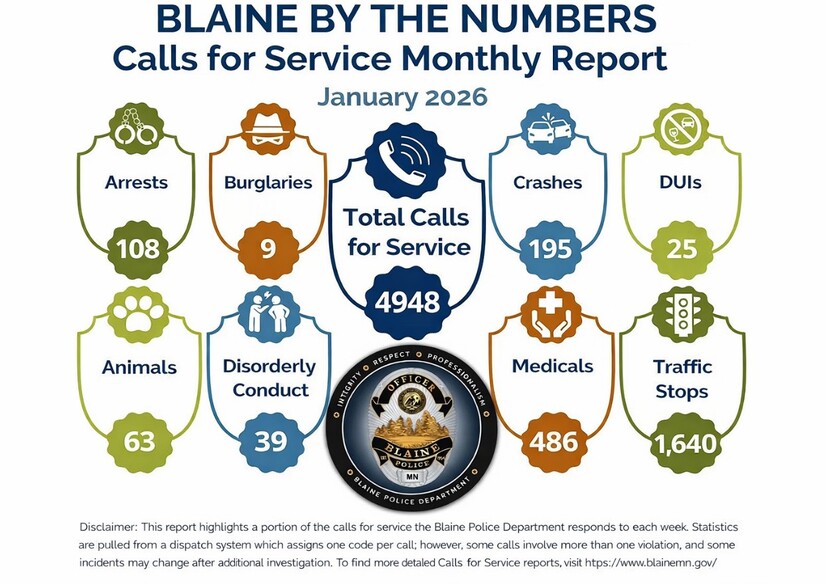
The January 2026 activity report breaks down as follows:
|
Category |
Total Incidents |
|
Total Calls for Service |
4,948 |
|
Traffic Stops |
1,640 |
|
Medical Emergencies |
486 |
|
Vehicle Crashes |
195 |
|
Arrests |
108 |
|
Animal-Related Calls |
63 |
|
Disorderly Conduct |
39 |
|
DUIs |
25 |
|
Burglaries |
9 |
The figures are drawn from the department’s dispatch system, which assigns one primary code per call. Officials note that some incidents may involve multiple violations and classifications can change following further investigation.
Residents seeking full monthly breakdowns can access archived reports at BlaineMN.gov/CallsForService.
Traffic activity accounted for the largest share of January’s calls.
Officers conducted 1,640 traffic stops, reinforcing roadway safety across key corridors such as Interstate 35W and Highway 65. In growing suburban communities like Blaine, traffic enforcement serves both preventive and investigative purposes. Stops may involve speeding, equipment violations, distracted driving, warrant arrests, or impaired driving investigations.
January also saw 195 reported vehicle crashes, a figure consistent with Minnesota’s winter driving season, when snow, ice, and reduced daylight contribute to collision risk statewide. According to statewide transportation data, winter months routinely produce elevated crash totals across Minnesota due to hazardous conditions.
The department recorded 25 DUI arrests during the month. Minnesota maintains some of the nation’s stricter impaired driving penalties, including immediate license revocation and escalating sanctions for repeat offenses. Enforcement remains a public safety priority, particularly during winter months when holiday gatherings and slippery road conditions can compound risk.
Together, traffic stops and crashes accounted for more than one-third of all police activity in January.
One of the most striking figures in the January report is the 486 medical calls, representing nearly 10 percent of the department’s monthly activity.
In many Minnesota communities, police officers are frequently first on scene during medical emergencies. Officers are trained in CPR, AED deployment, and in many cases carry naloxone to respond to suspected opioid overdoses. While paramedics and fire personnel provide advanced medical treatment, police often stabilize scenes and render immediate aid.
The volume of medical calls underscores how municipal policing increasingly intersects with public health response.
Officers made 108 arrests in January. Arrests can include a broad spectrum of offenses, ranging from warrant apprehensions and domestic-related cases to narcotics violations and assault.
Property crime figures were comparatively low, with 9 reported burglaries during the month. While burglary totals fluctuate year to year, suburban communities often monitor property crime closely as a barometer of neighborhood safety trends.
The department also responded to 39 disorderly conduct incidents, typically involving disturbances, altercations, or public behavioral complaints requiring officer intervention.
Additionally, 63 animal-related calls were logged. These calls often involve loose pets, welfare checks, or wildlife issues, a reminder that policing in suburban Minnesota includes responding to everyday community concerns beyond traditional crime categories.
Blaine has experienced steady residential and commercial expansion over the past decade. As one of Anoka County’s largest cities and home to the National Sports Center, the community sees significant daily traffic flow and regional visitation.
Population growth naturally increases service demand. Nearly 5,000 calls in a single month reflect not only crime or enforcement activity but also assistance calls, public safety checks, medical responses, and proactive policing.
Public safety officials emphasize that calls for service totals do not equate solely to criminal incidents. Many involve assistance, mediation, preventive patrol, or community engagement.
The release of monthly activity summaries reflects a broader commitment among Minnesota municipalities toward transparency in policing data. By publishing regular reports, departments provide residents with accessible insight into local public safety operations.
The Blaine Police Department notes in its disclaimer that dispatch coding assigns a single primary category per call. Some incidents may involve multiple violations or evolve after further investigation, meaning final case outcomes may differ from initial dispatch classifications.
Still, the report offers a structured snapshot of policing activity at a defined moment in time.
Statistics alone rarely tell the whole story. A traffic stop may prevent a crash. A medical call may save a life. A disturbance intervention may avert escalation. A single arrest may resolve an outstanding warrant tied to a broader investigation.
January’s 4,948 calls represent thousands of moments where officers engaged residents, stabilized emergencies, enforced traffic laws, or responded to community concerns.
For Blaine residents, the numbers offer both reassurance and responsibility: reassurance in the visibility of public safety reporting, and responsibility in understanding that policing data reflects collective community behavior, seasonal patterns, and demographic growth.
As 2026 unfolds, monthly reports will continue to provide measurable insight into how one of Minnesota’s fastest-growing suburbs navigates safety, service, and accountability in real time.



Sunny, with a high of 58 and low of 35 degrees. Sunny in the morning, clear in the afternoon and evening,