82° and Sunny
Image




In a brief social media post recapping January activity, the Coon Rapids Police Department offered a simple but telling reminder: behind every statistic is a real person, a real call for help, and an officer responding in real time. Beneath that message lies a fuller story about how public safety functions day to day in one of Anoka County’s largest cities and what the numbers actually say about community needs, policing priorities, and trust.
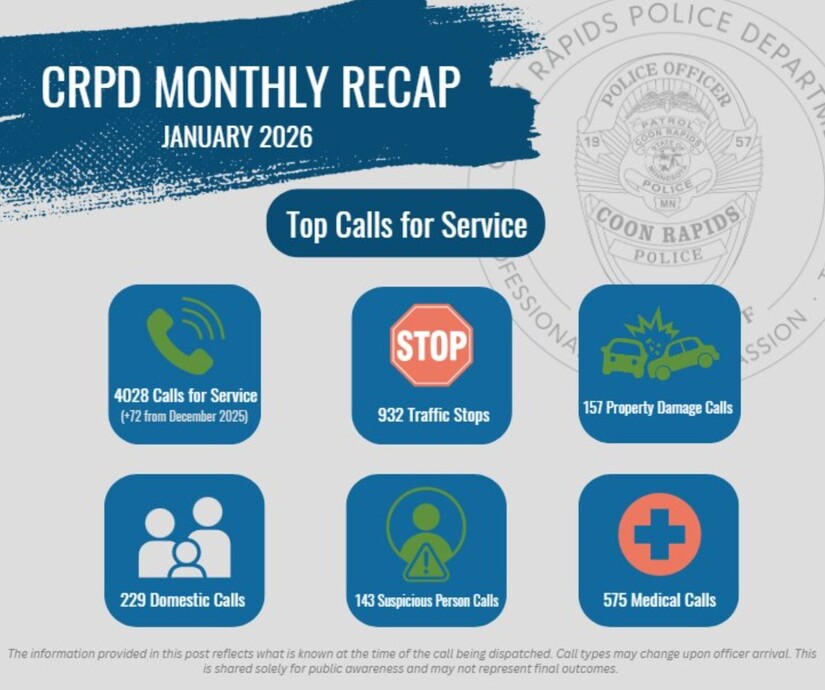
Coon Rapids is a city of more than 65,000 residents, and its police department operates as a 24-hour service agency. According to city data, the department handles roughly 50,000 calls for service each year, averaging more than 4,000 calls per month. That volume places steady, continuous demands on patrol officers, dispatchers, and supervisors.
Calls for service include both 911 emergencies and non-emergency requests. Importantly, they are not the same as crimes. Many calls never result in a police report or arrest. Others involve welfare checks, traffic hazards, medical emergencies, or situations resolved through conversation and referral rather than enforcement. As policing experts consistently note, calls-for-service data is best understood as a measure of community demand and officer workload, not a crime tally.
While daily activity fluctuates, January 2026 reflects patterns that are consistent with long-term reporting by the city and similar suburban departments across Minnesota.
Traffic enforcement and roadway safety continue to generate the highest call volume. Officers spend significant time responding to crashes, assisting stranded motorists, addressing hazardous road conditions, and conducting enforcement aimed at reducing impaired or reckless driving. Winter weather compounds these demands, particularly during snow and ice events.
Medical assistance calls remain a central part of police work. Officers are frequently first on scene for medical emergencies, providing CPR, first aid, and scene control until fire or emergency medical services arrive. These calls underscore the reality that policing often overlaps with emergency medical response.
Domestic and crisis intervention calls are among the most time-intensive. These incidents frequently require de-escalation, careful assessment of safety risks, documentation, and coordination with victim advocates, mental health professionals, or child protection services. While they may represent a smaller share of total calls, they often consume disproportionate time and emotional labor.
Proactive investigations and suspicious activity checks round out a significant portion of January activity. Many of these calls originate with residents reporting concerns about unfamiliar vehicles, unusual behavior, or potential property crimes in progress. Proactive response remains a cornerstone of neighborhood-level prevention.
January was not only about responding to calls. It also marked the rollout and continuation of several initiatives aimed at transparency, training, and community engagement.
The department launched its Community Police Academy on January 13, 2026, a seven-week program designed to give approximately 20 residents a firsthand look at modern policing. Participants are introduced to training standards, decision-making frameworks, and the realities of patrol work, with the stated goal of building understanding and trust through direct exposure.
Officers were also highly visible during the 62nd annual Snowflake Days Celebration, which began January 30. Snowflake Days is one of Coon Rapids’ most enduring civic traditions, and police participation places officers in non-emergency, relationship-building roles that research consistently links to improved community trust and cooperation.
On the accountability front, the department completed its 2026 Biennial Audit for Portable Recording Systems, a required review under Minnesota law. The audit ensures that body-worn camera data is collected, stored, and accessed in compliance with state statutes governing privacy, retention, and public accountability. For departments statewide, these audits serve as a key safeguard for both officers and the public.
The department’s January post noted that the numbers “show trends.” That language matters. A single month cannot define whether a city is becoming safer or less safe. January is shaped by seasonal forces: winter driving conditions, post-holiday stress, school schedules, and reduced daylight hours. Meaningful conclusions require comparison across months and years, using annual reports and audited data.
Still, monthly snapshots serve an important purpose. They offer a pulse check on what residents are calling about most often and where police time is concentrated. Used responsibly, they can guide prevention efforts, inform public discussion, and help residents understand how public safety resources are actually deployed.
Recent comparative metrics cited by the city place Coon Rapids at a 59 percent overall safety score relative to other Minnesota departments, reflecting factors such as response times, visibility, and service delivery rather than raw crime totals. While no single metric tells the full story, the figure aligns with a department that is heavily engaged in both reactive response and proactive presence.
The deeper takeaway from January’s recap is not the volume of calls, but their variety. Public safety in Coon Rapids is not defined solely by crime. It is defined by medical emergencies answered in minutes, domestic disputes calmed without violence, crashes cleared in dangerous conditions, and residents who pick up the phone because they believe someone will come.
Behind every statistic is a person who needed help, and an officer who answered. That, more than any monthly chart, is the true measure of what those January numbers represent.
If you want, I can adapt this into a front-page print layout, add a sidebar explaining “What counts as a call for service,” or tailor it for a MinneapoliMedia digital feature with data callouts and pull quotes.



Patchy rain nearby, with a high of 89 and low of 69 degrees. Cloudy during the morning, partly cloudy in the afternoon, sunny during the evening, patchy rain nearby overnight.