39° and Sunny
Image
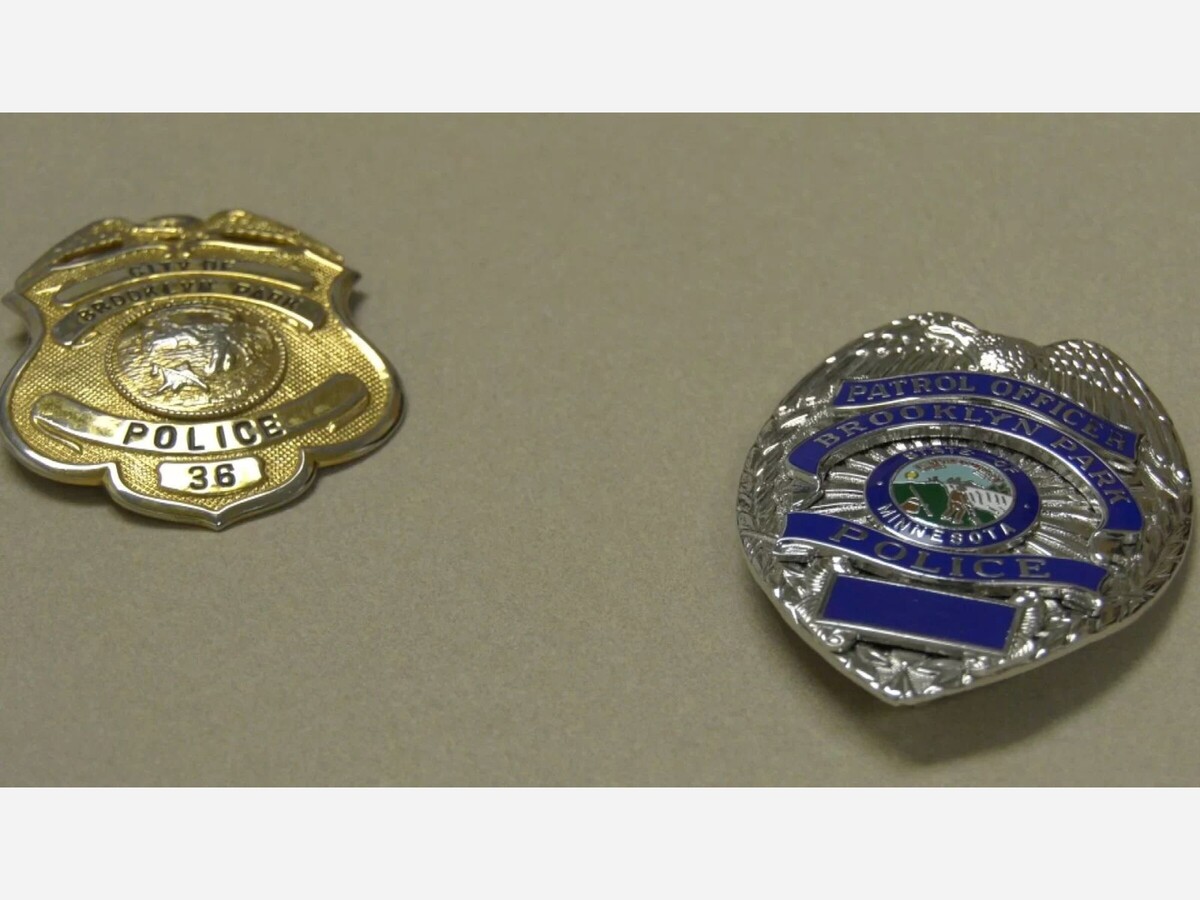



The redesign replaces the former Minnesota state seal that had appeared on department badges for roughly 50 years. That earlier seal, in use from the 1970s until 2024, depicted a settler plowing a field while a Native American rode into the distance. In 2023 and 2024, Minnesota completed a statewide update of its official seal and flag, prompting many agencies to reconsider how state imagery appeared on uniforms and vehicles.
Brooklyn Park chose not simply to swap one state emblem for another. Instead, the department created something distinctly local.
Lt. Seth Wilson, who oversaw the internal committee responsible for the redesign, described the goal succinctly. The badge, he said, is “something that we strive to represent and represent with the utmost integrity.”
The result is a third major chapter in the department’s visual history.
When the police department was formally established in the 1950s, its original badge reflected a young suburban city still forming its civic infrastructure. In the 1970s, the department adopted a new design centered on the Minnesota state seal. That version endured for five decades, a period in which Brooklyn Park transformed from farmland into one of the largest and most diverse suburbs in the state.
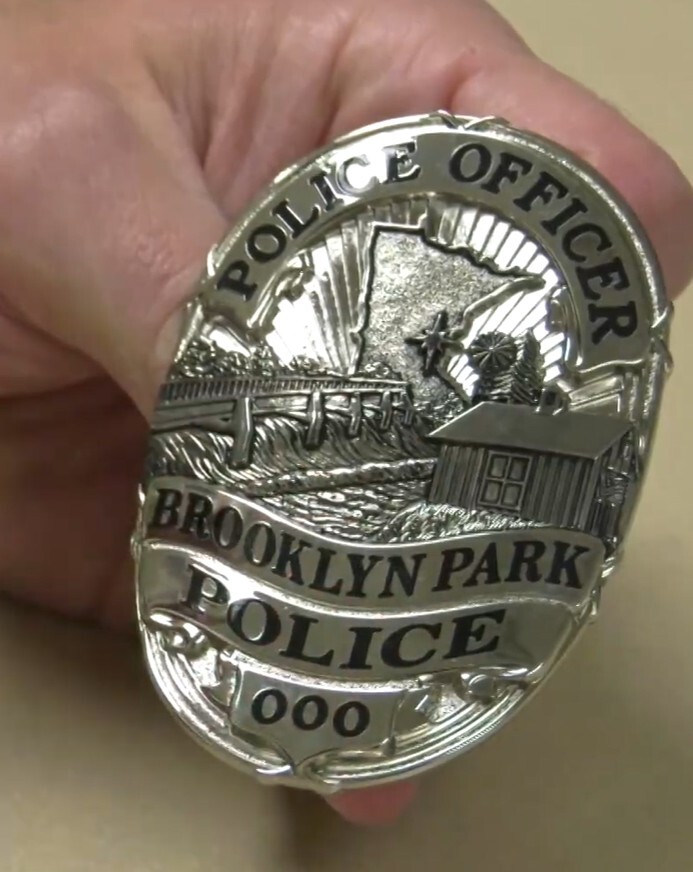
The newest badge, introduced in 2025, shifts from state symbolism to hyper local imagery. It mirrors a broader conversation unfolding across Minnesota about public symbols and what they communicate, but it also tells a story specific to Brooklyn Park.
Where the previous badge pointed outward toward the state, the new one turns inward toward the land, river, and history that shaped the city.
At the top of the badge, farmland stretches outward, recalling Brooklyn Park’s agricultural past. For decades, the city was known for its potato farms and rural character.
Central to that story is the historic red barn at Eidem Farm, a ten acre living history site on 85th Avenue North that preserves late nineteenth and early twentieth century farm life. The barn has become an unofficial landmark, visible from the road and woven into the city’s identity.
By incorporating the barn and farmland into the badge, the department places its modern officers in continuity with that rural foundation. It is a reminder that long before cul de sacs and commercial corridors, there were fields and harvest seasons.
The badge also features the Coon Rapids Dam, visible from the Brooklyn Park side of the Mississippi River. The dam anchors Mississippi Gateway Regional Park, a major recreational corridor along the river.
The Coon Rapids Dam is both infrastructure and overlook, a site where residents walk, fish, and watch the Mississippi push south toward Minneapolis and St. Paul. Including the dam in the badge signals a recognition that public safety extends beyond streets and neighborhoods to the natural spaces that define quality of life.
In Brooklyn Park, the river is not peripheral. It is a geographic spine.
Trees frame the design, honoring Brooklyn Park’s longstanding recognition as a Tree City USA community. The national designation, administered by the Arbor Day Foundation, acknowledges municipalities that maintain forestry programs, tree ordinances, and annual community investment in urban canopy.
Brooklyn Park has maintained this status for more than two decades, underscoring a civic commitment to environmental stewardship. The trees on the badge function as both literal and symbolic markers. They represent growth, continuity, and the quiet labor of maintaining a healthy city.
Despite the move away from the former state seal, the new badge does not abandon statewide identity. At its center sits the outline of Minnesota, topped with the North Star, L’Étoile du Nord.
The placement is deliberate. The city is local, but it is also part of a larger civic framework. Officers enforce city ordinances and state statutes alike. The North Star grounds the design in that dual responsibility.
The introduction of the new badge is part of a broader visual update that often includes shoulder patches and vehicle decals. Such transitions are typically funded through existing uniform and equipment budgets rather than through special appropriations.
In choosing a commemorative style badge centered on local heritage, Brooklyn Park joins other Minnesota departments, including the St. Paul Police Department, that have emphasized city specific imagery in recent years.
The decision reflects a subtle but meaningful shift in law enforcement branding. Instead of relying primarily on statewide iconography, departments are increasingly highlighting the communities they serve.
Badges carry symbolic weight. They signify authority, accountability, and public trust. By embedding farmland, a historic barn, a river dam, trees, and the outline of Minnesota into a single emblem, Brooklyn Park Police have attempted to fuse past and present into one visible statement.
It is a reminder that a police department is not an abstract arm of government. It is an institution situated in a particular landscape, shaped by particular people.
For officers, the new badge is a daily emblem of service. For residents, it is an acknowledgment that their history and geography are not peripheral to public safety. They are central to it.
After fifty years of wearing the old state seal, Brooklyn Park police have quite literally reshaped the symbol over their hearts.



Overcast, with a high of 50 and low of 31 degrees. Sunny during the morning, overcast for the afternoon, partly cloudy for the evening, clear overnight.