57° and Clear
Image
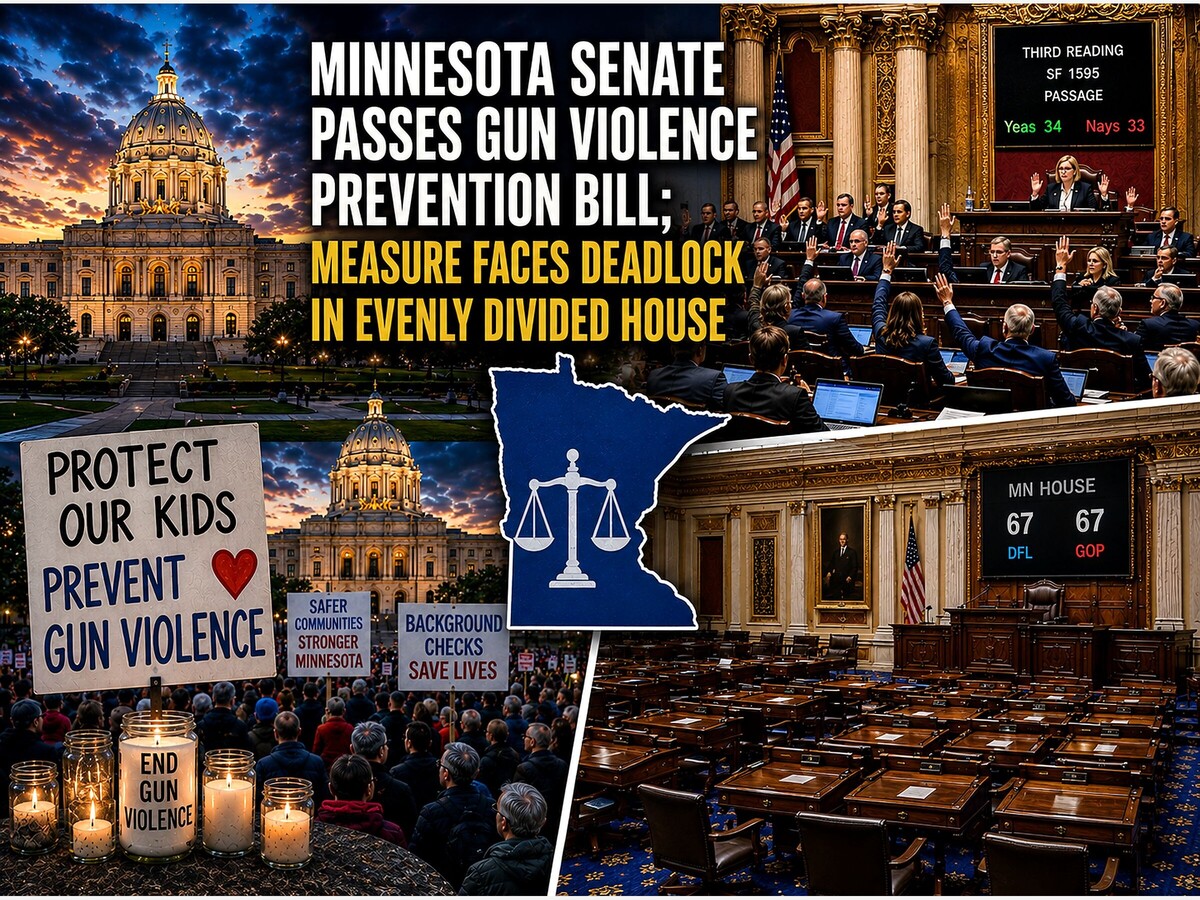



The Minnesota Senate’s passage of SF 4067 on May 4, 2026, marked one of the most consequential legislative actions of the current session. The bill, a comprehensive gun violence prevention omnibus package, passed on a 34 to 33 vote, with all Republican senators opposed and Democratic Farmer Labor members providing the margin needed for approval. Within hours, its path forward became clear. In the Minnesota House of Representatives, where the chamber is evenly divided 67 to 67 under a power-sharing agreement, the bill faces a procedural and political barrier that makes passage in its current form highly unlikely.
SF 4067 combines firearm restrictions with public safety and mental health investments. The legislation would prohibit the future sale of certain semi-automatic rifles commonly classified as military-style weapons, limit ammunition magazines to 17 rounds, and impose new criminal penalties on the manufacture and sale of untraceable firearms without serial numbers. It also reinstates restrictions on binary trigger devices. Alongside these provisions, the bill allocates approximately $20 million for school safety infrastructure and $14.7 million for student mental health services, including funding for anonymous threat reporting systems used by schools and law enforcement.
The Senate vote followed extended floor debate and came amid sustained pressure from advocacy organizations and families affected by gun violence. The legislation gained urgency after the August 2025 shooting at Annunciation Catholic School in Minneapolis, where two children were killed. In committee hearings and public testimony throughout the 2026 session, family members and community advocates called for restrictions on high-capacity firearms and expanded prevention measures, linking the bill’s provisions directly to the circumstances of that attack.
To secure passage, Senate DFL leadership relied on support from members representing politically competitive districts. Senators including Grant Hauschild and Judy Seeberger voted in favor of the bill, providing critical votes in a chamber where a single defection would have altered the outcome. Their support reflected both alignment with the bill’s policy goals and the political risk associated with supporting firearm restrictions in swing regions of the state.
Following Senate passage, the bill moved to a Minnesota House operating under a formal power-sharing agreement between Republicans and Democrats. Under that structure, committees are evenly split, and any motion that results in a tie vote fails to advance. Earlier in the 2026 session, stand-alone firearm proposals similar to provisions in SF 4067 stalled in committee on 10 to 10 votes, effectively halting their progress. The same structural limitation now applies to the omnibus package.
House Republican leadership has publicly stated opposition to the firearm restrictions included in SF 4067. Lisa Demuth and other Republican leaders have indicated that they will not support legislation that includes bans on specific categories of firearms or magazine capacity limits. In practical terms, that position means the bill cannot advance without significant changes. In a 67 to 67 chamber, at least one Republican vote would be required to move the legislation forward, and no such support has been indicated.
Republican members have proposed separating the bill’s funding provisions from its firearm restrictions, arguing that school safety and mental health investments should be advanced independently. Under that approach, funding for physical security upgrades, threat reporting systems, and student mental health services could move forward on a bipartisan basis. Senate DFL leadership has declined to split the bill, maintaining that the policy components are interdependent and that removing firearm provisions would undermine the legislation’s overall purpose.
This disagreement has produced a clear legislative outcome. Despite overlap in stated priorities on school safety and mental health, no portion of the package has advanced in the House. The decision to keep the bill intact has preserved its policy framework but has also limited its immediate viability.
The debate surrounding SF 4067 is grounded in fundamentally different assessments of how to reduce gun violence. Supporters argue that restrictions on high-capacity firearms, combined with preventive investments in schools and mental health systems, represent a comprehensive approach. Opponents argue that the firearm provisions impose restrictions on lawful ownership without clear evidence that they would prevent future incidents, and they advocate for enforcement of existing laws and expanded services without additional firearm regulation.
The Annunciation Catholic School shooting remains central to that debate. Public testimony during the session repeatedly referenced the use of high-capacity weapons in mass casualty incidents, and advocates framed the bill as a direct response to identifiable risk factors. Lawmakers opposing the bill acknowledged the tragedy but questioned whether the proposed restrictions would have changed the outcome, reinforcing a policy divide that has remained consistent throughout the session.
The political context surrounding SF 4067 is also shaping its trajectory. With the 2026 election cycle approaching, legislative votes on the bill are expected to factor prominently into campaign messaging. Senate Democrats have framed the bill’s passage as evidence of action on public safety, while House Republicans have framed their opposition as a defense of constitutional rights and legislative balance. The House deadlock ensures that both positions will remain part of the public debate through the end of the session and into the election cycle.
The evenly divided House has emerged as a defining factor in this outcome. The 67 to 67 split reflects a closely divided electorate and has required shared governance between the two parties. While the arrangement ensures that neither party can act unilaterally, it also creates conditions in which legislation cannot advance without cross-party agreement. In cases where policy differences are substantial, as they are with firearm regulation, that structure results in inaction.
For constituents, the effect is measurable. Provisions with broad conceptual support, including school safety funding and mental health investments, remain tied to a broader package that lacks the votes to pass. The legislative process has not produced a compromise outcome, nor has it advanced partial measures. Instead, the structure of the House has required an all-or-nothing result, and in this case, the outcome is neither.
As the 2026 legislative session approaches its conclusion, the prospects for SF 4067 remain limited. No negotiated amendments have been introduced that would alter its core provisions in a way that could secure bipartisan support. Without such changes, the bill is expected to remain stalled in the House.
The significance of SF 4067 extends beyond its immediate legislative fate. The bill has clarified where lawmakers stand on firearm regulation, school safety funding, and the role of government in addressing gun violence. It has also demonstrated the operational limits of a tied legislative chamber, where agreement on some issues does not translate into enacted policy when broader disagreements remain unresolved.
This moment defines more than a single bill. It establishes a record. The Senate has taken a position on a comprehensive approach to gun violence prevention. The House, by structure and by stated opposition, has not advanced that approach. The result is a legislative outcome shaped as much by institutional design as by policy disagreement.
For Minnesota, the question is no longer limited to whether SF 4067 becomes law in 2026. The more immediate reality is that the current legislative framework has produced a standstill on one of the most visible public safety issues before the state. Whether that changes will depend on future elections, shifts in legislative composition, or a willingness to separate policy priorities that are currently bound together.
As it stands, SF 4067 remains a fully defined proposal without a legislative path forward. Its passage in the Senate and its halt in the House together provide a complete account of how divided government functions in practice.
MinneapoliMedia | Community. Culture. Civic Life.


Overcast, with a high of 92 and low of 63 degrees. Partly Cloudy in the morning, patchy rain nearby for the afternoon, overcast during the evening,