60° and Overcast
Image
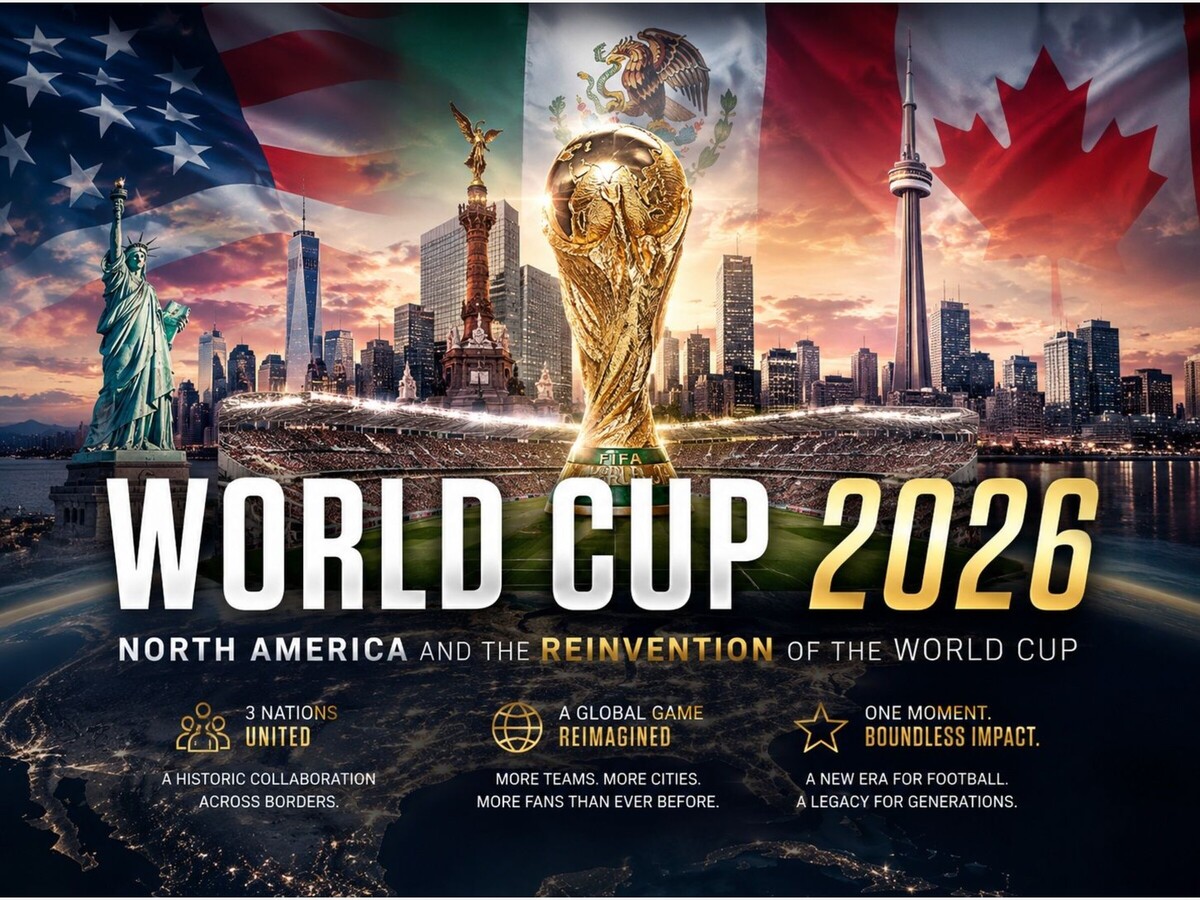



The 2026 tournament represents something far more consequential. It represents an attempt to reinvent what the modern World Cup is supposed to be.
For the first time in history, the tournament will be jointly hosted by three nations: the United States, Mexico, and Canada. For the first time, the field will expand to 48 teams. For the first time, the World Cup will operate across a continental logistical footprint stretching thousands of miles, multiple time zones, multiple immigration systems, and radically different football cultures. And for the first time, football’s governing institutions are attempting to fully merge the emotional traditions of the world’s most global sport with the commercial architecture of North American mega-sports entertainment.
That tension may ultimately define the entire tournament. Because World Cup 2026 is not merely a football event. It is a complex geopolitical exercise, a historic transportation challenge, a massive commercial gamble, and a profound cultural experiment. Perhaps most importantly, it is a test of whether football can fully globalize itself without losing the emotional identity that made it powerful in the first place.
The numerical scale alone is unprecedented. The 2026 FIFA World Cup will feature 48 national teams playing 104 matches across 16 host cities in three host nations. This expansion creates unparalleled travel demands and establishes the largest commercial footprint in tournament history.
Past World Cups generally operated within relatively compact national geographies. Even large countries such as Brazil or Russia functioned under a single governmental framework. The 2026 edition will instead operate across an entire continent. The distance between the outermost host cities, Vancouver and Miami, stretches roughly 3,000 miles, which is wider than the Atlantic Ocean width between West Africa and Brazil.
To manage the immense geography, FIFA has organized the 16 host venues into three distinct regional systems:
|
West Coast |
Central / Plains |
East Coast / North |
|
Los Angeles |
Dallas |
New York / New Jersey |
|
San Francisco Bay Area |
Houston |
Philadelphia |
|
Seattle |
Kansas City |
Boston |
|
Vancouver |
Atlanta |
Miami |
|
Guadalajara |
Monterrey |
Toronto / Mexico City |
This regional architecture changes nearly everything about the tournament's operational execution. Travel becomes more complex, border coordination becomes central, climate variation becomes extreme, broadcast scheduling becomes increasingly difficult, and security planning becomes exponentially more complicated. The World Cup is no longer arriving in a single country. It is arriving in a continental system.
No country will shape the meaning of the 2026 World Cup more than the United States. For decades, global football viewed America as both an irresistible opportunity and an unresolved frustration. The country possesses immense commercial power, advanced sports infrastructure, enormous media reach, billionaire ownership ecosystems, and world-class stadiums. Yet football historically struggled to fully penetrate the emotional core of American sports culture, where American football dominated culturally, basketball shaped urban sporting identity, and baseball carried historical mythology.
That perception has shifted significantly over the last decade. Major League Soccer expanded aggressively, youth participation increased, and European football audiences exploded through streaming access. Concurrently, Latin American, African, Asian, and European immigrant communities deepened football culture inside major American cities.
The tipping point arrived with Lionel Messi’s signing with Inter Miami CF. The commercial and cultural impact was immediate, altering visibility, media attention, ticket demand, sponsorship intensity, and the broader public conversation surrounding football in the United States. Messi’s presence accelerated a larger transformation already underway. Football stopped feeling foreign to many脉 Americans; it began feeling inevitable.
This shift matters enormously because FIFA has long viewed the United States as football’s largest unfinished market. The 2026 World Cup is designed, in part, to complete that integration into the country’s emotional sports hierarchy.
The American role in 2026 also reflects FIFA’s increasing alignment with mega-event commercial infrastructure. Most U.S. venues selected for the World Cup are massive NFL stadiums that offer huge seating capacities, premium hospitality infrastructure, advanced broadcast technology, corporate sponsorship integration, and luxury revenue systems.
From a business perspective, the logic is obvious. From a football perspective, sports economists and purists note that the debate is more complicated. Critics point out that many American stadiums lack traditional football intimacy, supporter culture architecture, and urban walkability.
Furthermore, NFL venues were designed primarily for television spectacle and commercial optimization rather than organic football culture, creating severe structural friction. For example, a standard NFL field is only 53.3 yards wide, whereas FIFA recommends an international tournament pitch be 74 yards wide. To meet these international requirements, venues like SoFi Stadium in Los Angeles and MetLife Stadium in New Jersey have had to undergo major engineering overhauls, including the physical removal of hundreds of corner seats and concrete barriers just to widen the playing surface. Additionally, these stadiums must temporarily replace their synthetic turf surfaces with multi-million dollar natural grass layouts equipped with specialized vacuum ventilation and subterranean grow lights.
The Central Philosophical Tension: Can football maintain emotional authenticity inside increasingly commercialized mega-spectacle environments? The answer may define not only 2026, but the future direction of the sport itself.
If the United States represents football’s commercial frontier, Mexico represents its emotional heart within North America. Football in Mexico is foundational, woven deeply into national identity, working-class culture, family tradition, political symbolism, and collective memory.
No stadium better symbolizes this emotional relationship than Estadio Azteca. Azteca is one of the sport’s great historical cathedrals. Pelé lifted the World Cup there in 1970, and Diego Maradona produced some of football’s most iconic moments on its pitch in 1986. By hosting matches again in 2026, Estadio Azteca becomes the first stadium in global sports history to host games in three separate World Cups, extending a football lineage stretching across generations.
But Mexico’s role also carries immense pressure. Few national teams operate under heavier emotional expectation than the Mexico national football team, commonly known as El Tri. World Cups repeatedly expose the tension between Mexico’s football passion and its tournament frustrations. The country consistently qualifies and consistently produces elite atmospheres, yet modern World Cups have repeatedly ended in round-of-16 disappointments. This pattern has created a psychologically exhausting cycle of high expectation, hope, intense pressure, sudden elimination, and national frustration. Hosting in 2026 intensifies that pressure further because Mexico will carry the emotional responsibility for preserving football authenticity within a tournament increasingly shaped by commercial expansion.
Among the three host nations, Canada occupies perhaps the most intriguing position. Canada does not possess Mexico’s deep football tradition, nor does it possess America’s commercial dominance. Instead, Canada enters 2026 as a bridge nation whose football rise reflects the changing demographics of modern North America itself.
Immigration has transformed Canadian football culture. Growing communities from Africa, the Caribbean, South Asia, the Middle East, Europe, and Latin America helped reshape the country’s relationship with the sport, making football one of Canada’s most multicultural athletic spaces.
That transformation accelerated dramatically during the national team’s recent rise. Canada’s qualification for the 2022 World Cup after a 36 year absence altered the national perception of the sport. Suddenly, football no longer felt peripheral; it felt possible. Soccer has now become the largest participatory sport in Canada for youth under the age of 14, outstripping ice hockey in total registration numbers. Countries become football nations not only through infrastructure, but through emotional adoption, and Canada is now entering that transition.
The geographic scale of the 2026 tournament introduces logistical complexity unlike anything in sports history. Teams will routinely travel thousands of miles between matches, while supporters must navigate multiple immigration systems, varying visa requirements, long-haul continental flights, different currencies, three languages, and entirely different public transportation systems.
Climate variation alone presents enormous complications. Within a single tournament cycle, teams could experience humid Miami heat, high altitude in Mexico City, Pacific Northwest rain, extreme Texas summer temperatures, and northeastern humidity.
Player recovery management becomes critically important under these conditions. National team sports science departments are already preparing for travel fatigue, rapid climate adaptation, hydration management, and scheduling optimization. The tournament effectively becomes a continental endurance exercise.
Security planning for 2026 represents one of the most complicated coordination exercises in modern sporting history. The tournament requires seamless collaboration across American federal agencies, Canadian federal authorities, Mexican security institutions, local police departments, border agencies, transportation authorities, and international intelligence coordination systems.
Each country operates under different legal structures, policing traditions, immigration procedures, and crowd-control frameworks. Managing security across that fragmented environment requires extraordinary synchronization.
Modern global sporting events also operate under heightened geopolitical tension. Concerns surrounding international terrorism, cyberattacks, crowd violence, political protest, and border disruption have become central components of tournament planning. The World Cup therefore functions not only as a sporting competition, but as a large-scale international security operation.
Perhaps no issue shapes modern football more deeply than commercialization. The World Cup has evolved from a pure football tournament into one of the largest entertainment properties on Earth. Broadcast rights generate billions of dollars, corporate sponsorship dominates visual presentation, ticket pricing increasingly favors premium revenue models, and luxury hospitality systems expand aggressively.
The 2026 tournament represents the fullest expression of this transformation. FIFA approved record financial figures for the 2023 to 2026 World Cup cycle, projecting total revenues to reach an unprecedented 11 billion dollars. This represents a 56% increase compared to the 2022 World Cup in Qatar, which generated 7 billion dollars. The primary driver of this financial surge is matchday revenue; ticket sales and hospitality packages are projected to jump from 950 million dollars in Qatar to as much as 3 billion dollars in 2026 due to the adoption of dynamic pricing models in North American stadiums.
North America possesses unparalleled experience monetizing sports spectacle. The United States especially operates within a sports economy built around sponsorship integration, premium seating, media packaging, entertainment branding, and event commercialization. FIFA sees enormous opportunity inside that environment, but critics see danger. The concern is cultural rather than financial. Can football remain emotionally communal while becoming increasingly corporate? Can supporter culture survive escalating pricing structures? Can authenticity coexist with hyper-commercialization? These are not abstract concerns; they define modern football’s central tension.
One of the most important underlying questions surrounding World Cup 2026 concerns football’s relationship with American sports culture. The United States excels at transforming sports into entertainment ecosystems where presentation becomes theatrical, broadcasts become narrative-driven, commercial integration expands aggressively, and data analysis intensifies.
Football historically evolved differently. The sport’s emotional power traditionally emerged from supporter identity, club culture, local belonging, working-class tradition, and a communal atmosphere. The fear among organized supporter groups is that football may gradually lose parts of that identity as commercialization expands.
Others argue globalization is inevitable and necessary. The 2026 World Cup sits directly at the center of this debate because the tournament will likely accelerate streaming integration, digital engagement, sponsorship saturation, celebrity culture, and entertainment crossover to unprecedented levels. Whether football emerges strengthened or diluted by that transformation remains one of the defining questions of the modern era.
Another increasingly unavoidable issue surrounding major tournaments is climate. The sheer geographic size of the 2026 World Cup creates an enormous environmental impact, particularly regarding air travel emissions between host cities. Extreme summer temperatures in several host regions also create player safety concerns. Climate scientists, sports medicine experts, and scheduling officials increasingly recognize that future tournaments must confront heat management, hydration risk, travel emissions, and environmental sustainability. The 2026 tournament will become a major case study in how global sporting events adapt to climate realities moving forward.
Ultimately, the 2026 FIFA World Cup represents something larger than sport. It reflects globalization, migration, commerce, media evolution, border politics, urban infrastructure, and cultural exchange. Football merely provides the organizing framework; the tournament itself functions as a mirror of the modern world.
That is why 2026 feels historically significant before a ball has even been kicked. The World Cup is no longer simply arriving in North America; it is testing whether the modern global game can sustain itself emotionally, commercially, politically, and culturally at an unprecedented scale.
The 2026 FIFA World Cup may ultimately be remembered as the tournament where football crossed into a new era permanently. This shift will not be defined by who wins, by tactical innovations, or by individual stars, but because the tournament itself is evolving into something fundamentally larger than it once was.
The World Cup now operates simultaneously as a sporting event, a global media property, a geopolitical exercise, a transportation network, a commercial ecosystem, and a cultural spectacle. North America provides the perfect environment for that transformation because the continent already understands how to stage events at an extraordinary scale. The final question is whether football can survive that expansion without losing the emotional intimacy that made the sport globally beloved in the first place. That tension will define World Cup 2026, and perhaps it will define football’s future beyond it.
MinneapoliMedia | Community. Culture. Civic Life.



Sunny, with a high of 66 and low of 51 degrees. Overcast in the morning, light rain in the afternoon, patchy rain nearby during the evening, clear overnight.