66° and Partly cloudy
Image




On Monday, May 25, 2020, Americans woke up observing Memorial Day, the nation’s solemn annual remembrance of military personnel who died in service to the country.
Flags flew at half-staff across the United States that morning. Cemeteries prepared for visitors carrying flowers and miniature American flags. Veterans organizations organized ceremonies honoring the dead. Families gathered quietly after months of fear, uncertainty, and isolation during the first devastating spring of the COVID-19 pandemic. Across the country, Americans attempted to balance the original meaning of Memorial Day with the cultural rhythms the holiday weekend had gradually absorbed over generations.
Yet by the end of that same Monday, another death would permanently alter how millions of Americans remembered May 25.
That evening in Minneapolis, George Floyd died beneath the knee of former Minneapolis Police Department officer Derek Chauvin outside the Cup Foods store at the intersection of East 38th Street and Chicago Avenue.
The killing unfolded in public view.
Bystanders pleaded with officers to stop. A teenage witness recorded the encounter on her phone. Floyd repeatedly stated that he could not breathe. The footage traveled across social media and international news platforms within hours, igniting one of the largest protest movements in modern American history and transforming Minneapolis into the center of a global conversation about policing, race, accountability, citizenship, protest, and public trust.
Six years later, Memorial Day 2026 arrives carrying two overlapping realities in Minnesota and across the United States.
The day remains dedicated to honoring military personnel who died defending the nation. That purpose has not changed. But for millions of Americans, particularly in Minneapolis and communities shaped by the aftermath of 2020, May 25 now also carries the memory of George Floyd’s death and the unresolved national reckoning that followed it.
That convergence has become historically unavoidable.
Memorial Day was never intended to be merely a long weekend or the unofficial beginning of summer.
The observance emerged from the devastation of the American Civil War, a conflict that killed an estimated 620,000 to 750,000 Americans and left entire communities fractured by grief. In the years following the war, families and towns across the country began decorating the graves of dead soldiers with flowers and flags in acts of public mourning that became known as “Decoration Day.”
The origins of the observance were deeply personal. The war had produced death on a scale previously unimaginable in the United States. Entire generations of young men disappeared into battlefields stretching from Gettysburg to Antietam to Shiloh. Communities that once sent large groups of sons and fathers to war received wagons of bodies, handwritten casualty notices, and folded flags in return.
In 1868, General John A. Logan formally called for a nationwide day of remembrance honoring Union soldiers who died during the Civil War. Over time, especially following World War I, the observance expanded to include Americans killed in all military conflicts.
Memorial Day became an official federal holiday in 1971.
Its purpose, however, remained specific: remembrance of the dead.
Not generalized patriotism. Not abstract nationalism. Not commercial celebration.
The holiday exists because families lost sons and daughters, husbands and wives, mothers and fathers to war and military service. Cemeteries such as Arlington National Cemetery stand as reminders that national policy decisions eventually arrive at human consequences measured in graves, folded flags, and grieving families.
Throughout American history, Memorial Day has functioned as a collective acknowledgment that national sacrifice carries human cost. Rows of military headstones represent not abstract ideals but individual lives interrupted. Behind every marker sits a family story, a hometown memory, an unfinished future.
That historical foundation matters in 2026 because Memorial Day now intersects with another modern American discussion centered around loss, public mourning, citizenship, and the value of human life.
To understand the scale of the reaction following George Floyd’s death, it is necessary to remember the broader national atmosphere in which it occurred.
The United States in May 2020 was already strained emotionally, economically, and politically.
The COVID-19 pandemic had shut down large sections of American public life. Schools closed. Businesses shuttered. Hospitals filled with patients. Refrigerated trucks appeared outside overwhelmed medical facilities in some cities. Millions of Americans lost jobs within weeks. Fear and uncertainty dominated daily life.
At the same time, the country remained deeply polarized politically following years of escalating national division surrounding race, immigration, policing, economic inequality, media trust, and partisan conflict.
Many Americans were already emotionally exhausted before May 25 arrived.
Against that backdrop, the bystander video showing Floyd’s death landed with extraordinary force.
The footage circulated during a moment when millions of Americans were confined to their homes, heavily online, emotionally raw, and intensely focused on public institutions. The country was already carrying grief, fear, anxiety, and frustration. Floyd’s death entered directly into that environment.
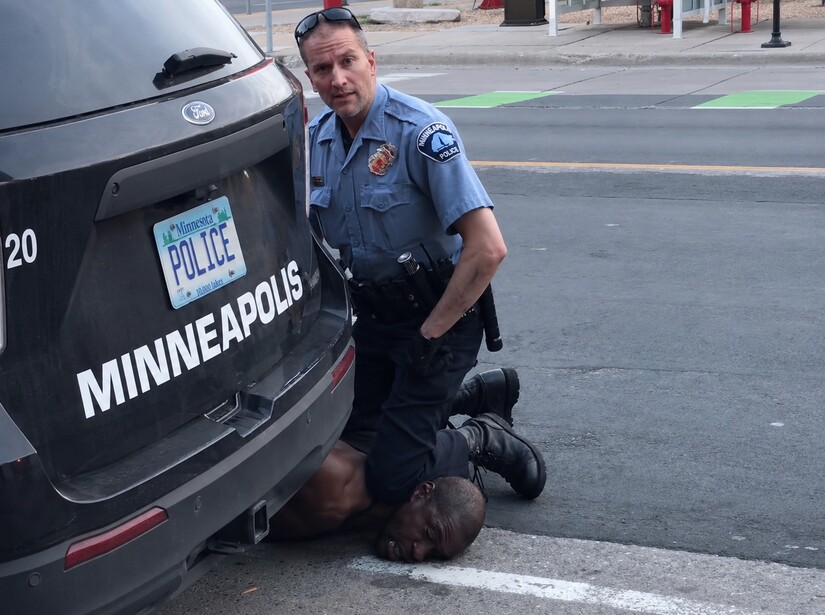
On the evening of May 25, 2020, Minneapolis police officers responded to a call alleging that Floyd had attempted to use a counterfeit $20 bill at Cup Foods.
The encounter escalated quickly.
Video evidence later presented during trial proceedings showed Floyd handcuffed and pinned to the street while Chauvin pressed his knee against Floyd’s neck and upper back area for approximately nine minutes and 29 seconds. Two other officers restrained Floyd’s body while another controlled nearby bystanders.
Witnesses begged officers to check Floyd’s pulse. Some identified themselves as medical professionals. Others shouted that Floyd was no longer moving.
The footage proved difficult to watch not simply because of the physical restraint itself, but because of the duration captured in real time.
Americans were not watching a rapidly unfolding split-second confrontation. They were watching persistence. They were watching repeated pleas ignored publicly. They were watching a visibly distressed man restrained long after he stopped responding.
That distinction mattered.
The video removed much of the ambiguity that often surrounds public debates regarding police use of force. Millions of viewers concluded almost immediately that what they witnessed was unjustifiable.
Within days, Minneapolis became the focal point of national protests, media coverage, political debate, and civil unrest unlike anything the city had experienced in generations.
For several weeks in 2020, Minneapolis ceased to be merely a regional Midwestern city.
It became symbolic terrain.
Journalists from around the world arrived in Minnesota. International media organizations broadcast live from south Minneapolis intersections, damaged commercial corridors, protest sites, memorial spaces, and city council meetings. The area surrounding 38th Street and Chicago Avenue transformed into a global site of mourning, protest, pilgrimage, and political symbolism.
The unrest that followed Floyd’s death produced both peaceful demonstrations and destructive violence.
Businesses burned. Residents lost stores, pharmacies, workplaces, and neighborhood anchors. Entire commercial corridors suffered extensive damage. Insurance losses reached hundreds of millions of dollars across the Twin Cities region. Communities already carrying economic vulnerability absorbed additional trauma during the pandemic.
The destruction left lasting scars across parts of Minneapolis and neighboring communities.
Small business owners who had spent decades building neighborhood establishments watched properties burn in a matter of hours. Some never reopened. Residents who depended on nearby pharmacies, grocery stores, and transit corridors suddenly found themselves living inside damaged commercial zones with reduced access to essential services.
Many immigrant-owned businesses were heavily impacted. So were locally rooted family businesses operating on thin margins after months of pandemic shutdowns.
At the same time, millions of Americans viewed the protests as morally necessary responses to longstanding grievances regarding policing disparities and unequal treatment within the criminal justice system.
Those realities existed simultaneously.
Any historically honest assessment of 2020 requires acknowledging both the legitimacy of widespread public outrage over Floyd’s death and the profound pain experienced by residents and business owners whose communities absorbed destruction during the unrest.
Too often, public discourse reduced Minneapolis into simplistic narratives. Depending on political perspective, the city was portrayed either exclusively as a symbol of righteous protest or exclusively as a symbol of urban collapse.
Neither version captured the full truth.
The actual story was more human and more complicated.
Residents mourned George Floyd while also fearing for neighborhood safety. Small business owners supported calls for justice while watching livelihoods disappear. Community leaders attempted to prevent violence while simultaneously demanding accountability from government institutions. Families navigated overlapping pressures involving public health fears, economic instability, civil unrest, and emotional exhaustion.
The city carried all of it at once.
What followed Floyd’s death extended far beyond Minnesota. The borderless nature of digital technology allowed a single cellphone recording from a Minneapolis street corner to bypass traditional media gatekeepers, presenting international audiences with an unedited, undeniable depiction of state power. This raw visual clarity instantly catalyzed dormant domestic grievances worldwide.
Demonstrations occurred across all 50 states and in dozens of countries under the banner of Black Lives Matter, surprising even longtime organizers and activists with their scale.
In the United Kingdom, protesters toppled the statue of slave trader Edward Colston in Bristol, intensifying national debates surrounding imperial history and public monuments.
In France, demonstrations renewed scrutiny surrounding the death of Adama Traoré and broader allegations involving racial profiling and police violence.
In Australia, rallies highlighted Aboriginal deaths in custody and the treatment of Indigenous populations.
In Brazil, protesters connected Floyd’s death to longstanding concerns regarding police violence in Black and low-income communities.
Across Africa, Europe, South America, and parts of Asia, demonstrators linked the events in Minneapolis to their own experiences involving inequality, discrimination, and state authority. The speed of transmission permanently altered the scale of public mobilization, proving that local trauma could instantly become international flashpoints.
In the months following Floyd’s murder, corporations, universities, sports organizations, media institutions, and governments issued public statements pledging commitments to diversity, equity, inclusion, reform, or racial justice initiatives.
Book sales concerning race surged. Public officials announced task forces. Murals appeared on streets and buildings across the country. Institutions reviewed building names and historical monuments. Diversity officer positions expanded throughout corporate America.
Some reforms proved tangible. Several police departments revised use-of-force policies. Certain jurisdictions restricted chokeholds or no-knock warrants. Body camera requirements expanded, and conversations surrounding qualified immunity entered mainstream political debate with new urgency. In Minnesota, Floyd’s death directly contributed to legislative negotiations that produced portions of the Minnesota Police Accountability Act, including changes regarding training standards and disciplinary transparency.
Yet six years later, the contrast between the rapid-fire declarations of 2020 and the enduring realities of 2026 exposes a deep ideological divide regarding how much meaningful structural transformation actually occurred.
Some activists argue that institutions adopted the language of reform without fundamentally changing power structures, economic disparities, or policing systems. Others believe the national conversation unfairly demonized law enforcement broadly while overlooking violent crime increases and the complexity of public safety responsibilities.
Furthermore, the intervening years exposed the difficulty of sustaining national attention. As political pressures shifted and economic conditions tightened, many organizations quietly reduced the staffing, funding, and visibility originally allocated to diversity initiatives. To critics, this retreat confirmed that portions of the institutional response were performative from the beginning. To defenders, it represented a necessary correction after institutions moved too quickly into politically charged territory without long-term policy direction. This retreat triggered a profound secondary cultural and political backlash that continues to fracture public education, corporate activism, and civic speech today.
One of the most important realities to remember in 2026 is that George Floyd’s death was not experienced primarily as political symbolism by those closest to it.
It was experienced as personal loss.
His family lost a son, brother, father, and relative. Witnesses carried psychological trauma from what they saw. Residents absorbed the emotional strain of living at the center of global unrest. Business owners lost decades of work. Police officers faced intense scrutiny and danger. Protesters suffered injuries and arrests. Journalists encountered threats while documenting events.
The scale of the public conversation sometimes obscured the deeply individual human consequences underneath it.
That remains true today.
For many Minnesotans, May 25 is no longer simply an abstract anniversary discussed through political frameworks. It is a date connected to memory, grief, tension, exhaustion, fear, anger, reflection, and unresolved civic questions.
The emotional impact also extended to younger generations. Children in Minneapolis and across the country watched adults argue intensely over policing, race, protest, safety, and justice. Students returned to classrooms carrying emotional strain from the pandemic alongside the social tensions that followed Floyd’s death.
Educators, clergy members, mental health professionals, and community organizers spent years navigating conversations that became emotionally charged almost immediately. For many families, the events of 2020 permanently altered how they discussed public institutions, law enforcement, race relations, and civic trust inside their homes.
The intersection where Floyd died became one of the most recognizable protest memorial sites in modern American history. Murals, artwork, flowers, signs, and public tributes transformed the area into an evolving public memorial space commonly referred to as George Floyd Square.
The location undeniably holds profound historical significance, drawing visitors from around the world who wish to witness the cradle of a global movement. Yet, because it sits within a living neighborhood, it remains a continuing source of friction regarding governance, policing, business access, public safety, and urban recovery.
Supporters view the square as an essential site of historical memory and community autonomy. Critics and city leaders argue that prolonged municipal instability around the cordoned area hinders neighborhood recovery and complicates emergency public safety operations. This ongoing coexistence of sacred memorial space and ordinary, daily neighborhood functionality continues creating difficult, unresolved practical questions for all stakeholders six years later.
In April 2021, Derek Chauvin was convicted of second-degree unintentional murder, third-degree murder, and second-degree manslaughter in Floyd’s death.
The verdict represented a rare instance in modern American history in which a police officer was convicted for the on-duty killing of a civilian after a nationally publicized incident.
For many Americans, particularly those who had long expressed skepticism about accountability within policing systems, the conviction represented an important moment of legal recognition.
Yet even that historic conviction did not resolve broader national disagreements regarding policing, race, criminal justice policy, or public trust in institutions. If anything, the years following 2020 demonstrated how fragmented public consensus had become.
The trial itself became a major national event. Millions watched testimony involving medical experts, police supervisors, use-of-force specialists, and eyewitnesses. The proceedings forced Americans to confront difficult questions regarding training, restraint practices, institutional culture, and the legal standards governing police conduct.
The conviction carried symbolic significance because many Americans viewed it as historically unusual. Critics of policing systems had long argued that officers rarely faced criminal accountability after controversial on-duty deaths. Others warned against reducing complex policing realities into simplified national narratives shaped primarily through viral footage and public outrage.
Those disagreements remain active in American public life today.
This year, Americans again gather for Memorial Day ceremonies, cemetery visits, family cookouts, military tributes, and community events.
In Minnesota, the day also arrives with another layer of remembrance.
Six years later, George Floyd’s death continues shaping the civic identity of Minneapolis and influencing national discussions surrounding race, policing, protest movements, criminal justice reform, institutional trust, and political polarization.
Some Americans remain deeply engaged with the issues raised in 2020. Others believe the country has grown fatigued by constant social conflict and ideological division. Some continue demanding sweeping reform. Others prioritize restoring institutional confidence and public order.
But regardless of political viewpoint, one fact remains historically undeniable: May 25, 2020 changed the trajectory of Minneapolis and altered the national conversation in ways that continue reverberating today.
The date now occupies two places in American memory simultaneously. One remembrance reaches back through generations of military sacrifice, battlefield loss, and national mourning tied to Memorial Day itself. The other reaches into a modern American reckoning born on a Minneapolis street corner captured on a cellphone video watched around the world.
That overlap has become part of the historical identity of the day. For younger Americans especially, Memorial Day 2020 may eventually be remembered not only as a federal holiday but also as the day that ignited one of the defining protest movements of the early 21st century.
The challenge for the country moving forward is not merely remembering George Floyd’s death symbolically. It is deciding what honest remembrance requires.
Responsible remembrance requires factual clarity rather than mythmaking.
It requires acknowledging legitimate public grievances regarding unequal treatment and police misconduct while also recognizing the real complexity of maintaining public safety in communities facing violence and instability.
It requires rejecting simplistic political narratives that flatten human beings into ideological props.
It requires remembering that communities cannot heal through denial, selective memory, or performative outrage alone.
And it requires understanding that public trust, once broken, is extraordinarily difficult to restore.
Memorial Day has always been rooted in the recognition that loss changes nations. That truth extends beyond battlefields.
The events of May 25, 2020 forced Americans to confront difficult questions about justice, authority, citizenship, accountability, and human dignity. Those questions did not disappear after the protests ended, after election cycles changed, or after media attention shifted elsewhere.
They remain embedded within the civic life of Minneapolis, Minnesota, and the United States itself. Six years later, the country continues living inside the consequences. And every Memorial Day now carries that memory with it.
For Minneapolis in particular, the date remains deeply personal. The city continues rebuilding physically, emotionally, economically, and civically from the aftershocks of 2020. Residents continue debating how public safety should function, how trust should be restored, and how historical memory should be preserved without allowing communities to become permanently trapped inside trauma.
Those are not abstract policy discussions. They shape neighborhoods, schools, businesses, elections, policing strategies, investment decisions, and the daily emotional atmosphere of communities still carrying the weight of what happened.
The lasting impact of George Floyd’s death cannot be measured solely through legislation, protest attendance, corporate statements, or election outcomes.
Its impact lives in altered public trust. It lives in changed conversations between parents and children. It lives in communities still rebuilding. It lives in institutions still struggling to regain confidence. And it lives in a Memorial Day that, for millions of Americans, no longer carries only the memory of military sacrifice, but also the memory of a man who died on a Minneapolis street while the world watched.
That reality is now part of American history. And six years later, the nation is still deciding what to do with it.
MinneapoliMedia | Community. Culture. Civic Life.


Sunny, with a high of 87 and low of 64 degrees. Sunny during the morning, patchy rain nearby overnight.