66° and Partly cloudy
Image
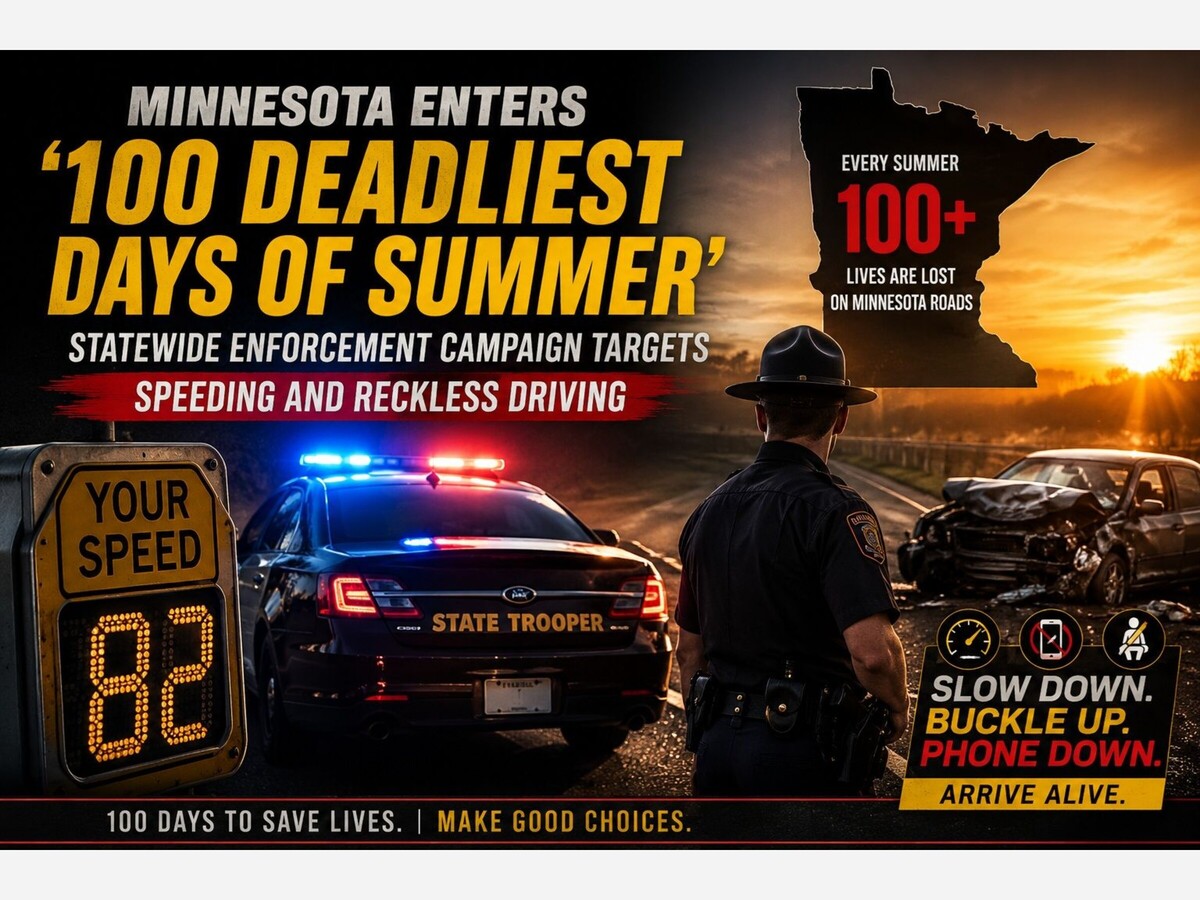



The stretch between Memorial Day and Labor Day, commonly referred to by traffic safety agencies as the “100 Deadliest Days of Summer,” has long been associated with a seasonal rise in fatal crashes, serious injuries, and high-risk driving behavior. With schools out, vacation travel increasing, road construction expanding, and dry pavement replacing winter hazards, traffic volumes surge statewide while many drivers begin traveling faster and taking greater risks behind the wheel.
For Minnesota safety officials, the concern is not theoretical. It is grounded in years of crash investigations, fatality data, and increasingly alarming patterns tied to speeding and aggressive driving.
In response, the Minnesota Department of Public Safety, the Minnesota Office of Traffic Safety, the Minnesota State Patrol, and law enforcement agencies across the state are expanding summer patrol operations targeting what traffic coordinators refer to as the “Big Four” contributors to roadway deaths: speeding, impaired driving, distracted driving, and seatbelt non-use.
According to Shannon Grabow of the Minnesota Office of Traffic Safety, the arrival of summer often changes driver psychology in ways that create dangerous conditions on the road.
Once snow and ice disappear, many motorists unconsciously lower their guard. Dry pavement and clear weather create a false sense of control and safety that frequently translates into higher speeds, shorter following distances, more distracted driving behavior, and reduced caution overall.
Traffic safety researchers have repeatedly found that even modest increases in vehicle speed dramatically raise both crash severity and fatality risk. Higher speeds reduce reaction time, increase stopping distance, and magnify the force transferred during impact collisions. Public safety officials stress that speed is not merely a traffic violation. It is often the determining factor separating a survivable crash from a fatal one.
Minnesota’s crash statistics continue to reinforce that reality.
State law enforcement agencies issued more than 166,000 speeding citations statewide last year alone. Preliminary data from the Department of Public Safety also shows that speed-related crashes contributed to 102 deaths and 388 serious injury crashes across Minnesota during the past year.
Internal traffic safety analyses indicate that roughly 65 percent of Minnesota’s speed-related fatalities involved drivers traveling at least 10 miles per hour above the posted speed limit.
The numbers become even more concerning during the summer travel period itself.
Last year, Minnesota recorded 111 traffic fatalities during the Memorial Day-to-Labor Day stretch. A closer breakdown of those deaths revealed that speeding contributed to 31 fatalities, while impaired driving was connected to 37 deaths. Sixteen people killed during the summer period were not wearing seatbelts, and distracted driving was identified as a factor in multiple fatal crashes investigated by state authorities.
For investigators who routinely respond to fatal crashes, many of the incidents are viewed not as unavoidable accidents, but as preventable outcomes tied directly to driver decisions.
Minnesota State Patrol officials say the overwhelming majority of deadly summer crashes involve behaviors that are entirely avoidable: excessive speed, alcohol or drug impairment, distracted driving, reckless passing, fatigue, or failure to use seatbelts consistently.
At the same time, state officials say there are signs of measurable progress.
Preliminary Department of Public Safety figures indicate that Minnesota experienced a substantial decline in overall traffic deaths during 2025 compared with the previous year. Early estimates place statewide fatalities between approximately 363 and 370 deaths, down significantly from the 475 roadway deaths recorded in 2024.
If finalized, the decline would represent Minnesota’s lowest annual traffic fatality total since 2019 and position the state among the nation’s strongest year-over-year improvements in roadway safety.
Still, safety coordinators warn against interpreting the reduction as evidence that the danger has disappeared.
Transportation experts note that Minnesota, like much of the country, continues to experience lingering post-pandemic driving behaviors marked by elevated speeds, more aggressive lane changes, reduced compliance with traffic laws, and increased instances of reckless driving at extreme speeds.
Throughout the summer enforcement initiative, officers across Minnesota will be conducting targeted patrols on highways, rural corridors, local streets, and high-crash zones identified through state traffic data analysis.
Drivers stopped for speeding violations face escalating financial penalties under Minnesota law. Standard speeding citations often begin around $100 or more for drivers exceeding the speed limit by at least 10 miles per hour, with fines increasing substantially at higher speeds. Minnesota law also allows automatic driver’s license suspension for motorists caught traveling 100 miles per hour or faster.
Safety officials say enforcement alone cannot solve the problem, but they hope visibility and accountability can help interrupt the behavioral patterns that historically make summer Minnesota’s deadliest driving season.
The broader initiative remains part of Minnesota’s long-running Toward Zero Deaths strategy, a statewide traffic safety partnership involving engineers, emergency responders, educators, health officials, transportation planners, and law enforcement agencies working toward a long-term goal of reducing annual roadway fatalities to historically low levels.
For families preparing for holiday travel, lake weekends, graduation parties, road trips, and summer vacations, officials say the message entering Memorial Day weekend remains straightforward: slow down, stay alert, wear a seatbelt, and treat every mile of roadway as consequential.
Because for traffic investigators, the most difficult part of summer is not the increase in traffic volume.
It is the number of families whose summer never fully resumes after a knock at the door from law enforcement.
MinneapoliMedia | Community. Culture. Civic Life.



Sunny, with a high of 87 and low of 64 degrees. Sunny during the morning, patchy rain nearby overnight.