80° and Sunny
Image
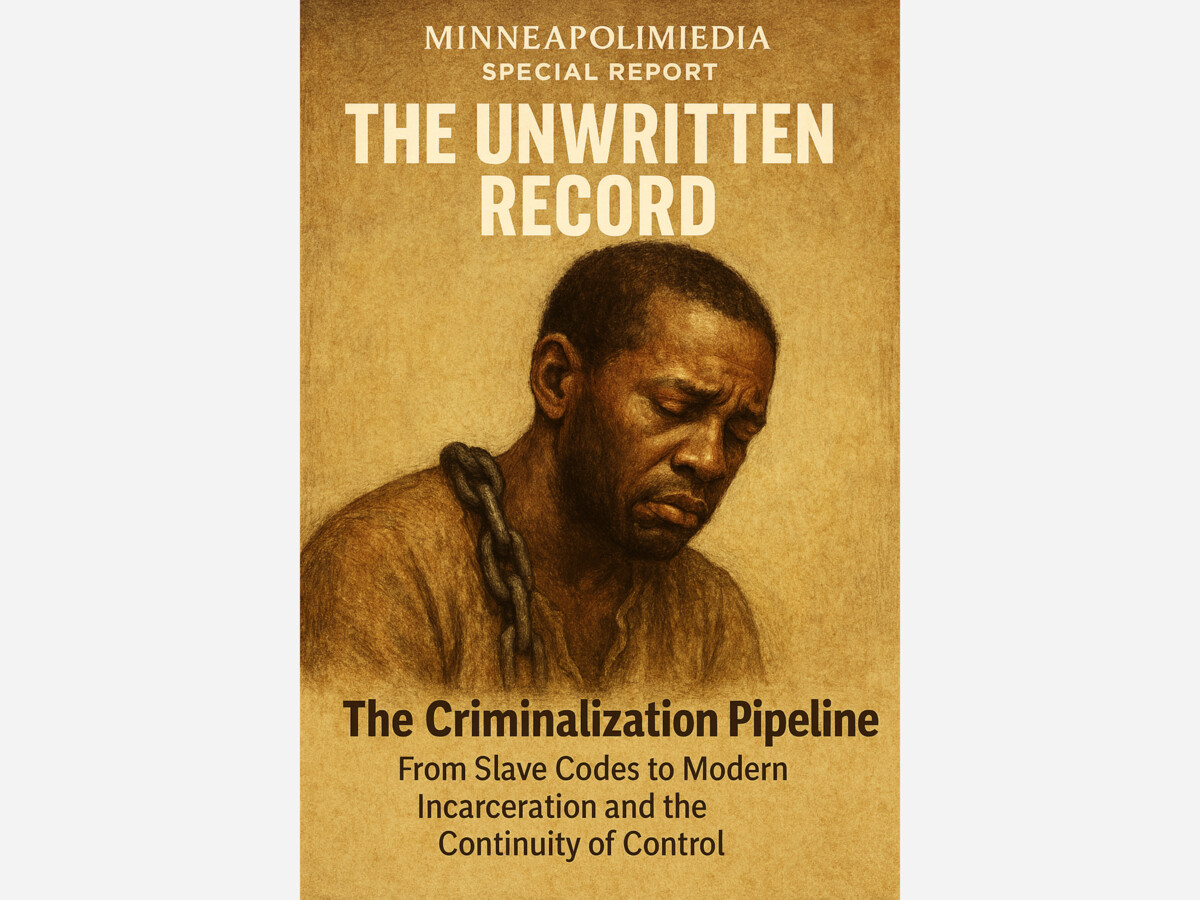



The American criminal legal system is often presented as a neutral instrument. Laws are written. Rules are enforced. Punishment follows violation.
This framing collapses when examined alongside history.
For African Americans, criminalization has not functioned primarily as a response to harm. It has functioned as a method of governance. From enslavement through the present, legal codes, policing practices, and punishment systems have been repeatedly reconfigured to manage labor, suppress mobility, and enforce racial hierarchy under the language of order.
The pipeline did not emerge suddenly. It was engineered.
Under enslavement, law did not protect African Americans. It defined their captivity.
Slave codes criminalized movement, assembly, literacy, and resistance. These laws were not peripheral. They were foundational to the economic system of slavery. Control required surveillance. Enforcement required punishment. Violence was legalized.
Crime, in this context, was not behavior that caused harm. It was behavior that challenged ownership.
This distinction matters, because it establishes the pattern that would persist long after legal enslavement ended.
The formal end of enslavement created a crisis for those who depended on coerced labor. The response was not reconciliation. It was adaptation.
Black Codes emerged across former slaveholding states, criminalizing unemployment, vagrancy, loitering, and breach of labor contracts. These laws transformed ordinary conditions of poverty into punishable offenses.
Freedom became conditional. To be unemployed was to be suspect. To move without permission was to be criminal.
The legal system replaced the plantation as the primary mechanism of control.
The Thirteenth Amendment prohibited slavery and involuntary servitude, except as punishment for crime. That exception became a gateway.
African Americans were arrested in disproportionate numbers under newly expanded criminal statutes. Once convicted, they were leased to private companies, farms, and industries. The state profited. Businesses acquired cheap labor. Lives were treated as expendable.
Convict leasing reproduced the core features of enslavement through legal process. Labor was coerced. Conditions were brutal. Mortality rates were high.
This was not a deviation from the law. It was the law.
As African Americans migrated, organized, and sought political participation, policing evolved as a boundary-setting institution.
Law enforcement practices were shaped to protect property, enforce segregation, and suppress dissent. Police power was frequently deployed to uphold racial order rather than public safety.
This pattern did not require explicit racial language. It relied on discretion. Who was stopped. Who was searched. Who was believed. Who was punished.
Neutral law produced unequal outcomes because enforcement was unequal by design.
Minnesota is often excluded from conversations about racialized criminalization. This exclusion rests on the same myth of neutrality addressed earlier in this series.
African Americans in Minnesota have long experienced disproportionate surveillance, arrest, and punishment. Housing segregation, employment exclusion, and educational inequity created conditions that were then policed rather than addressed.
Criminalization here often appeared procedural rather than overt. Ordinances, traffic enforcement, school discipline, and probation systems functioned as points of contact with law enforcement.
The absence of spectacle did not mean the absence of harm.
Criminalization increasingly moved upstream.
School discipline policies introduced surveillance, exclusion, and punishment at early ages. African American students were disciplined more harshly for similar behavior. Suspensions and expulsions increased contact with the legal system.
Education became a site of sorting. Behavior was criminalized before adulthood. The pipeline narrowed future options while expanding enforcement.
This was not about safety. It was about control.
By the late twentieth century, incarceration rates surged. Mandatory minimums, sentencing disparities, and expanded policing produced a system where African Americans were imprisoned at vastly disproportionate rates.
This expansion was justified through narratives of crime waves and public fear. Those narratives often ignored structural conditions and focused on punishment as solution.
Incarceration removed people from communities, fractured families, and restricted economic participation long after sentences ended. Criminal records became lifelong barriers to employment, housing, and civic engagement.
Punishment extended beyond prison walls.
The criminalization pipeline functions by converting vulnerability into violation.
Poverty becomes suspicion.
Dislocation becomes disorder.
Resistance becomes threat.
Each stage reinforces the next. Surveillance leads to arrest. Arrest leads to punishment. Punishment limits opportunity. Limited opportunity increases exposure to enforcement.
The pipeline sustains itself.
Acknowledging the continuity of criminalization challenges foundational assumptions.
It disrupts the belief that the legal system operates independently of social power. It reveals that punishment has often substituted for policy. It exposes how inequality has been managed rather than resolved.
Minimization allows reform to focus on surface-level change while leaving structure intact.
The criminalization pipeline is not a series of unfortunate outcomes. It is a historical throughline.
African Americans were first criminalized for seeking freedom. Then for seeking work. Then for seeking housing. Then for seeking education. Then for seeking safety.
Law did not merely respond to social conditions. It helped produce them.
To understand the present requires acknowledging this continuity. Reform without history repeats design without intent.
This series exists to name what has been engineered, normalized, and defended.
The pipeline did not begin with crime.
It began with control.
And it persists because the record remains incomplete.


Patchy rain nearby, with a high of 83 and low of 48 degrees. Partly Cloudy in the morning, clear in the afternoon and evening, overcast overnight.