Image




According to the department’s monthly recap, police responded to 3,494 calls for service during February, a decrease of 534 calls compared with January. Calls for service include a wide range of incidents reported by residents or observed by officers, from emergency situations to routine requests for assistance.
The figures offer a glimpse into the daily workload facing officers in a growing community that sits along the Mississippi River in northern Anoka County.
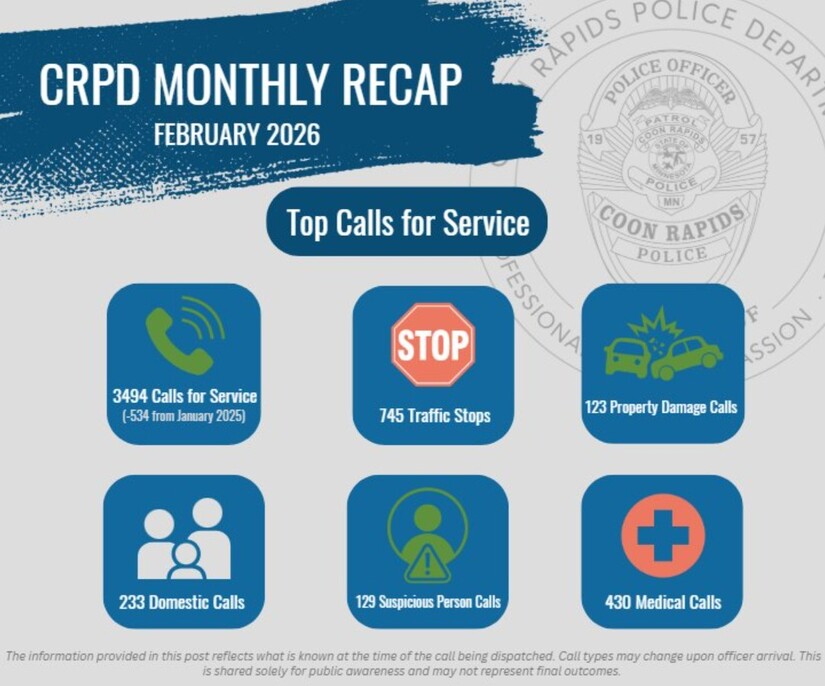
Several types of incidents accounted for a significant share of officer responses in February.
• 3,494 total calls for service
• 745 traffic stops
• 430 medical calls
• 233 domestic-related calls
• 129 suspicious person calls
• 123 property damage calls
Police agencies commonly categorize calls based on the reason dispatchers initially assign when a report is received. Officials note that call classifications may change after officers arrive and determine the full circumstances of the incident.
Traffic enforcement represented one of the most visible components of police activity in February. Officers conducted 745 traffic stops, reflecting ongoing efforts to address speeding, impaired driving, and other roadway violations.
Traffic enforcement remains a central component of policing in Minnesota communities, where local departments often prioritize roadway safety as part of broader public safety strategies.
Medical emergencies accounted for 430 calls during the month. Police officers are frequently dispatched alongside fire and ambulance crews to assist with emergency scenes, help secure locations, and provide immediate aid until medical professionals arrive.
Meanwhile, 233 domestic-related calls required police response. Domestic disturbance calls often involve complex family or household situations and can demand extended time from officers, including conflict mediation, safety assessments, and follow-up documentation.
The department also recorded 129 suspicious person calls, reflecting reports from residents who observed unusual behavior or circumstances and contacted police for assistance.
Property damage incidents accounted for 123 calls, which may include vehicle crashes, vandalism reports, and other situations where property was damaged but injuries were not necessarily involved.
Police departments track calls for service as a key indicator of operational demand. The numbers represent the volume of requests handled by dispatch centers and responding officers throughout a given period.
Officials emphasize that the statistics represent initial dispatch classifications, meaning the final determination of an incident may differ once officers complete their investigation.
For residents of Coon Rapids, the February recap offers a snapshot of the scale and variety of issues handled by the local police department each month.
From routine traffic enforcement and suspicious activity checks to medical emergencies and domestic disputes, officers responded to thousands of requests for help across the city in just four weeks.
Monthly activity summaries like this one provide the public with greater transparency into the types of incidents shaping day-to-day policing across the community.



Patchy rain nearby, with a high of 85 and low of 48 degrees. Sunny in the morning, patchy light rain in area with thunder for the afternoon and evening, clear overnight.