66° and Overcast
Image
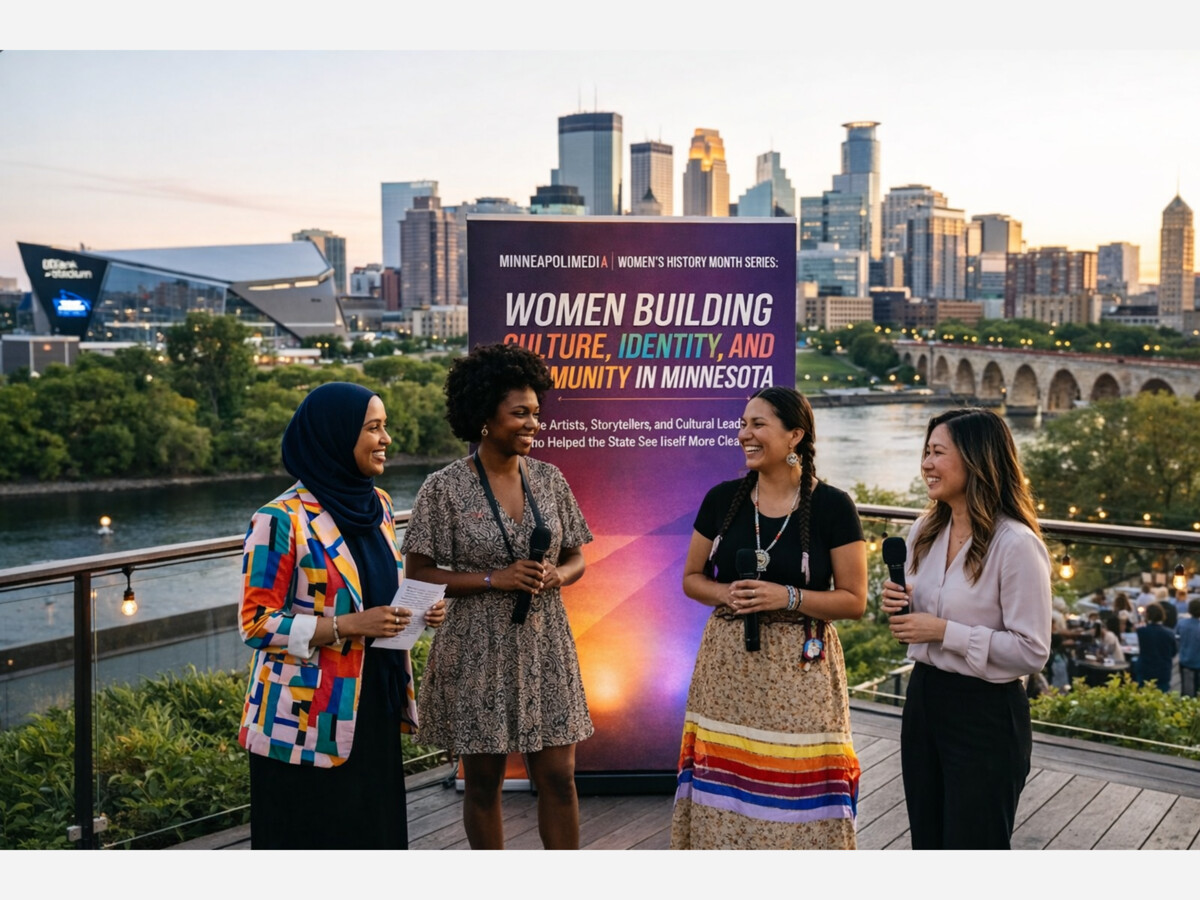



Minnesota is often described through its institutions.
Its schools. Its hospitals. Its public agencies. Its elected leaders. Its businesses and civic organizations.
Those structures matter. They help explain how the state functions. They show how power is organized, how services are delivered, and how public life is managed.
But institutions alone do not explain who a people believe themselves to be.
That work belongs to culture.
Culture shapes memory. It preserves language. It gives people symbols, music, stories, images, rituals, and traditions through which they understand where they come from and what they owe one another. It influences how communities see themselves, how they are seen by others, and how they respond when the official story of a place leaves too much out.
In Minnesota, women have long played a decisive role in that work.
They have taught communities how to remember. They have protected traditions that displacement and assimilation threatened to erase. They have written, painted, organized, performed, filmed, interpreted, archived, and spoken the state into fuller view. They have built cultural spaces where people could recognize themselves with dignity. They have also challenged a narrower version of Minnesota that too often presented the state through a limited, incomplete lens.
Their work did not merely decorate public life.
It helped define it.
One of the enduring mistakes in how states tell their own stories is the tendency to treat culture as something peripheral. Government is described as serious. Business is described as consequential. Infrastructure is described as essential. Culture is too often left to the side, as if it belongs to celebration rather than survival.
That distinction does not hold.
Culture determines whose stories are carried forward and whose are forgotten. It influences whether communities feel seen inside the places where they live. It shapes how children come to understand their history, how immigrant families maintain continuity across generations, and how societies confront the parts of themselves that public myth would rather avoid.
In Minnesota, women have been central to this process because they have so often served as the keepers and transmitters of identity. In homes, houses of worship, performance spaces, neighborhood centers, schools, community papers, galleries, and public gatherings, they have preserved what institutions alone could not hold.
To understand Minnesota honestly, one has to understand that culture was never just an accessory to the state’s development.
It was one of the ways the state learned what it was.
Any serious account of cultural leadership in this region must begin before statehood.
Long before Minnesota became a political unit in 1858, Indigenous women in Dakota and Ojibwe communities carried responsibilities tied directly to cultural continuity and communal survival. They preserved food traditions, language, family structures, ceremonial practices, kinship systems, and forms of knowledge rooted in place. They helped sustain collective identity through daily practice, not occasional recognition.
That history matters because it establishes a truth that later public narratives often obscured: Minnesota did not begin culturally with settlement. It was already a lived world of meaning, relationship, memory, and tradition.
Colonization disrupted those systems with force. Removal, broken treaties, boarding schools, land theft, and sustained pressure toward assimilation were not only political attacks. They were cultural attacks. They sought to sever people from language, ceremony, community, and inherited knowledge.
Women stood at the center of resistance to that erasure.
They maintained continuity under conditions designed to break it. They carried traditions through families and generations even when public systems treated those traditions as something to be displaced or managed rather than respected.
That is cultural leadership in one of its deepest forms.
It does not begin with applause. It begins with preservation.
As Minnesota’s population expanded through immigration in the nineteenth and twentieth centuries, culture became one of the principal ways communities made life possible in unfamiliar surroundings.
Women within Scandinavian, German, Eastern European, and later African, Asian, and Latin American communities served as crucial transmitters of continuity. They preserved languages inside homes, organized gatherings, maintained food traditions, taught children inherited customs, and created the social environment through which community could survive transition.
This labor is often described too simply, as if tradition is merely handed down. In reality, it is continuously rebuilt. It requires interpretation. It requires selection. It requires knowing what must be protected and what can adapt.
That work shaped Minnesota far more than is often acknowledged.
The state’s cultural identity did not emerge from one source. It was layered, negotiated, contested, and expanded through generations of people who carried other worlds into this one and refused to let those worlds disappear. Women were often the people doing the carrying.
In that sense, they did not just preserve culture.
They broadened Minnesota’s capacity to contain more than one story about itself.
If some women preserved continuity, others challenged the state to confront the limits of its own self-image.
African American women have played an especially important role in this work. In a state that has often preferred to describe itself through ideals of fairness, education, civic participation, and relative progress, African American women have insisted on a more complete record. Through journalism, the arts, education, organizing, and public storytelling, they have pushed Minnesota to examine the distance between its values and its realities.
That contribution cannot be reduced to representation alone.
It is interpretive work. It is corrective work. It is public truth-telling.
African American women cultural leaders have preserved community memory in the face of neglect, strengthened institutions that served African American families, and created platforms where African American life in Minnesota could be documented on its own terms rather than filtered through outside assumptions. They have shaped how the state talks about race, belonging, inequality, creativity, and resilience. They have also refused the shallow treatment that often turns African American cultural life into either spectacle or trauma narrative without honoring its complexity.
This matters because the public understanding of a place is never neutral. It is shaped by those who have the power to narrate it.
African American women have expanded that power in Minnesota.
Culture is often thought of in personal terms. Art. Music. Writing. Performance. Memory. But culture also has an institutional side. Newspapers, theater companies, community archives, literary circles, festivals, museums, oral history projects, and media platforms all determine what gets recorded and repeated.
Women have played an extraordinary role in building and sustaining those structures in Minnesota.
They have founded organizations. They have curated public memory. They have created stages for stories that would otherwise go unheard. They have organized gatherings that did more than entertain. They connected people, affirmed identity, raised resources, and built audiences for narratives that mainstream institutions either overlooked or misunderstood.
That work is not minor. It affects how children imagine their future, how communities retain confidence in their own worth, and how a state comes to recognize forms of leadership outside its narrowest traditions.
A festival can do this. A poem can do this. A local publication can do this. A community theater performance can do this. An archive can do this. A photograph can do this.
Culture shapes public consciousness long before policy catches up.
Women have understood that for generations.
In Minnesota, women artists and cultural workers have repeatedly expanded what could be seen, said, and felt in public.
They have used visual art to reclaim history and challenge distortion. They have used music to carry memory, language, and emotion across generations. They have used theater to make audiences confront social realities that are easier to avoid in ordinary conversation. They have used writing to document communities that the broader record treated as marginal, temporary, or invisible.
This has been especially important for communities whose experience in Minnesota did not fit the dominant public narrative.
For African Americans, immigrants, Indigenous communities, and other groups too often described from the outside, women artists have created work that insists on self-definition. They have not waited for major institutions to interpret their lives correctly. They have done the work themselves.
That choice has consequences.
It produces a public record less vulnerable to erasure. It produces audiences that can identify with what they see. It produces a stronger civic culture because it broadens the number of people who are allowed to belong in the state’s imagination.
Not all cultural leadership takes place in highly visible spaces.
Some of it happens where communities gather without publicity. In church basements. At family celebrations. In neighborhood kitchens. At language schools. Through youth dance groups, women’s associations, community choirs, reading circles, and small public events that never make it into formal histories but shape belonging in lasting ways.
These spaces matter because they are often where identity is stabilized. They are where children hear stories that do not appear in textbooks. They are where elders pass on expectations, humor, caution, memory, and pride. They are where communities decide what they are unwilling to lose.
Women are frequently the organizers of this continuity.
They arrange the event, prepare the meal, gather the names, teach the songs, preserve the recipes, remember who has passed, and make sure the children know why something matters.
This work can appear ordinary until one asks what happens when it disappears.
When it disappears, communities lose coherence. The bond between generations weakens. Memory grows thinner. Public life becomes easier to flatten.
That is why this labor belongs in the historical record.
It is not simply social.
It is structural.
One of the most important truths about culture in Minnesota is that it has never been fixed.
The state’s identity has been revised repeatedly through conflict, migration, reinvention, and public debate. Women have helped drive those revisions by expanding what counted as Minnesota culture in the first place.
They challenged the assumption that one heritage could stand in for the whole state. They created room for African American, Indigenous, immigrant, diasporic, neighborhood-based, and working-class narratives inside a public culture that too often preferred a cleaner, narrower version of itself.
This has not always happened through confrontation alone. Sometimes it happened through creation. A book. A play. A broadcast. A community event. A local institution. A piece of visual art. A curriculum. A public conversation that changed what people were willing to name.
Over time, these acts accumulate.
They alter what the state can see.
And once people see more clearly, it becomes harder to return to the old fiction.
The need for cultural leadership has not diminished.
Minnesota continues to confront major questions about race, inequality, migration, memory, development, and belonging. It continues to wrestle with how it tells its own story, who gets centered in that story, and which communities are still treated as additions rather than authors.
Women across the state remain central to that work.
They are using media to challenge distortion and deepen public understanding. They are organizing cultural spaces where younger generations can inherit language and identity with confidence. They are preserving archives and oral histories that institutions were slow to value. They are creating work that reflects the actual complexity of Minnesota life rather than the simplified version that is easier to market.
This is not only artistic work.
It is civic work.
A state cannot govern itself wisely if it does not understand itself honestly.
If Minnesota is serious about documenting its own history, then the women who built, preserved, and redefined its culture cannot be treated as secondary figures.
They helped communities endure dislocation. They protected traditions through periods of pressure and change. They created public space for people who had been misrepresented, minimized, or ignored. They helped the state become more truthful, more complex, and more capable of recognizing the full range of lives within it.
Their contributions belong in the same conversation as policy, public service, education, and institutional development because culture shapes the conditions under which all of those things are understood.
Without cultural leadership, a state has systems but no self-knowledge.
Without cultural memory, public life becomes easier to distort.
Without women who preserve and create meaning across generations, the official story of Minnesota becomes thinner, less honest, and less humane.
Minnesota’s identity was not formed by institutions alone.
It was formed in language and memory. In music and image. In story and ritual. In community spaces where belonging was defended and redefined. In artistic work that challenged omission and made room for truth. In traditions carried through disruption. In public acts of creation that told the state what it had failed to notice about itself.
Women have been central to that process.
They preserved culture where it was threatened.
They created culture where it was missing.
They expanded culture where it was too narrow.
And in doing so, they helped Minnesota see itself more clearly.
That is not background work.
That is state-shaping work.
That is history.
MinneapoliMedia
Community. Culture. Civic Life.



Patchy rain nearby, with a high of 66 and low of 53 degrees. Overcast in the morning, partly cloudy in the afternoon, clear in the evening, patchy rain nearby overnight.