59° and Partly Cloudy
Image



In Blaine, city officials and public safety agencies are attempting to intervene before that seasonal surge fully begins.
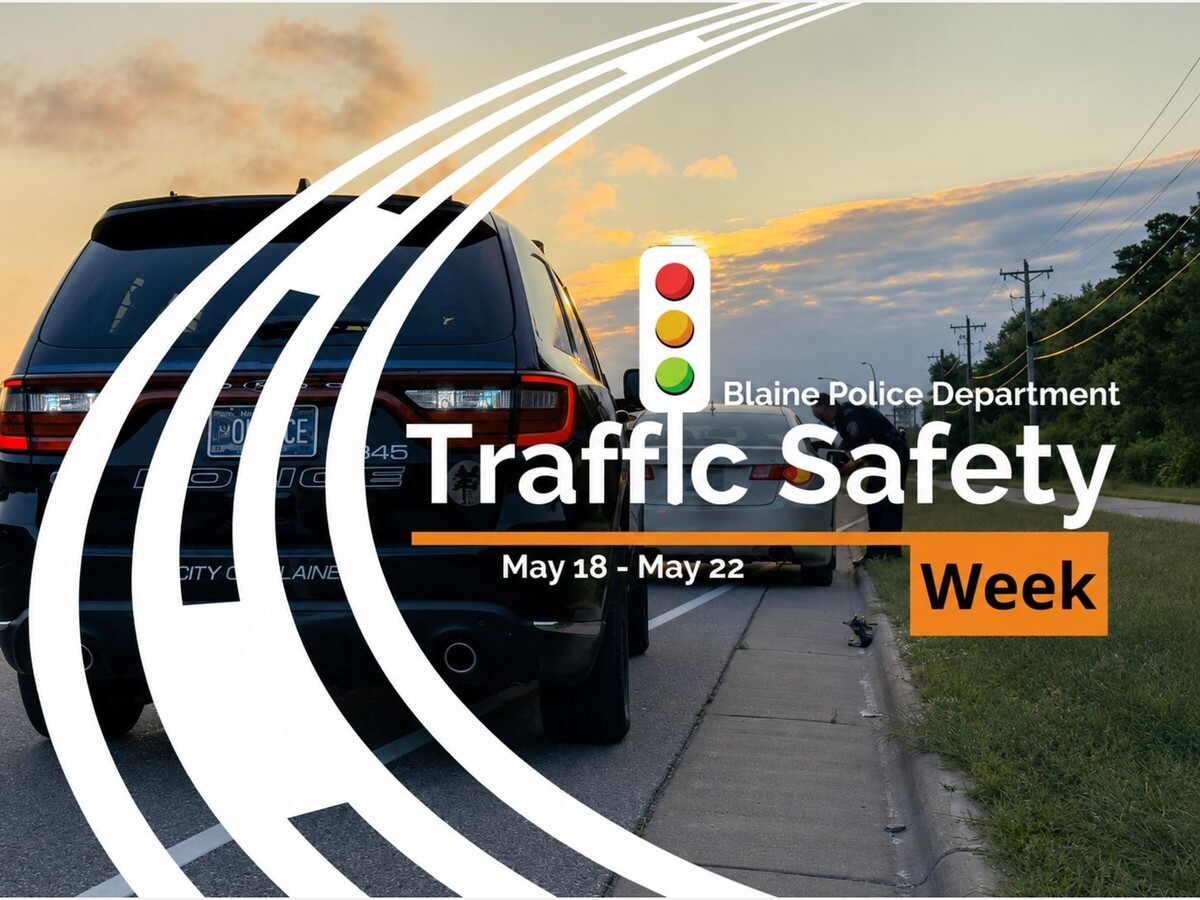
Starting Monday, May 18, the Blaine Police Department, the City of Blaine, and the Anoka County chapter of Minnesota’s Toward Zero Deaths initiative will launch Traffic Safety Week 2026, a coordinated five-day enforcement and public education campaign focused on reducing preventable roadway deaths and serious crashes throughout the north metro region.
The initiative, operating through Friday, May 22, is being conducted with support from the Minnesota Department of Public Safety and reflects a broader statewide push to confront dangerous driving behaviors before Memorial Day weekend marks the unofficial beginning of Minnesota’s high-risk summer traffic season. (dps.mn.gov)
For Blaine officials, the campaign represents more than a week of traffic stops and patrol visibility.
It is a preventative strategy grounded in years of crash data, behavioral research, and increasingly urgent concerns about the human cost of reckless driving.

Historically, Blaine’s traffic safety operations have occurred during different periods of the year. But for 2026, the campaign was deliberately repositioned to mid-May in direct anticipation of the summer travel season known nationally for elevated crash fatalities.
Traffic safety officials commonly define the “100 deadliest days” as the stretch between Memorial Day and Labor Day, a period when fatal crashes traditionally spike because of increased travel volume, holiday traffic, summer recreation, road construction, motorcycle activity, teen drivers, and impaired driving incidents.
According to the Minnesota Department of Public Safety Office of Traffic Safety and national roadway safety studies, the summer months consistently produce some of the year’s highest fatal crash totals. Officials attribute that increase to a convergence of factors:
In Minnesota alone, hundreds of people are killed annually in preventable traffic crashes, with speeding, distraction, impairment, and failure to wear seat belts remaining among the most persistent contributing factors.
By launching high-visibility enforcement operations before Memorial Day rather than after, officials say the objective is to establish safer driving behaviors before dangerous summer travel patterns become fully entrenched.
Traffic Safety Week will divide operations into five daily enforcement themes, each targeting a major cause of serious crashes and roadway fatalities.
Monday’s operations will focus on distracted driving enforcement, particularly violations of Minnesota’s hands-free driving law.
Under Minnesota law, motorists are prohibited from holding wireless communication devices while operating vehicles except under limited emergency circumstances. The law was enacted in response to growing concerns about crashes linked to texting, scrolling, video viewing, and other cellphone-related distractions behind the wheel.
Distracted driving remains one of the most persistent crash contributors on heavily traveled north metro commuter corridors, including Highway 65 and University Avenue.
According to safety officials, officers will utilize both marked and unmarked patrol vehicles to monitor intersections, stop-and-go traffic patterns, and traffic queues where distracted driving behaviors are most commonly observed.
Public safety leaders have repeatedly warned that distracted driving crashes frequently occur within seconds and often involve rear-end collisions, intersection crashes, pedestrian strikes, and lane departure incidents.
Tuesday’s focus shifts toward pedestrian safety as warmer weather brings increased foot traffic into parks, commercial corridors, trails, and residential neighborhoods throughout Blaine.
Pedestrian fatalities have become an increasing concern nationally and statewide as suburban development patterns place higher-speed roadways near retail zones, residential expansions, and recreational areas.
Minnesota law requires motorists to stop for pedestrians in marked crosswalks as well as unmarked intersection crosswalks. During Tuesday’s operations, officers will conduct crosswalk compliance monitoring and public education efforts in areas experiencing high pedestrian activity.
Officials say particular attention will be paid to intersections where traffic speeds, turning movements, and pedestrian crossings create elevated risk conditions.
The campaign also aims to educate both drivers and pedestrians about visibility, right-of-way awareness, and distracted walking behaviors that increasingly contribute to urban and suburban roadway injuries.
Wednesday’s enforcement efforts will concentrate on commercial vehicle operations.
As Blaine has grown into a major north metro commercial and logistical corridor, officials say truck traffic and freight movement have increased substantially throughout the city and surrounding areas.
Commercial enforcement operations will involve collaboration between patrol officers and specialized vehicle inspectors tasked with monitoring:
Construction activity throughout the metropolitan region has further increased heavy vehicle traffic moving through suburban corridors, raising concerns about roadway wear, work zone safety, and interactions between commercial vehicles and passenger traffic.
Officials say commercial enforcement campaigns are designed not only to identify violations but also to prevent catastrophic crashes involving oversized or improperly maintained vehicles.
Thursday’s campaign emphasis centers on speed enforcement, an area consistently identified by the Minnesota Department of Public Safety as one of the leading contributors to fatal crashes statewide.
Traffic safety experts have long noted that higher speeds dramatically reduce crash survivability, shorten driver reaction times, and increase both impact force and stopping distance.
During prior Minnesota summer enforcement campaigns, officers documented numerous motorists traveling at extreme speeds exceeding 90 or even 100 miles per hour.
Thursday’s operations will include saturation patrols, targeted speed monitoring, and enforcement visibility along known speeding corridors and high-risk roadway segments.
Officials say the timing is intentional, coming immediately before increased holiday traffic begins building ahead of Memorial Day weekend.
Friday’s operations will transition into large-scale DWI enforcement efforts tied to graduation celebrations, weekend nightlife activity, and pre-holiday travel.
Historically, the period leading into Memorial Day weekend produces elevated rates of alcohol- and drug-impaired driving incidents across Minnesota.
Additional evening and nighttime patrol shifts will focus on arterial roads, entertainment corridors, and high-traffic commuter areas where impaired driving risks increase significantly.
Law enforcement agencies throughout Minnesota continue emphasizing that impairment includes not only alcohol but also cannabis, prescription medications, and controlled substances capable of affecting driver reaction time and judgment.
Officials say the objective is straightforward: removing impaired drivers from the roadway before crashes occur.
Underlying the entire campaign is Minnesota’s broader Toward Zero Deaths strategy, a statewide traffic safety initiative built around what officials call the “4E” framework:
Rather than viewing traffic fatalities as unavoidable accidents, the Toward Zero Deaths model approaches roadway deaths as preventable public health events shaped by driver behavior, roadway design, enforcement practices, vehicle safety systems, and emergency response capacity.
The initiative brings together police departments, transportation engineers, firefighters, trauma specialists, educators, public health officials, and policymakers in a coordinated effort to reduce traffic deaths and life-altering injuries across Minnesota.
For Blaine residents, Traffic Safety Week will include regular safety alerts, enforcement updates, educational messaging, and behind-the-scenes looks at roadway safety operations shared across city communication channels throughout the week.
Behind every enforcement initiative lies a harsher reality rarely visible in public statistics alone.
Traffic fatalities ripple outward through emergency rooms, dispatch centers, fire departments, tow crews, trauma teams, insurance investigations, school communities, workplaces, and grieving families whose lives can change permanently in seconds.
A distracted glance toward a phone.
A speeding decision on an open roadway.
A drunk driver leaving a gathering.
A missed crosswalk.
A reckless lane change.
A motorcycle unseen in traffic.
A teenager overestimating experience behind the wheel.
For the officers preparing to begin Traffic Safety Week patrols Monday morning in Blaine, officials say the mission extends far beyond issuing tickets.
The hope is that visible intervention now, before Minnesota’s deadliest stretch of summer driving fully arrives, may prevent another knock at a family’s door later this season.
MinneapoliMedia | Community. Culture. Civic Life.



Sunny, with a high of 66 and low of 46 degrees. Overcast during the morning, sunny in the afternoon, clear for the evening, cloudy overnight.