Image



National Peace Officers Memorial Day, observed annually on May 15 during National Police Week, is not merely ceremonial for law enforcement agencies and surviving families. It is a national act of remembrance for officers whose shifts ended not with retirement or homecoming, but with death in service to the public.
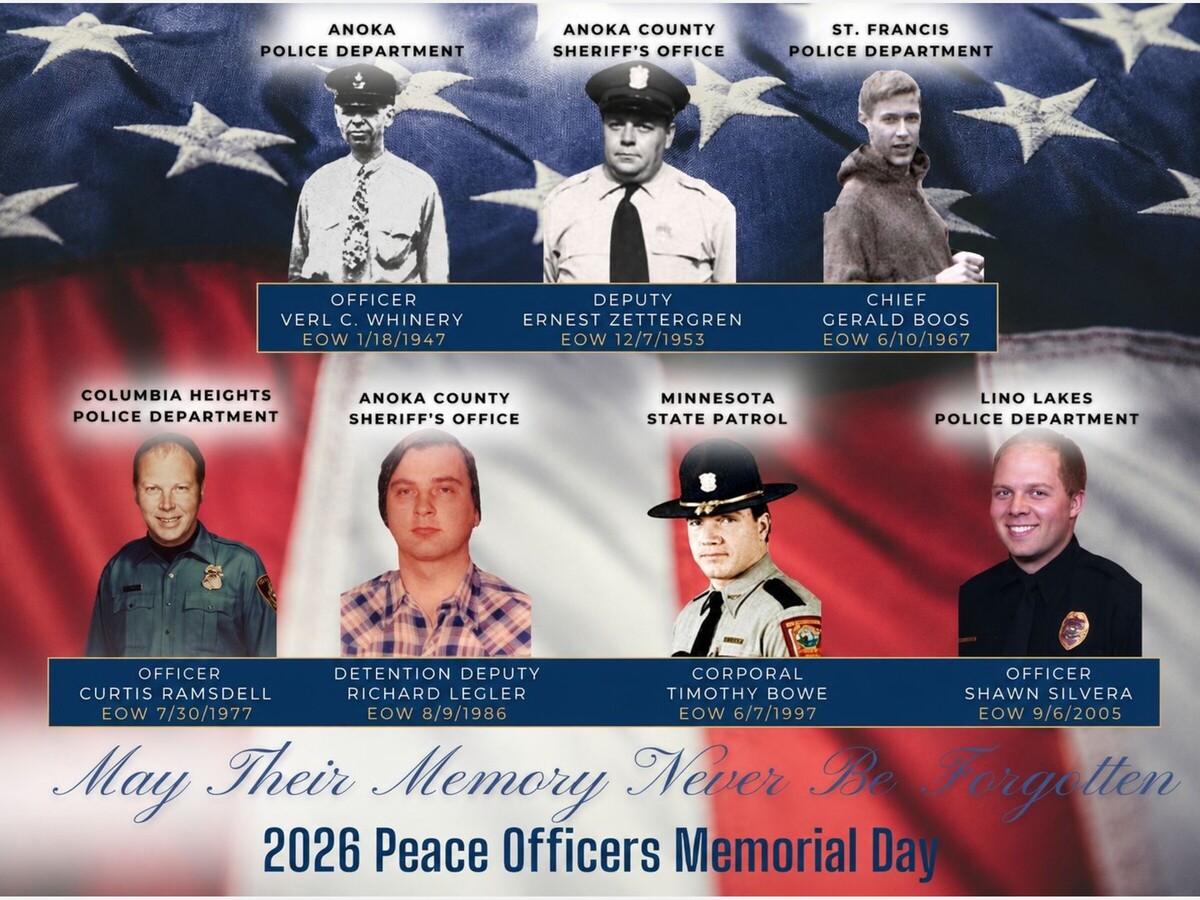
This year, the Anoka County Sheriff's Office marked the observance with a commemorative bulletin honoring seven officers whose line-of-duty deaths remain woven into the history of Anoka County and the broader north metro region.
The bulletin revisited stories stretching across more than seven decades and involving multiple agencies connected to the county, including the Anoka Police Department, Columbia Heights Police Department, Lino Lakes Police Department, Minnesota State Patrol, St. Francis Police Department, and the sheriff’s office itself.
Taken together, the names tell a difficult and deeply human story about policing in Minnesota: burglaries interrupted in the dead of winter, roadside traffic stops turned fatal, officers struck during pursuits, heart attacks following violent emergency calls, and random ambushes triggered simply by the sight of a uniform.
Using verified records from the Officer Down Memorial Page, the Minnesota Law Enforcement Memorial Association, federal memorial archives, and agency historical records, the stories behind those names reveal not only how these officers died, but also how their communities continue remembering them decades later.
Among the earliest names memorialized is Deputy Ernest Zettergren of the Anoka County Sheriff's Office, who was killed on December 7, 1953.
Zettergren, 43, was conducting routine patrol during the early winter hours when he noticed signs of a burglary in progress at a local tavern. A window had been shattered. A suspicious vehicle sat parked outside.
Before approaching the scene, Deputy Zettergren demonstrated the kind of procedural discipline officers are trained to rely upon during uncertain encounters. He radioed the vehicle’s license plate number back to dispatch before exiting his squad car.
Moments later, the burglary suspect emerged from the building and opened fire.
The deputy was struck twice.
Investigators later determined that after the shooting, the suspect stole Zettergren’s service weapon and clipboard before fleeing the area. But the deputy’s final radio transmission proved decisive. The plate number he transmitted allowed authorities to quickly identify and locate the suspect later that same morning.
The man confessed to the murder and received a life sentence.
Deputy Zettergren left behind a wife and six children.
More than seventy years later, his death remains one of the defining tragedies in the history of the sheriff’s office and continues to be formally recognized in statewide and national law enforcement memorial records.
If Zettergren’s death reflected the dangers of patrol work in mid-century Minnesota, the killing of Detention Deputy Richard Erhardt Legler decades later exposed another reality of law enforcement: violence can emerge without warning, motive, or direct confrontation.
On the morning of August 9, 1986, Legler and fellow detention deputy Anthony Hesch were driving to work at the county jail.
Both men were wearing official jail uniforms.
According to investigators, a dark-colored vehicle suddenly pulled alongside their car during the early morning commute. Without provocation, an occupant fired a handgun round through the driver’s side window.
The bullet struck Legler in the left arm, passed through the limb behind his uniform patch, and pierced his lung.
Despite suffering catastrophic injuries, Legler maintained enough control of the vehicle to steer safely toward the shoulder of the road before collapsing.
He was 38 years old and had served approximately three years with the sheriff’s office.
The shooting baffled investigators for years because there appeared to be no prior relationship between Legler and the gunman. No robbery occurred. No confrontation preceded the attack. No other motorists reported similar shootings that morning.
Authorities ultimately concluded that the uniforms themselves may have triggered the ambush.
The suspect was later found deceased from a self-inflicted gunshot wound.
Nearly four decades later, Legler’s death has taken on renewed significance within the law enforcement community. During the 2026 National Police Week observances in Washington, his name was formally added to the National Law Enforcement Officers Memorial, permanently inscribed among officers from across the country killed in the line of duty.
For corrections and detention personnel in particular, the recognition carried symbolic weight. Advocates have long argued that jail and detention officers often face substantial danger while receiving less public visibility than patrol officers.
The Anoka County remembrance extends beyond the two sheriff’s office deputies.
The county’s memorial history includes officers from municipal departments and state agencies whose deaths occurred under dramatically different circumstances but share a common thread of public service cut short.
Lino Lakes Police Department
End of Watch: September 6, 2005
Officer Shawn Silvera was struck and killed by a stolen vehicle while attempting to deploy spike strips during a high-speed pursuit on Interstate 35W.
Authorities said Silvera was trying to stop a fleeing suspect when the stolen vehicle struck him at highway speed. His death became one of the region’s stark reminders of the dangers officers face during traffic enforcement and vehicle pursuits.
Columbia Heights Police Department
End of Watch: January 31, 1996
Officer Robert Johnson suffered a fatal heart attack shortly after responding to a volatile domestic disturbance call involving combative circumstances.
His death highlighted another often overlooked reality within policing: many line-of-duty deaths stem not from gunfire, but from intense physiological stress placed on officers responding to dangerous emergency situations.
St. Francis Police Department
End of Watch: December 21, 1972
Officer Richard Anderson was fatally shot during a routine traffic stop on Highway 47 after a driver suddenly produced a concealed handgun.
The incident became one of the most enduring reminders within Minnesota law enforcement training culture that even ordinary roadside stops can become deadly within seconds.
Minnesota State Patrol
End of Watch: April 29, 1979
Trooper John Simpson was struck and killed by a drunk driver while conducting a traffic stop along the highway shoulder.
His death occurred years before distracted and impaired driving became central national traffic safety campaigns, but it remains emblematic of the dangers officers face while working roadside enforcement assignments.
Anoka Police Department
End of Watch: September 14, 2022
Officer Eric Groebner died following a medical emergency shortly after participating in intensive department physical conditioning and defensive tactics training exercises.
His death underscored the physical toll law enforcement work can exact even outside emergency calls or violent confrontations.
National Peace Officers Memorial Day was formally established in 1962 after President John F. Kennedy signed federal legislation creating both the memorial observance and National Police Week. Since then, thousands of officers’ names have been added to memorial walls in Washington and state capitals across the country.
According to the National Law Enforcement Officers Memorial Fund, more than 24,000 American officers have died in the line of duty throughout the nation’s history.
Yet memorial observances like the one held in Anoka County often carry meanings far beyond statistics.
For surviving spouses, children, retired colleagues, dispatchers, jail staff, investigators, and patrol officers, the ceremonies are deeply personal acts of remembrance tied not only to how these officers died, but to who they were before tragedy permanently defined their public legacy.
Behind every engraved name stands an unfinished life: a patrol shift interrupted, a family forever altered, a final radio transmission, a drive to work that never ended, or an ordinary stop along a Minnesota roadway that suddenly turned fatal.
And for the agencies that continue carrying those names forward each May, remembrance is not viewed as symbolic tradition alone.
It is viewed as obligation.
MinneapoliMedia | Community. Culture. Civic Life.

Sunny, with a high of 86 and low of 49 degrees. Sunny in the morning, clear overnight.