Image
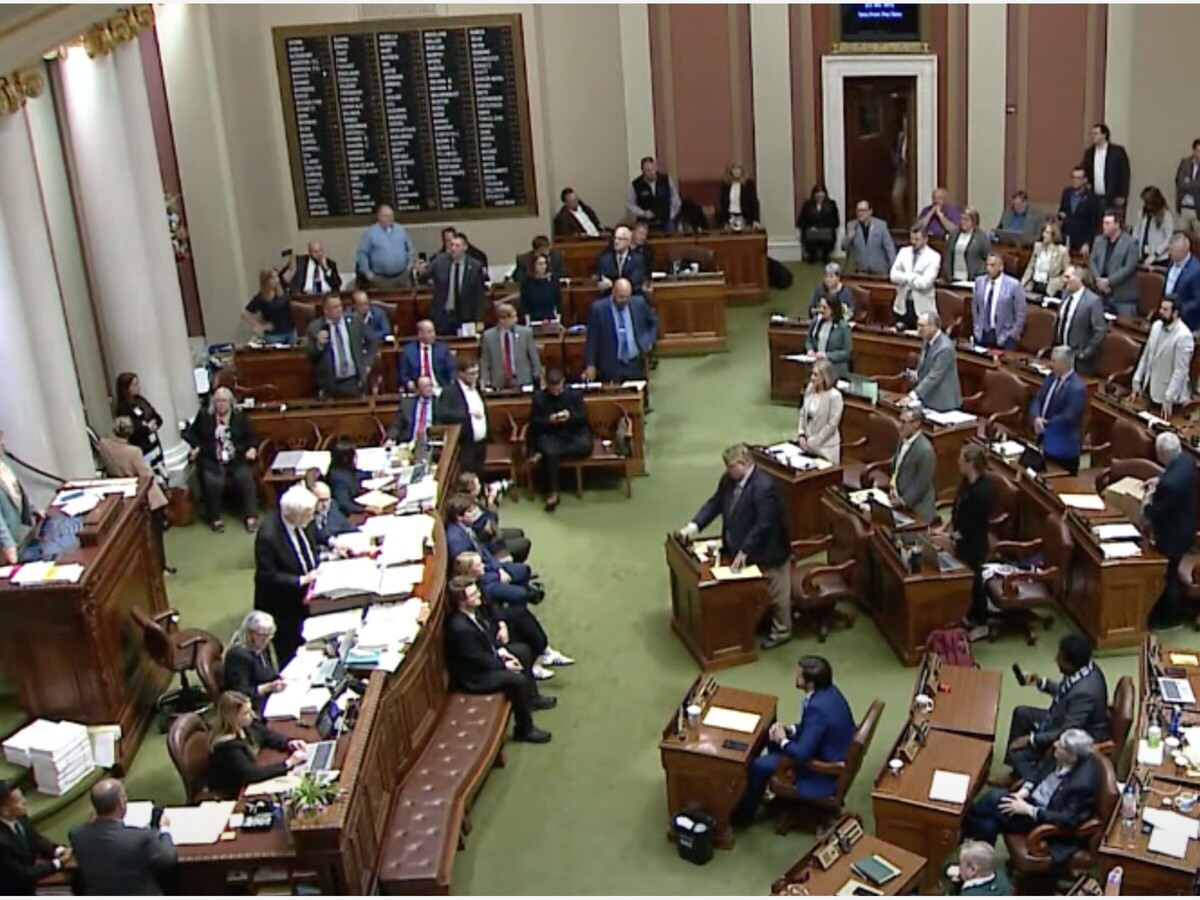



The extraordinary burst of legislative activity reflected both the urgency and fragility of a session defined by divided government. The Minnesota House remains tied 67-67 between Democrats and Republicans, creating one of the most politically delicate governing environments in modern state history and forcing bipartisan negotiations on virtually every major proposal moving toward Gov. Tim Walz’s desk.
By late Sunday evening, lawmakers had approved or advanced a series of measures carrying implications for veterans, schools, hospitals, local governments, healthcare systems, cannabis businesses, environmental programs, and ordinary Minnesotans navigating rising costs and growing concerns about government accountability.
The atmosphere inside the Capitol oscillated between exhaustion, relief, tension, and cautious celebration as lawmakers raced against the clock to finalize agreements before mandatory adjournment Monday night.
Among the most symbolic bills approved Sunday was legislation expanding opportunities for military veterans to receive honorary high school diplomas decades after leaving school to serve in the armed forces.
The bill, unanimously approved by the Senate after earlier House passage, now heads to Gov. Walz, himself a former teacher and National Guard veteran.
Supporters described the measure as a long-overdue recognition of Minnesotans whose education was interrupted by military service during wartime or national emergencies.
For many aging veterans, particularly those from earlier military eras, enlistment obligations effectively ended their formal academic careers before graduation requirements could be completed. Lawmakers from both parties framed the bill as an overdue act of civic gratitude and historical acknowledgment.
The legislation also modifies portions of Minnesota’s school literacy requirements, another major issue that has consumed lawmakers, educators, and school administrators in recent years.
Minnesota schools continue facing pressure to improve reading proficiency outcomes amid statewide debates over teacher preparation standards, implementation timelines, curriculum mandates, and literacy intervention strategies. Education officials have repeatedly warned lawmakers that districts are struggling to balance ambitious reform requirements with staffing shortages and uneven funding realities.
The literacy modifications included in the bill were viewed by many legislators as an attempt to provide schools with greater implementation flexibility while maintaining broader statewide reading goals.
The House also approved a major omnibus cannabis bill Sunday that could significantly reshape Minnesota’s emerging marijuana industry.
The legislation creates a new “macrobusiness” license intended to allow vertically integrated cannabis operators to cultivate, process, transport, and sell products under a single business structure. The proposal would also merge Minnesota’s medical cannabis and adult-use cannabis supply chains, a change supporters argue could improve efficiency, stabilize inventories, and reduce operational duplication.
The bill additionally contains provisions aimed at supporting hemp businesses facing economic uncertainty tied to evolving federal regulations and unstable market conditions.
Minnesota’s cannabis rollout has faced mounting scrutiny in recent months as businesses, regulators, and local governments continue navigating the complexities of building a new regulated marketplace following legalization.
Industry representatives have repeatedly warned lawmakers about licensing bottlenecks, delayed implementation timelines, financing difficulties, and supply chain fragmentation that they argue could disadvantage smaller Minnesota operators before the industry fully matures.
Supporters of the legislation said the restructuring measures are intended to stabilize the market during its formative stages and provide greater operational clarity moving forward.
Critics, however, continue raising concerns about potential market consolidation and the growing influence of large vertically integrated operators within the state’s cannabis economy.
Another major proposal approved Sunday targeted one of the least publicly visible but most consequential operational problems inside the Minnesota government: decades-old computer systems still used to administer major human services programs.
County administrators, caseworkers, and public assistance staff have for years complained about reliance on aging “green screen” technology systems widely viewed as outdated, inefficient, and vulnerable to operational breakdowns.
The modernization bill authorizes substantial information technology upgrades intended to replace older infrastructure supporting programs tied to healthcare services, Medicaid administration, public assistance processing, and eligibility systems.
State officials have increasingly warned that Minnesota’s aging systems create operational inefficiencies, slow processing timelines, cybersecurity concerns, and administrative burdens for both workers and residents attempting to access critical services.
The push for modernization also reflects broader national concerns about outdated government technology infrastructure following a series of high-profile system failures and cybersecurity incidents affecting public agencies across the country.
Supporters said replacing aging systems is no longer optional but necessary to preserve the long-term functionality and integrity of Minnesota’s human services operations.
In another bipartisan vote, the Minnesota House approved legislation expanding staffing levels within the Office of the Attorney General’s Medicaid fraud investigation unit while simultaneously strengthening criminal penalties tied to Medicaid-related fraud.
The measure arrives amid growing political pressure across Minnesota to tighten public oversight systems following several major fraud investigations in recent years involving nonprofit organizations, public assistance programs, and misuse of taxpayer funds.
Under the proposal, the Attorney General’s Office would receive additional investigative personnel and expanded enforcement tools to pursue complex healthcare and Medicaid fraud cases more aggressively.
Supporters argued the expanded enforcement capacity is necessary as healthcare spending continues growing and fraud schemes become increasingly sophisticated.
The proposal also intersects with broader Capitol discussions surrounding accountability reforms, anti-fraud infrastructure, and the possible expansion of inspector general oversight functions within state government.
Republicans and Democrats alike acknowledged that public confidence in state oversight systems has been strained in recent years by high-profile failures that exposed weaknesses in monitoring and enforcement mechanisms.
Environmental and conservation programs also emerged as major beneficiaries of Sunday’s legislative negotiations.
Lawmakers advanced a Legacy funding package appropriating approximately $191 million through Minnesota’s Outdoor Heritage Fund and related environmental programs.
The package includes funding for wetlands restoration, wildlife habitat protection, prairie conservation, trout stream rehabilitation, forest preservation initiatives, invasive species mitigation efforts, and public land stewardship projects across Minnesota.
During legislative debate, lawmakers referenced projects involving prairie chickens, carp barriers, water quality protections, and outdoor recreation investments. Olympic gymnast Sunisa Lee also received mention during discussions connected to broader outdoor recreation and community engagement themes.
Conservation advocates had earlier warned that partisan gridlock threatened to derail portions of the Legacy package before negotiators ultimately revived the legislation during final-hour talks.
The Legacy Amendment remains one of Minnesota’s most significant long-term environmental funding mechanisms after voters approved a dedicated sales tax increase in 2008 to support clean water, parks, arts, cultural heritage, and wildlife habitat initiatives.
Supporters emphasized Sunday that Legacy funds are constitutionally dedicated revenues approved directly by Minnesota voters and are therefore distinct from standard state budget appropriations.
Perhaps the most consequential development of the day came with the unveiling of a proposed public works and infrastructure package valued at roughly $1.2 billion.
The proposal surfaced only hours before critical legislative deadlines, underscoring the fragile nature of negotiations between legislative leaders and Gov. Walz.
Bonding bills traditionally represent some of the most politically difficult negotiations at the Minnesota Capitol because they require supermajority support, forcing bipartisan agreement in an already evenly divided House.
The infrastructure package reportedly includes funding for roads, bridges, water systems, housing infrastructure, local government projects, public facilities, lead pipe replacement programs, and healthcare stabilization efforts.
A particularly urgent component of negotiations centered on financial support for Hennepin Healthcare and HCMC, Minnesota’s largest safety-net hospital and Level I trauma center, amid warnings from officials about escalating financial instability facing the institution.
Negotiators also discussed temporary vehicle tab fee relief, expanded property tax refund assistance, housing initiatives, and infrastructure modernization projects affecting communities throughout Minnesota.
The rapid succession of votes Sunday reflected the compressed political reality of the Legislature’s closing days.
Many bills continued evolving through amendments and negotiations even as lawmakers prepared for final floor votes. Legislators moved between committee rooms, caucus meetings, floor debates, and leadership negotiations throughout the day as staff worked behind the scenes attempting to finalize unresolved details.
The tied House has fundamentally reshaped Capitol power dynamics this session, limiting either party’s ability to advance major ideological priorities without bipartisan cooperation.
Even with Sunday’s legislative surge, several broader issues remained politically contentious entering the final hours of session, including taxes, healthcare affordability, transportation funding, public safety policy, housing costs, and long-term budget stability.
Still, by Sunday evening, lawmakers from both parties appeared focused on one overriding objective: preventing total legislative collapse before the constitutional deadline arrives Monday night.
For exhausted lawmakers navigating one of Minnesota’s most politically delicate sessions in decades, the final hours became less about partisan victories and more about whether the government itself could still function through compromise under pressure.
MinneapoliMedia | Community. Culture. Civic Life.


Sunny, with a high of 86 and low of 49 degrees. Sunny in the morning, clear overnight.