76° and Overcast
Image




Others stay with you.
Not because of performance or spectacle, but because something deeper reveals itself slowly over the course of the exchange. A worldview. A burden. A philosophy shaped across generations.
Speaking with Dr. Anton Treuer felt like entering one of those conversations.
Treuer is widely recognized as an Ojibwe scholar, educator, author, and public intellectual whose work in Indigenous language revitalization has influenced classrooms, communities, and public discourse throughout Minnesota and beyond. Yet titles alone cannot fully account for the role he has come to occupy. Over decades, his work has expanded far beyond academic spaces into broader conversations about history, identity, cultural survival, education, truth telling, and healing.
Builders of Minnesota is a MinneapoliMedia interview series dedicated to documenting the individuals actively shaping the systems, ideas, and lived realities that define Minnesota today and into the future. The series focuses on people whose work is not only impactful in the present, but foundational to how communities understand themselves and move forward.
Treuer stands firmly within that definition.
Throughout our conversation, he spoke thoughtfully about language, memory, colonization, responsibility, fear, survival, and the difficult work of building futures that extend beyond one lifetime. He moved comfortably between humor and gravity, between personal memory and historical reflection. What emerged was not simply a discussion about Indigenous language preservation. It became a larger meditation on inheritance itself, on what human beings choose to carry forward, and on what disappears when they do not.
Long before the books and public recognition, Treuer was a child observing two very different histories intersect inside one household.
His father was an Austrian Jewish immigrant and a survivor of the Nazi Holocaust.
“He made it out of there at age 13,” Treuer recalled. “He probably had 300 family members who were killed.”
His father arrived in the United States at 14 and later joined the U.S. Army after lying about his age.
“I think he wanted to kill Nazis or something,” Treuer said with a brief laugh, before explaining that his father was eventually stationed in the Philippines instead.
After military service, his father settled in Minnesota and met Treuer’s mother, an Ojibwe woman from Leech Lake whose childhood unfolded under very different but equally difficult conditions.
She grew up in a reservation town of roughly 400 people.
“Half of them are my cousins without exaggeration,” Treuer joked.
His mother was searching for a way out of poverty. During her childhood, the only Native professional she encountered was a school nurse.
“So she thought maybe I could do that,” Treuer said.
She became a nurse, returned to work for the tribe’s health program, and later reached another conclusion.
“Even here our people are getting pushed around,” Treuer recalled her realizing. “Enough of that.”
She eventually became the first Native female attorney in Minnesota.
Treuer remembers accompanying her to court while he was still a child.
“She’d say, ‘Sit there. Don’t say anything.’ So I sat there and I didn’t say anything,” he recalled.
He does not remember the cases themselves. What remained with him was the image.
His mother was the only woman in the courtroom. She and her law partner, Paul Day, were the only Native people there.
“I just came walking out of there thinking, you know what? We can do stuff.”
The sentence arrived simply, without theatrical emphasis. Yet it captured something much larger than childhood encouragement. It reflected the power of visibility, of witnessing people who looked like you occupying spaces where history had long excluded them.
Treuer described his upbringing as humble. There were outhouses and financial hardship. But he also watched education transform his family’s circumstances in real time. By middle school, his mother had built a career and stability. He could see the possibility taking shape around him.
At the same time, he saw the limits of America’s promises.
“Work hard, good morals, you get a piece of sweet American apple pie, it’s like half true,” he said.
He believed effort mattered. He saw evidence of that within his own family. But he also recognized that oppression and inequality were woven deeply into the country’s foundations.
“The foundational promise was riddled with oppressions from genocide to slavery to contemporary inequities,” he said.
That tension shaped him early. Alongside a growing sense of personal capability came another realization.
“There were things that needed attention,” he said.
Treuer’s relationship with Ojibwe language deepened significantly later in life.
Growing up, he was already aware of movement between cultures and languages. His father spoke German and English. His mother spoke English and some Ojibwe. But after college, Treuer returned home and began living with Ojibwe spiritual leader Archie Mosay, an experience that changed the direction of his life.
Mosay spoke very little English. Treuer explained that he was around 12 years old before he ever saw a white person.
“That was an American experience,” Treuer said.
Living alongside him immersed Treuer in a world where language was inseparable from ceremony, worldview, and identity.
“I came to see and value the power of language in shaping worldview,” he said.
At one point, Treuer compared the experience to a scene from Forrest Gump.
“In some ways, I was a little bit like Forrest Gump when he realized he could run,” he said.
He laughed softly while describing it.
“After that, every time he went somewhere he was running and he never thought it would take him anywhere. But it did.”
That, he explained, mirrored his own journey with Ojibwe language.
“I was just excited to be in the room. I wanted to learn and connect. It ended up taking me places.”
Over time, however, the work became far more than personal curiosity or intellectual pursuit.
Living with Archie forced him to confront how much knowledge existed inside the language itself, and how fragile that knowledge could become when languages disappear.
“All our ceremonies are officiated in our tribal language,” he explained.
He realized that language was carrying more than vocabulary. It carried memory, philosophy, humor, instruction, relationships, and ways of understanding the world.
“I didn’t want him to take things with him when he went,” Treuer said quietly of Archie.
One of the central ideas guiding Treuer’s worldview is embedded in an Ojibwe word: “aanikobijigan.”
Treuer explained that the same word is used for both great grandparent and great grandchild.
“It spans seven generations,” he said. “The word literally means my line.”
The philosophy behind the word has profoundly shaped how he thinks about responsibility and legacy.
Treuer described imagining his ancestors seven generations ago confronting treaties, displacement, boarding schools, and cultural suppression while still asking themselves what future generations would need in order to survive and live well.
“The answer was some land, some clean water, our language, our culture, and each other,” he said.
Against immense pressure, those things survived.
Now, he believes the current generation carries the same obligation forward.
“Seven generations from now, nobody’s going to know my name,” he said. “It doesn’t matter how many books I write.”
The statement was not false humility. It reflected the long horizon through which he views life and work.
The question, for him, is not whether he will be remembered personally.
The question is whether the next generations will still have what they need.
That philosophy has reshaped how he understands success itself.
“My job is to be replaceable many times over,” he said. “Not to be the only one or the most awesome one at anything. To be replaceable.”
In a culture built around visibility, individual recognition, and permanence, the idea feels strikingly countercultural. Treuer is not trying to make himself indispensable. He is trying to ensure continuity.
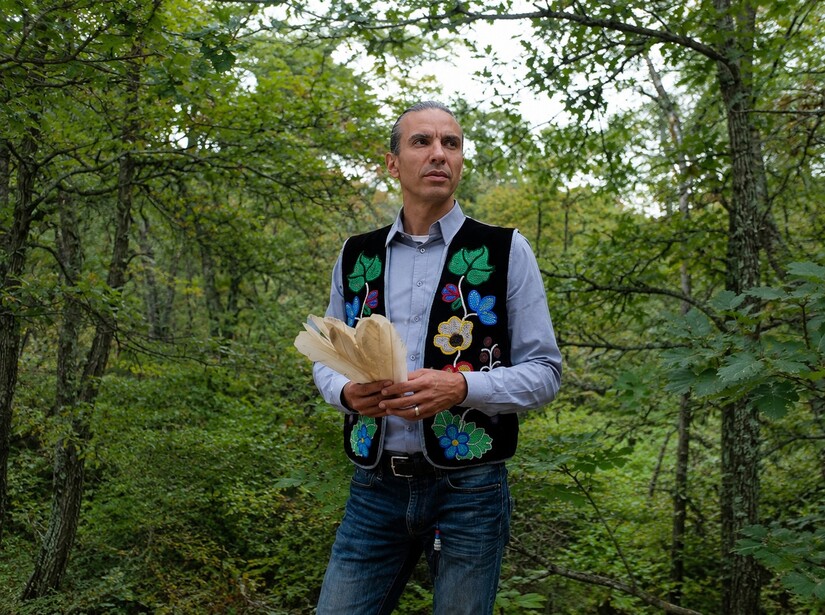
Treuer gently resisted describing his work as simple preservation.
“It’s building,” he said directly.
Languages, he explained, are alive. They evolve with each generation and adapt to changing realities.
“In English, we have words like firewall and motherboard that probably would have terrified somebody a few generations back,” he joked.
For him, language revitalization is not about freezing culture in time. It is about ensuring that language remains useful, living, and connected to everyday life.
“It’s used as a tool for the things that matter,” he said. “For me, that includes our ceremonial life and our unique worldview.”
Treuer also spoke candidly about colonization and the deeper forms of violence it imposed.
“It wasn’t someone clunking someone over the head with a club and taking their bologna sandwich kind of mean,” he said. “It was: you have to worship God the way I do. You have to speak the language I speak. You have to adopt my culture and abandon your own.”
The consequences of that history continue to shape communities generations later.
“When you solve problems with violence, it makes a lot of other problems,” he said.
Despite the historical weight carried throughout the conversation, Treuer repeatedly returned to hope.
Not abstract optimism, but tangible examples of renewal already taking place.
He described immersion schools where children are once again growing up speaking Ojibwe fluently.
“We built fluent speakers out of little kids,” he said.
He noted that it had been generations since communities had witnessed that kind of language continuity on a broad scale.
Treuer recalled an elder speaking during a language gathering in Mille Lacs.
“We’ve been through a lot the past few hundred years,” the elder told him. “But seeing what we’ve been able to build, knowing our elders will be teaching people our language for hundreds of years to come, this has been the happiest time of my life.”
For Treuer, language revitalization is not symbolic nostalgia.
“It’s about sovereignty,” he said. “It’s an economic driver. It’s at the heart of health and educational success.”
Treuer spoke extensively about misconceptions surrounding Indigenous communities and the dangers of incomplete narratives.
Referencing Nigerian writer Chimamanda Ngozi Adichie, he explained that stereotypes often become dangerous precisely because they reduce entire groups of people into narrow, repetitive images.
“With Native people, most of the stories people hear are from before 1900,” he said.
The effect, he explained, is that many Americans unconsciously view Indigenous communities as historical rather than contemporary.
At times, the misunderstandings become surreal.
“I’ve had people say, ‘It’s kind of a shame they killed all the Indians.’ And I’m saying, ‘Wait a minute. I’m feeling pretty good today.’”
Humor surfaced frequently throughout the conversation, often functioning less as entertainment than as a way of exposing absurdity without bitterness.
But underneath the humor was a serious point. Treuer believes broader and more honest storytelling is essential if societies hope to move beyond inherited distortions.
“Nobody sees the world the way it is,” he said. “We all see the world the way we are.”
At the same time, he emphasized that objective truths still exist, even when they challenge comforting narratives.
“Our reality is unsettling,” he said.
For Treuer, healing begins with the willingness to confront that discomfort honestly.

Near the end of our conversation, I asked Treuer what he hoped people would someday say he helped build.
His answer arrived without self-importance.
“I hope they will see me as someone who contributed to the healing and health of our communities,” he said. “The healing and health of our language and culture. Reconciling around difficult topics and making the world a better place.”
The conversation ended quietly, much the same way it unfolded.
No grand conclusions. No attempt at self-mythology.
Only the steady sense that the work continues.
Perhaps that is the clearest measure of builders like Anton Treuer. They understand that the most important things human beings create are rarely completed within a single lifetime. They are carried forward gradually through memory, teaching, sacrifice, language, and community.
And somewhere generations from now, long after names have faded, someone may still be speaking words that nearly disappeared, sustained by people who understood that survival is not only about enduring history, but about choosing what must continue beyond you.
MinneapoliMedia | Community. Culture. Civic Life.



Overcast, with a high of 75 and low of 55 degrees. Overcast for the morning, light rain shower in the afternoon, overcast in the evening,