43° and Overcast
Image
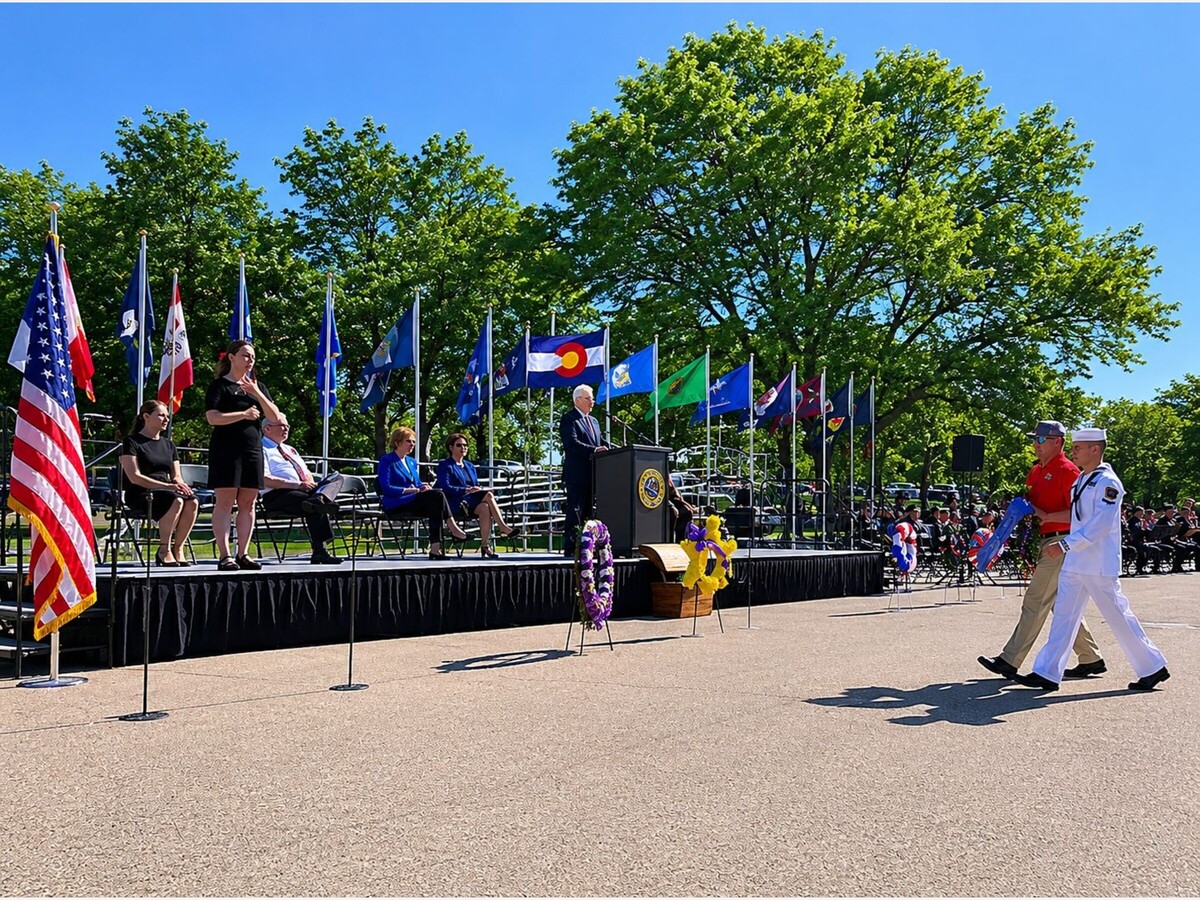



This year’s remembrance carried additional historical weight as the nation approaches the 250th anniversary of American independence, a milestone referenced repeatedly throughout the ceremony as veterans, military families, elected officials, and community members reflected on generations of sacrifice tied to the country’s wars and conflicts.
The annual Memorial Day ceremony concluded shortly after 11 a.m. following a morning marked by military ritual, patriotic music, public reflection, and one of the largest volunteer-led tribute efforts in the Upper Midwest.
Pre-ceremony activities began at approximately 9:45 a.m., with the formal remembrance program running from 10 a.m. to 11 a.m. before a crowd that included veterans, Gold Star families, active-duty military personnel, and visitors from across Minnesota.
Keynote remarks were delivered by Richard Middleton, commander of the Fort Snelling Memorial Rifle Squad, who spoke about the enduring human cost carried by military families across generations of American conflict.
“Our country's commitment to freedom during the last 250 years of wars and conflicts has been at the cost of personal sacrifice and, yes, of human lives,” Middleton said.
The ceremony incorporated many of the military traditions that have long defined Memorial Day observances across the country. Wreaths were placed in honor of the fallen. A formal moment of silence settled over the cemetery grounds. Members of the Memorial Rifle Squad carried out a ceremonial rifle volley. The familiar notes of “Taps” echoed across the cemetery as visitors stood quietly among the headstones.
Throughout the morning, the 34th Infantry Division Band, widely known as the “Red Bull” Band, performed patriotic arrangements across the cemetery grounds as families moved carefully between gravesites decorated with flags and flowers.
Marshall Murphy, director of Fort Snelling National Cemetery, told attendees the cemetery stands as a visible reminder of the price paid by generations of American service members.
“It is a solemn reminder that every freedom we enjoy was purchased at a tremendous cost,” Murphy said.
Fort Snelling National Cemetery remains one of the country’s largest military burial grounds, with roughly 200,000 service members buried at the site alongside spouses and family members connected to military service.
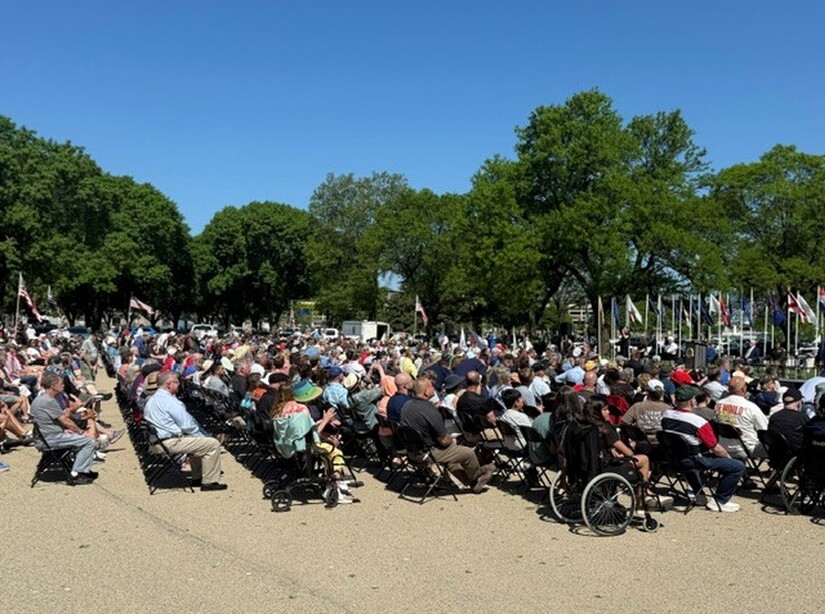
Over the weekend, more than 2,400 volunteers gathered at the cemetery to place nearly 200,000 American flags throughout the grounds in preparation for Memorial Day. The coordinated effort transformed the cemetery into one of Minnesota’s largest visual tributes to fallen military personnel.
The volunteer operation was organized largely through Flags for Fort Snelling, a Minnesota-based nonprofit organization that has coordinated annual flag placement ceremonies at the cemetery since 2015. Organizers say every dollar raised by the registered 501(c)(3) nonprofit is directed back into purchasing, preserving, transporting, and maintaining the flags used each year.
The flag coverage extended across the graves of veterans representing multiple generations of American military service, from the Civil War to Iraq and Afghanistan.
For many volunteers, the effort represented more than a ceremonial tradition. Organizers described the work as an attempt to reconnect younger generations with the historical meaning of Memorial Day beyond the unofficial beginning of summer.
“For me, it’s very humbling,” one organizer said during local television coverage of the volunteer effort. “This is what matters. I feel like so many of the younger generations kind of lost the importance of what all of this means.”
Among the elected officials attending Monday’s observance was Amy Klobuchar, who spoke about the deeply personal nature of Memorial Day for families still grieving recent military losses.
Klobuchar said she had spoken earlier in the day with Joey Amor, husband of Master Sgt. Nicole Amor, the Minnesota service member killed earlier this year while deployed in Kuwait after a drone strike hit her unit.
“She was in Kuwait, stationed there when the drone hit her unit,” Klobuchar said. “I talked to her husband Joey this morning and they're honoring Nicole and going to the gravestone, so there are families like that who recently lost someone all over Minnesota.”
The senator also reflected on her own family’s military connection, visiting the grave of her father, James Klobuchar, a Korean War veteran stationed in Germany during the Cold War.
“He was stationed in Germany, where he wrote anti-communist material during the Cold War,” Klobuchar said before laying flowers at his headstone.
Klobuchar told attendees Memorial Day continues to hold a unique place within American civic life because it often transcends political disagreement.
“What ties us together, even if we have differences on war, we always stand up for the warrior and respect the warrior,” she said. “That is what Memorial Day is about.”
The memorial landscape at Fort Snelling this year also carried additional symbolism connected to the nation’s approaching 250th anniversary.
As part of a broader national remembrance initiative known as “The Honor Project,” the National Cemetery Administration partnered with veterans organizations including Carry The Load, Victory for Veterans, and Travis Manion Foundation to expand commemorative activities through the placement of additional flowers, wreaths, and flags honoring fallen service members nationwide.
Established in 1939 near the confluence of the Mississippi and Minnesota rivers, Fort Snelling National Cemetery has become one of Minnesota’s central civic spaces for military remembrance, drawing thousands annually during Memorial Day and Veterans Day observances.
Monday’s ceremony unfolded against a broader national backdrop in which Memorial Day increasingly exists simultaneously as a day of remembrance and the unofficial beginning of summer. But within Fort Snelling National Cemetery, the atmosphere remained rooted in memory, sacrifice, and military loss.
Families paused quietly beside headstones carrying flowers, photographs, and handwritten messages. Veterans saluted former comrades. Children moved carefully between grave markers while parents explained military service and sacrifice.
The flags placed over the weekend will remain standing throughout the week before volunteers return next Saturday to carefully remove, preserve, and store them for reuse in future ceremonies.
For many attendees leaving the cemetery Monday afternoon, the image lingering longest was not necessarily the speeches or formal ceremony itself, but the scale of remembrance spread across the landscape: hundreds of thousands of graves, nearly 200,000 American flags, and the quiet acknowledgment that Memorial Day remains inseparable from the enduring human cost of war.
MinneapoliMedia | Community. Culture. Civic Life.


Sunny, with a high of 52 and low of 41 degrees. Overcast for the morning, sunny in the afternoon, clear in the evening, overcast overnight.