70° and Clear
Image
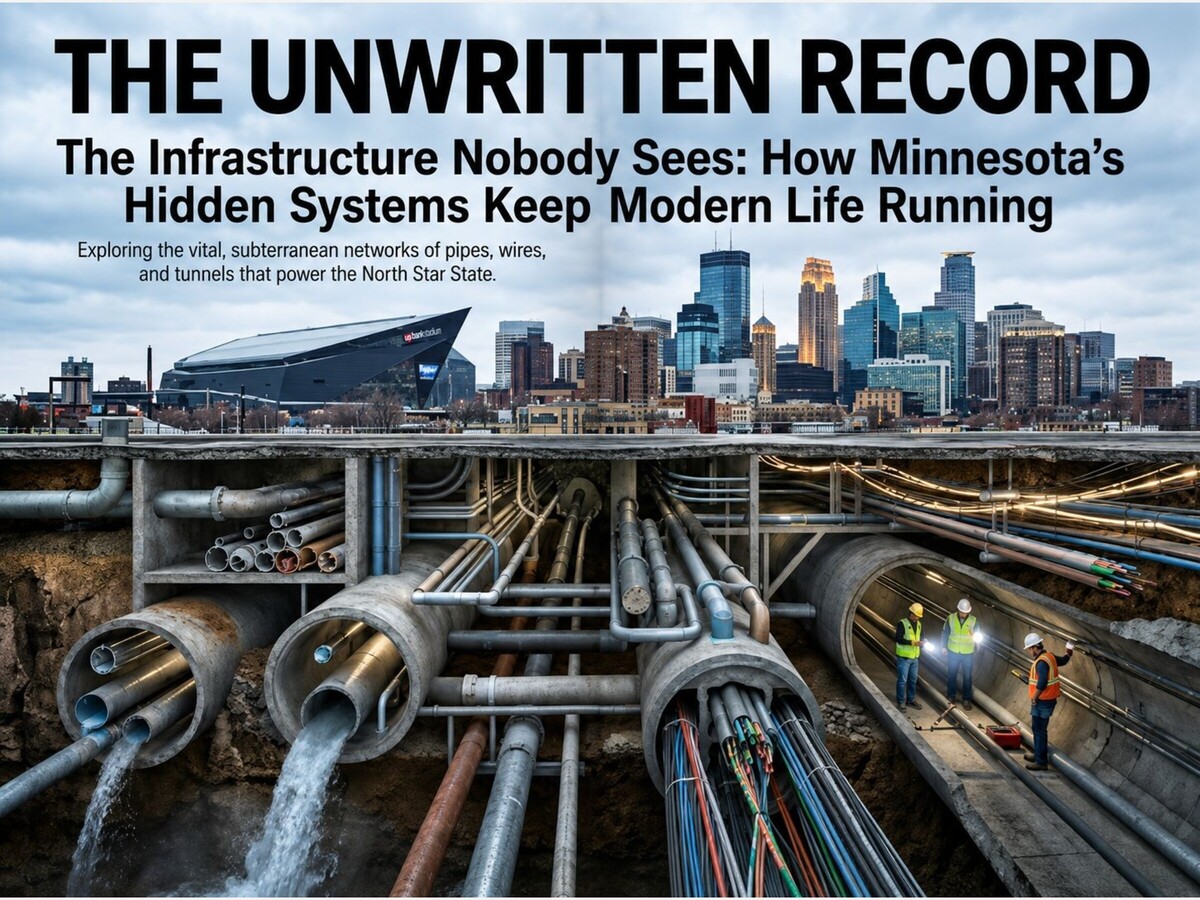



Every morning across Minnesota, millions of people begin their day by relying upon systems they will never see.
They turn on a faucet and expect clean drinking water. They leave their homes and expect roads to be safe and passable. They send emails, call emergency services, flush toilets, switch on lights, and travel across bridges without giving much thought to the complex networks operating beneath their feet and beyond their sight. These expectations feel so ordinary that they rarely register as expectations at all. They are simply part of modern life.
Yet modern life depends upon an extraordinary assumption: that the systems supporting it will continue to function.
For much of the past half century, that assumption has proven remarkably reliable. Water has flowed. Roads have remained open. Stormwater has drained away from homes and businesses. Emergency communications systems have connected residents to help when they needed it most. Wastewater has been safely collected and treated. Public facilities have operated quietly in the background, rarely attracting attention unless something went wrong.
The reliability of these systems has created a peculiar form of invisibility. The better infrastructure performs, the less people think about it. Success is measured not by what residents notice but by what they never have to notice. Most Minnesotans know where their schools are located, where city hall stands, and where major roads intersect. Far fewer could identify the route of the water mains serving their neighborhoods, the location of the treatment facilities protecting public health, or the network of stormwater infrastructure preventing routine rainfall from becoming a public emergency.
This invisibility has become one of the defining characteristics of modern infrastructure. It is also one of the reasons so many Minnesotans find themselves puzzled by conversations surrounding property taxes, utility rates, municipal borrowing, and public works spending. Residents often see the bill. They rarely see the systems behind it.
What makes this moment particularly significant is that Minnesota is entering a period unlike any it has experienced in generations. Across the state, communities are confronting the reality that much of the infrastructure supporting modern life was built during the same broad era of expansion and growth. The pipes, roads, treatment facilities, public buildings, and utility systems that transformed Minnesota during the decades following World War II are now reaching ages at which maintenance alone is no longer sufficient. Increasingly, communities are being asked not simply to preserve these systems but to replace them.
That distinction matters.
Maintenance is the work of extending the life of an asset. Replacement is the work of accepting that the asset's life is ending.
Across Minnesota, that transition is occurring simultaneously across multiple categories of infrastructure, creating financial, operational, and political pressures that are reshaping conversations in city halls, county offices, utility commissions, and public works departments. To many residents, these pressures appear disconnected. A road reconstruction project in one city, a water rate increase in another, a major treatment facility upgrade somewhere else. Viewed separately, they seem like isolated events. Viewed together, they tell a much larger story.
It is the story of a generation inheriting the physical foundation built by another generation and discovering that stewardship carries obligations as well as benefits.
The roots of that story stretch back to one of the most transformative periods in Minnesota history.
Following World War II, communities throughout Minnesota experienced extraordinary growth. Returning veterans purchased homes, families expanded, businesses invested, and suburban development accelerated. New neighborhoods emerged around Minneapolis and Saint Paul. Regional centers grew. Rural communities modernized public services. The state invested heavily in roads, water systems, sewer networks, schools, public buildings, and utility infrastructure designed to support a growing population and a growing economy.
These investments fundamentally changed Minnesota. Communities that once depended upon wells and septic systems expanded into modern municipal networks. Roads connected people and commerce at unprecedented scales. Public infrastructure enabled residential development, industrial expansion, educational opportunities, and economic growth. The physical systems built during this era became so successful that later generations often forgot they had ever been built at all.
The Long Years of Invisible Success
For decades, those investments performed exactly as intended.
Water systems delivered clean drinking water to growing communities. Wastewater treatment facilities protected public health and environmental quality. Roads connected neighborhoods to schools, businesses, and employment centers. Public buildings housed the civic institutions upon which communities depended. Utility systems provided reliability that previous generations could scarcely have imagined.
The remarkable aspect of this success was not simply that the systems worked. It was that they worked continuously.
A child born in a Minnesota suburb in 1965 could grow into adulthood without ever questioning whether clean water would emerge from the faucet. A family purchasing a home in the 1980s rarely asked how old the underground infrastructure might be because there was little reason to ask. Roads were maintained. Utilities functioned. Public services continued. The infrastructure built during the postwar decades became so dependable that it faded from public awareness.
In many ways, that invisibility represented the highest form of success. Residents were free to focus on their families, careers, businesses, schools, and communities because they could trust the underlying systems supporting everyday life. Infrastructure did not demand attention. It simply worked.
Yet while communities moved forward, time continued its work beneath the surface.
Water mains aged. Mechanical systems accumulated wear. Electrical components approached the limits of their useful lives. Public buildings required modernization. Roads experienced decades of freeze-thaw cycles. Treatment facilities faced evolving environmental standards and technological requirements. None of these developments occurred suddenly. They unfolded gradually, often hidden from public view.
The challenge confronting Minnesota today is not the result of a single failure or policy decision. It is the consequence of time itself.
Infrastructure ages whether communities pay attention to it or not.
The engineers who designed many of these systems understood that reality. Water mains were never intended to last forever. Treatment facilities were designed with expected service lives. Roads were built with maintenance and eventual reconstruction in mind. Every piece of infrastructure carries an anticipated lifespan, after which replacement becomes increasingly unavoidable.
What makes the present moment unusual is that so many of those timelines are converging at once.
Across Minnesota, communities are discovering that assets constructed during the same broad period of growth are now reaching similar stages of deterioration. The result is not one replacement project, one budget challenge, or one difficult decision. It is a sustained cycle of reinvestment occurring across multiple systems simultaneously.
A city replacing aging water infrastructure may also face road reconstruction needs. A wastewater treatment facility may require modernization at the same time public buildings demand significant capital improvements. Communications systems may require technological upgrades while parks, bridges, and utility infrastructure compete for limited resources.
Each individual project can be justified on its own merits. Collectively, however, they reveal something larger.
Minnesota is entering one of the most significant infrastructure replacement periods in its modern history.
This reality helps explain why infrastructure has emerged as a recurring subject in conversations about local government finance. Residents frequently encounter the consequences through property tax statements, utility bills, construction projects, and capital improvement plans. What is less visible is the historical context connecting these developments.
When communities debate whether to replace aging water mains, rehabilitate treatment facilities, modernize emergency communications systems, or reconstruct deteriorating roads, they are not necessarily confronting new problems. More often, they are confronting old investments reaching the end of their intended life cycles.
The distinction is important because it reframes the conversation. Infrastructure challenges are often discussed as though they represent sudden crises. In many cases, they are better understood as predictable outcomes of decisions made decades earlier. The infrastructure built by previous generations succeeded. It lasted. It supported growth. It enabled prosperity. It performed the tasks for which it was designed.
Now it requires renewal.
That renewal arrives at a particularly difficult moment. The economic environment facing communities today bears little resemblance to the environment that existed when many of these systems were originally constructed.
The cost of construction materials has increased substantially. Engineering and design requirements have become more complex. Environmental regulations have evolved. Technology expectations have expanded. Public agencies must account for cybersecurity risks, resilience planning, and sophisticated monitoring systems that would have been unimaginable to many local governments in the 1950s and 1960s.
Communities are not merely replacing infrastructure. They are replacing it in a world that has become far more expensive and far more complicated.
This reality creates a challenge that extends beyond dollars and cents. It raises fundamental questions about stewardship, public priorities, and the obligations each generation bears toward the next. The residents who benefit from today's infrastructure did not build most of it. Likewise, the residents who will benefit from tomorrow's infrastructure have not yet arrived.
Infrastructure therefore occupies a unique place in public life. It requires communities to think beyond immediate circumstances and make decisions whose consequences may not be fully realized for decades.
That responsibility becomes even more significant when considering the people who operate these systems every day. While discussions often focus on pipes, roads, facilities, and equipment, infrastructure ultimately depends upon human expertise. Without the workforce responsible for operating, maintaining, and improving these systems, even the most advanced infrastructure would quickly become ineffective.
The public often thinks of infrastructure as a collection of physical things. Roads, bridges, water towers, treatment facilities, utility networks, and public buildings are visible expressions of infrastructure, and they naturally attract attention because they can be seen, measured, and photographed.
Yet the infrastructure supporting modern life is not merely physical.
It is also human.
Behind every functioning system exists a workforce whose knowledge, training, and experience are just as essential as the assets themselves. Water treatment operators monitor drinking water quality around the clock. Wastewater professionals oversee complex biological and mechanical processes that protect both public health and environmental quality. Engineers evaluate asset conditions, forecast future needs, and design replacement strategies. Public works employees maintain roads, parks, equipment, and facilities. Utility crews respond to failures before they become crises. Information technology professionals protect critical public systems from cyber threats. Dispatchers coordinate emergency communications that residents rely upon during moments of uncertainty and danger.
Most residents rarely encounter these professionals during routine operations.
In fact, the public's awareness of infrastructure workers often follows the same pattern as its awareness of infrastructure itself. The better the system performs, the less attention it receives.
Residents notice utility crews after a major storm. They notice public works employees when roads are closed for repairs. They notice water operators when boil-water advisories are issued. They notice dispatchers when emergencies occur. During ordinary days, however, the people responsible for keeping communities functioning largely disappear into the background.
This invisibility can obscure one of the most significant challenges facing local governments across Minnesota.
Many of the professionals who built careers maintaining and operating public infrastructure are approaching retirement age.
For decades, communities benefited from employees whose expertise was accumulated through years of practical experience. They learned the peculiarities of local water systems. They understood which facilities required extra attention during severe weather. They knew where historical repairs had been made, how older equipment functioned, and which maintenance practices had proven successful over time. Much of this knowledge existed not only in manuals and engineering drawings but in memory, observation, and experience.
As those employees retire, communities are discovering that replacing infrastructure and replacing institutional knowledge are often interconnected challenges.
The issue extends across multiple sectors. Water treatment operators must obtain specialized certifications and complete extensive training. Wastewater facilities require highly skilled personnel capable of managing increasingly sophisticated treatment processes. Engineers face growing demands as communities plan large-scale replacement projects. Public works departments compete with private industry for skilled tradespeople, equipment operators, mechanics, electricians, and technicians.
Recruiting new workers into these fields is not always easy.
Many infrastructure careers operate largely outside public view. Young people may be familiar with careers in healthcare, law, education, technology, or business while having little understanding of the opportunities available in public works, utilities, water operations, or municipal engineering. At the same time, the technical requirements of many infrastructure-related occupations continue to increase.
Modern infrastructure systems are substantially more sophisticated than the systems built during the postwar era.
A contemporary water treatment facility is no longer simply a collection of pumps, pipes, and valves. It is an integrated technological environment incorporating sensors, automated controls, digital monitoring systems, data analytics, and cybersecurity protections. Wastewater treatment plants rely upon advanced operational processes and increasingly sophisticated environmental compliance standards. Emergency communications networks connect multiple jurisdictions through technologies that require specialized expertise to manage effectively.
The same transformation can be observed across virtually every category of public infrastructure.
Road maintenance increasingly incorporates digital asset management systems. Utility networks rely upon advanced monitoring technologies. Municipal facilities employ energy management systems designed to improve efficiency and reduce costs. Public agencies store and protect enormous amounts of digital information, making cybersecurity a critical infrastructure responsibility rather than a purely technological concern.
The result is that communities face a dual transition.
They are replacing aging physical infrastructure while simultaneously adapting to a future in which infrastructure is becoming more technologically complex, more interconnected, and more dependent upon specialized expertise.
This convergence creates a challenge that extends beyond engineering or finance. It is fundamentally a challenge of continuity.
Every generation inherits physical assets from the people who came before. Less often acknowledged is the fact that communities also inherit knowledge. They inherit lessons learned through experience, relationships built through years of service, and an understanding of local systems that cannot be fully captured in reports or databases.
When experienced infrastructure professionals retire, communities are tasked with transferring that knowledge to a new generation of workers while continuing to operate systems that residents depend upon every day.
This work rarely attracts headlines.
There are no ribbon-cuttings for institutional memory. No public ceremonies commemorate the successful transfer of operational expertise from one generation to another. Yet these transitions may ultimately prove just as important as any capital project.
A city can invest millions of dollars replacing a water treatment facility. It still requires skilled operators capable of managing that facility effectively. A county can modernize emergency communications systems. It still depends upon trained professionals to coordinate responses during moments of crisis. Infrastructure, no matter how advanced, remains inseparable from the people responsible for operating it.
This reality reinforces a broader truth that often goes unnoticed in public discussions. Infrastructure is not merely a collection of assets owned by government. It is an ongoing relationship between physical systems, human expertise, and public trust. Remove any one of those elements and the entire structure becomes less reliable.
The challenge facing Minnesota therefore extends beyond the replacement of pipes, roads, buildings, and equipment. It includes the responsibility of preparing a new generation to inherit the knowledge required to sustain them.
That responsibility has become even more urgent as communities confront another emerging reality. The infrastructure systems built during the twentieth century are being asked to perform in a twenty-first century environment shaped by new technologies, new risks, and new environmental pressures that their designers could not fully anticipate.
The infrastructure inherited by today's communities was designed for a different Minnesota.
It was designed for a state whose population was smaller, whose economy was less digitally dependent, and whose public expectations were shaped by a very different technological reality. The engineers, planners, and public officials who oversaw much of the infrastructure expansion following World War II built systems that were sophisticated for their time and remarkably durable by any reasonable standard. What they could not fully anticipate was the pace and scale of change that would occur during the decades that followed.
The modern economy depends upon forms of connectivity that barely existed when many of Minnesota's foundational infrastructure systems were constructed. Businesses rely upon digital networks. Schools integrate technology into nearly every aspect of instruction. Hospitals depend upon complex data systems and communications infrastructure. Public safety agencies coordinate responses through interconnected technologies that operate across jurisdictions and disciplines. Local governments manage vast quantities of information that must remain secure, accessible, and reliable.
As a result, infrastructure has become more than a collection of physical assets. It has become an integrated network of physical and digital systems whose reliability increasingly depends upon technology.
Consider a modern water treatment facility. From the outside, it may appear similar to facilities built decades ago. Water enters, is treated, tested, and distributed to homes and businesses. Yet beneath that familiar process lies a technological environment that previous generations could scarcely have imagined. Sensors continuously monitor system performance. Automated controls regulate treatment processes. Operators rely upon digital monitoring platforms to identify potential issues before they become operational failures. Cybersecurity protections help defend critical infrastructure from threats that did not exist when many facilities were first designed.
The same pattern extends throughout modern public infrastructure.
Emergency communications systems depend upon sophisticated digital networks. Transportation systems increasingly incorporate technology designed to improve safety and efficiency. Public facilities employ automated energy management systems. Utility providers rely upon real-time monitoring capabilities. Even routine maintenance decisions are increasingly informed by digital asset management tools that help communities prioritize investments and anticipate future needs.
This transformation has created new opportunities, but it has also created new vulnerabilities.
A generation ago, infrastructure planning focused primarily on physical deterioration. Roads cracked. Pipes corroded. Equipment wore out. Those challenges remain, but communities must now also consider technological obsolescence, cybersecurity risks, data protection requirements, and the growing interdependence of systems that once operated more independently.
The challenge is particularly significant because infrastructure failures today can have consequences that extend far beyond the physical asset itself.
A water main break remains a water main break. Yet modern infrastructure systems are so interconnected that disruptions can affect communications, transportation, emergency response capabilities, and public confidence in ways that previous generations rarely encountered. The systems supporting contemporary life are more capable than ever before, but they are also more complex.
At the same time, communities are confronting environmental realities that were not central considerations when much of Minnesota's infrastructure was originally constructed.
For generations, engineers relied upon historical patterns to guide infrastructure design. Stormwater systems were sized according to expected rainfall events. Roads and bridges were designed based upon known environmental conditions. Utility infrastructure reflected assumptions about weather, demand, and operational requirements that had proven reliable over time.
Today, many of those assumptions are being reexamined.
Across Minnesota, communities are increasingly evaluating infrastructure through the lens of resilience. The question is no longer simply whether a system performs adequately under normal conditions. The question is whether it will continue to perform under conditions that may be more extreme, less predictable, or fundamentally different from those for which it was originally designed.
Heavy rainfall events can place significant pressure on drainage systems. Extended periods of heat can affect roads, facilities, and utility infrastructure. Severe storms create challenges for transportation networks, communications systems, and emergency response operations. Communities are finding that infrastructure planning must account not only for the conditions of the present but also for the uncertainties of the future.
This shift represents a profound change in the philosophy of public investment.
Historically, infrastructure planning often focused on replacement. An aging asset would eventually be renewed or rebuilt. Today, replacement alone may not be sufficient. Communities are increasingly being asked to improve systems while replacing them, enhancing resilience while maintaining affordability, and preparing for future conditions while managing present-day demands.
The financial implications of this transition are substantial.
When residents observe major infrastructure projects, they often see construction activity, temporary inconveniences, and significant expenditures. What is less visible is the extent to which those projects frequently involve preparing communities for future challenges as much as addressing existing needs. Infrastructure investments increasingly reflect both replacement and adaptation.
This reality helps explain why conversations about infrastructure have become inseparable from conversations about public finance.
Residents frequently encounter infrastructure through tax statements, utility bills, and public budget discussions. Yet those documents rarely tell the full story. Beneath every capital improvement plan lies a series of decisions about how communities intend to balance current obligations with future responsibilities. Every infrastructure project requires local leaders to answer difficult questions about priorities, timing, affordability, and risk.
Those decisions are rarely simple because infrastructure occupies a unique place in public life. The costs are often immediate. The benefits frequently unfold over decades. Today's residents may pay for improvements whose greatest value will be realized by future generations. Future generations, in turn, will inherit systems made possible by investments they did not personally fund.
In that sense, infrastructure represents one of the clearest expressions of intergenerational stewardship found in public life.
The roads, treatment facilities, public buildings, and utility systems supporting Minnesota today exist because previous generations chose to invest in a future they would never fully see. The question now facing communities across the state is whether they possess the same willingness to invest on behalf of those who will follow.
This is where public conversation often becomes most difficult.
Infrastructure rarely inspires the excitement associated with new development, cultural projects, athletic facilities, or visible civic improvements. Residents understandably prefer to see tangible results from public investment. A new building can be visited. A new park can be enjoyed. A community event can be experienced directly. Infrastructure often asks communities to invest in things they may never see.
A water main replacement project disappears beneath the street once construction is complete. A stormwater improvement project may be invisible except during periods of severe weather. Upgrades to communications systems, cybersecurity protections, treatment facilities, and utility networks often leave no visible evidence of the investment that occurred. Their success is measured by reliability rather than visibility.
This reality creates a challenge for local governments throughout Minnesota. Public officials must frequently make the case for investments whose greatest achievement is preventing problems that may never occur. Success is not always visible. Failure, however, is often immediate.
A bridge that remains safe rarely attracts public attention. A bridge that fails becomes a crisis. A treatment facility that consistently protects water quality receives little notice. A treatment facility that experiences a significant failure quickly becomes the focus of public concern. Roads that function properly are generally taken for granted. Roads that deteriorate beyond acceptable conditions become subjects of frustration and criticism.
Infrastructure therefore exists within an unusual relationship with public perception. Communities depend upon it every day, yet its value often becomes most apparent only when it is absent.
The challenge facing Minnesota today is not whether infrastructure matters. The challenge is whether communities are prepared to recognize its importance before failure forces the conversation.
This question extends beyond engineering, budgeting, and construction schedules. At its core, it is a question about stewardship.
Every generation inherits a physical world it did not create.
The roads carrying today's traffic were largely built by people who are no longer driving on them. The water systems serving today's neighborhoods were often installed before many current residents were born. Public facilities, utility networks, treatment plants, and countless other public assets exist because previous generations invested resources, accepted inconvenience, and made decisions whose benefits would not be fully realized for years or even decades.
Modern Minnesota is, in many respects, the accumulated result of those decisions.
Residents inherit the benefits every day. They inherit reliable drinking water. They inherit public safety systems. They inherit transportation networks, parks, libraries, schools, utility systems, and public institutions. They inherit communities capable of supporting economic activity, educational opportunity, healthcare access, and civic life.
What is less frequently acknowledged is that inheritance also includes responsibility.
Infrastructure is not self-sustaining. Roads do not repair themselves. Water systems do not renew themselves. Public buildings do not modernize themselves. Every generation eventually confronts the same obligation faced by those who came before: deciding whether to invest in systems whose greatest beneficiaries may be people they will never meet.
This responsibility can be difficult to recognize because infrastructure operates on a timescale far longer than most public debates.
Election cycles are measured in years. Infrastructure lifecycles are often measured in decades.
Budget discussions focus on immediate costs. Infrastructure investments frequently generate benefits that extend across generations.
Public attention naturally gravitates toward urgent issues. Infrastructure demands attention to long-term realities.
Yet communities ultimately rise or fall based upon their ability to manage both.
The decisions being made in Minnesota today will shape the experience of residents for decades to come. The water systems being replaced, the roads being reconstructed, the facilities being modernized, and the technologies being integrated into public infrastructure will become part of the physical foundation inherited by future generations.
Most of the people who benefit from those investments may never know when they occurred. They may never learn the names of the engineers who designed them, the operators who maintained them, the public officials who approved them, or the taxpayers who helped fund them.
They will simply experience the results.
Water will flow when they turn on a faucet.
Roads will carry them to work and school.
Emergency responders will answer when called.
Public systems will continue functioning quietly in the background of daily life.
In many ways, that is the highest purpose of infrastructure. It creates the conditions under which communities can focus on everything else. It provides the reliability that allows businesses to operate, schools to educate, hospitals to heal, and families to build their lives. It rarely seeks recognition. It simply performs its function, year after year, generation after generation.
That reliability is neither accidental nor inevitable.
It is the product of choices.
It is the product of planning, investment, expertise, and stewardship carried forward over time by people who understood that the most important things they built might never be fully seen.
The infrastructure nobody sees is therefore more than a collection of pipes, roads, facilities, and utility systems. It is the physical expression of a promise that every generation makes to the next. It is an agreement that communities will not merely consume what they inherit, but will preserve, improve, and pass it forward.
Minnesota now stands at a moment when that promise is being tested. The systems that helped create modern life are aging. The workforce that maintained them is changing. The technologies that support them are evolving. The environmental conditions affecting them are shifting. The costs associated with sustaining them are increasing.
Yet the fundamental question remains remarkably simple.
Will today's generation demonstrate the same commitment to the future that previous generations demonstrated toward them?
The answer will not be found in a single project, budget, or policy decision. It will emerge gradually through thousands of decisions made by communities across the state over the coming years and decades.
Those decisions will determine whether the infrastructure that remains largely invisible today continues serving future Minnesotans with the same reliability that current residents often take for granted.
Because before a community can pursue prosperity, innovation, education, public safety, economic development, or cultural growth, it must first accomplish something far more fundamental.
It must create and sustain the conditions that allow daily life to function.
For generations, Minnesota's hidden infrastructure has done exactly that.
The question now is whether the next generation will be prepared to do the same.
MinneapoliMedia | Community. Culture. Civic Life.

Sunny, with a high of 97 and low of 66 degrees. Sunny for the morning, clear for the afternoon and evening,