67° and Cloudy
Image
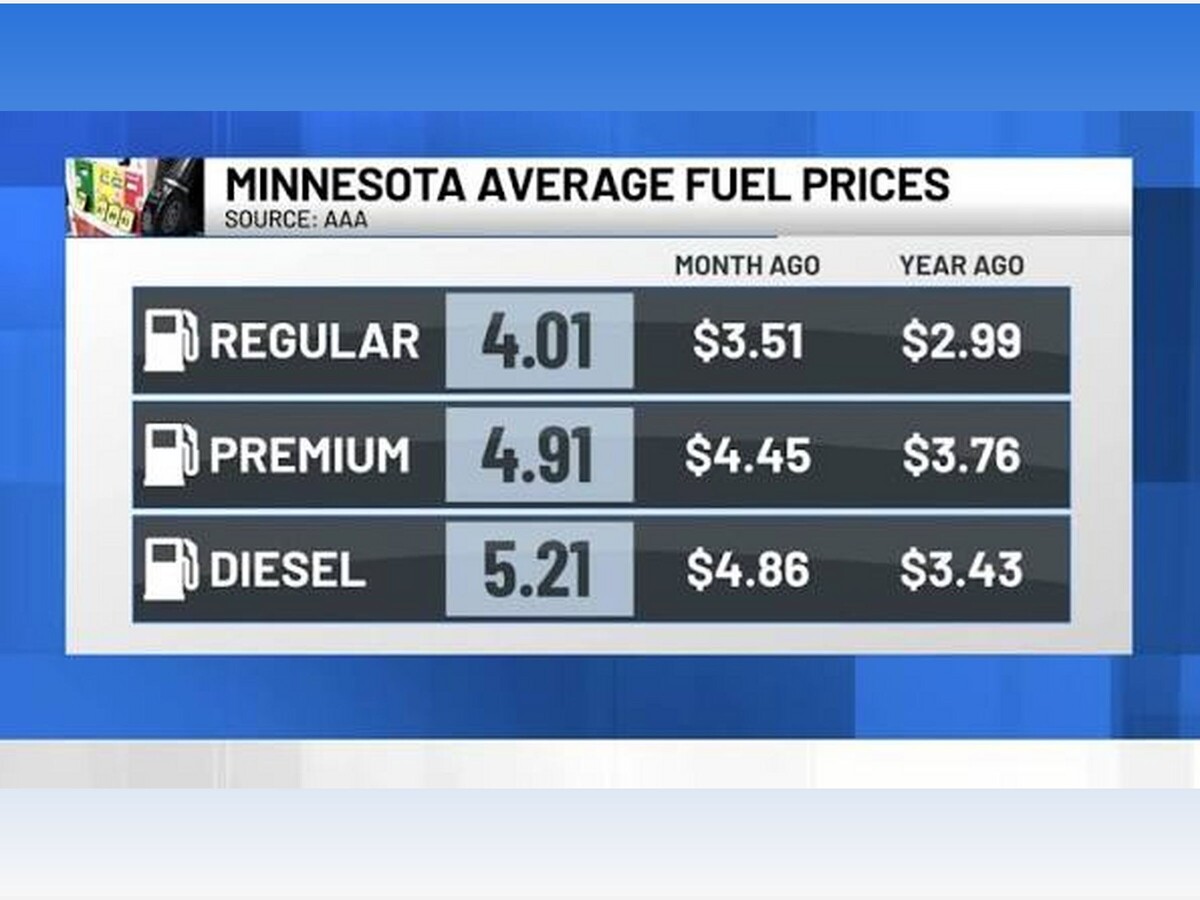



AAA reported Monday that regular gasoline averaged $4.088 per gallon in Minneapolis-Saint Paul. That was approximately 17 cents higher than the metro average of $3.921 one week earlier.
The current average was also about 45 cents above the $3.641 recorded one month earlier and approximately $1.08 higher than the $3.006 average reported at the same point in 2025.
The statewide Minnesota average stood at $4.037 per gallon Monday, compared with $3.873 one week earlier, $3.641 one month earlier and $2.98 one year earlier.
The national average was $4.11 Monday, meaning both Minnesota’s statewide average and the Twin Cities metro average remained slightly below the national figure despite their recent increases.
AAA reported the following Monday averages for regular gasoline:
Prices vary among stations and neighborhoods, so individual drivers may encounter amounts above or below the regional averages.
Diesel fuel presented an even greater expense. AAA placed Minnesota’s statewide diesel average at $5.136, while the Minneapolis-Saint Paul average reached $5.204.
Higher diesel costs can affect more than truck drivers. Businesses may pass increased freight, agricultural and delivery expenses to consumers through higher prices for groceries, construction materials and other goods.
AAA has attributed the broader national increase primarily to rising crude-oil prices and instability affecting international petroleum markets.
FOX 9 reported that tensions involving the United States and Iran, along with Ukrainian attacks on Russian oil infrastructure, were contributing to uncertainty in global energy markets.
AAA said in its July 23 national analysis that volatility near the Strait of Hormuz and instability in the region had pushed crude-oil prices into the $90-per-barrel range. The organization cautioned that those conditions could keep fuel costs elevated during the second half of summer.
Retail gasoline prices do not move in perfect alignment with crude oil. Refinery capacity, distribution expenses, taxes, seasonal fuel requirements and local competition also influence what drivers pay.
For families that drive long distances to work, child care, medical appointments or school activities, a 17-cent weekly increase can quickly become significant.
At Monday’s Twin Cities average, filling a 15-gallon tank cost approximately $61.32. At the corresponding 2025 average, the same amount would have cost about $45.09, a difference of more than $16 per fill-up.
Workers without reliable public transportation may have little ability to reduce their fuel consumption. Rising gasoline prices can therefore take money directly from household spending on food, rent, utilities and other necessities.
Drivers can reduce fuel use by combining errands, maintaining correct tire pressure, avoiding unnecessary idling and comparing local prices before filling their tanks. Those measures, however, cannot eliminate the burden for households whose work and family responsibilities require frequent travel.
AAA updates its state and metro averages daily, meaning the figures may change before the end of the week.
Sources: AAA Minnesota gas-price report; AAA national price analysis; FOX 9
MinneapoliMedia | Community. Culture. Civic Life.



Overcast, with a high of 86 and low of 67 degrees. Moderate rain for the morning, overcast in the afternoon,