70° and Clear
Image
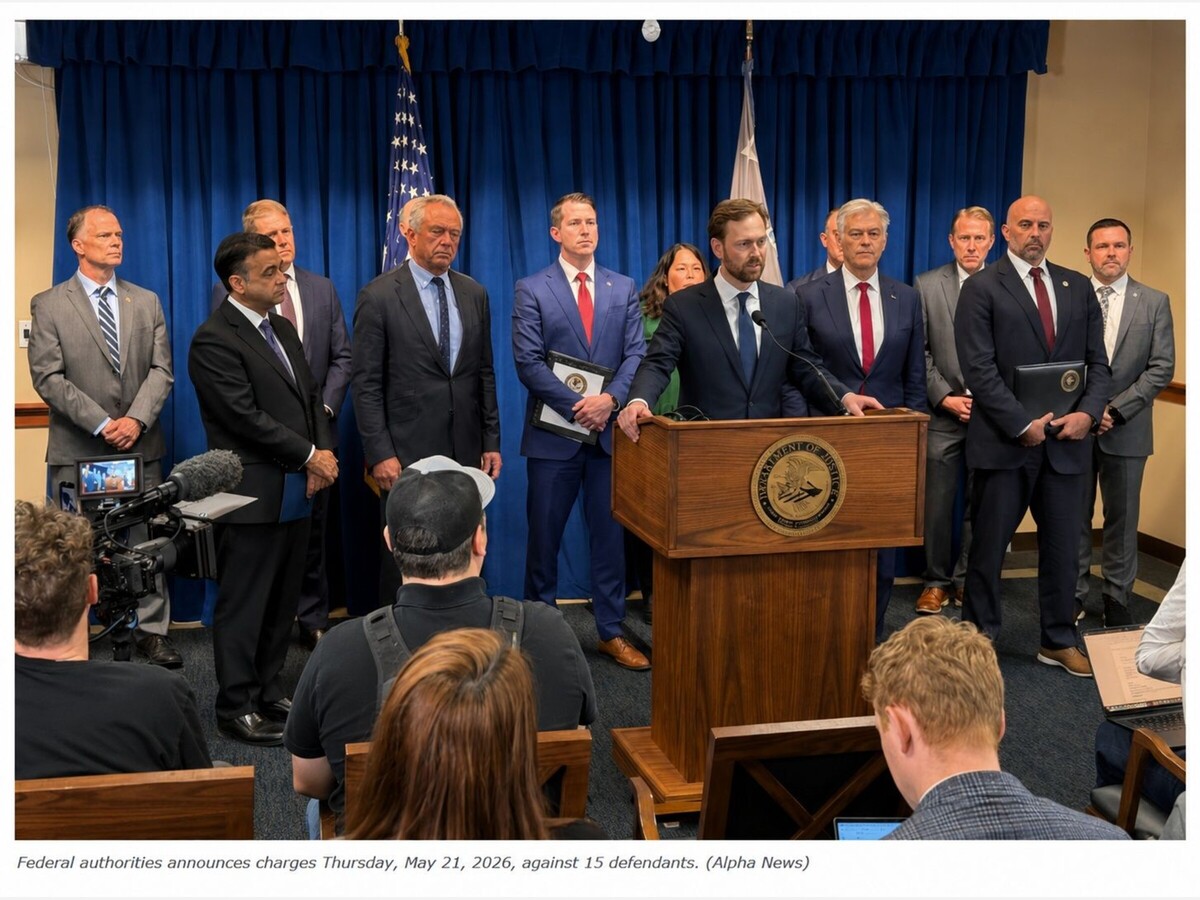



BLUE EARTH, MN (June 16, 2026) What federal authorities describe as one of Minnesota's largest recent Medicaid fraud cases did not unfold in the Twin Cities or inside a sprawling corporate health care network.
Instead, prosecutors say it operated out of a small southern Minnesota community where a company known as Healey Homes built its reputation around helping vulnerable adults live independently.
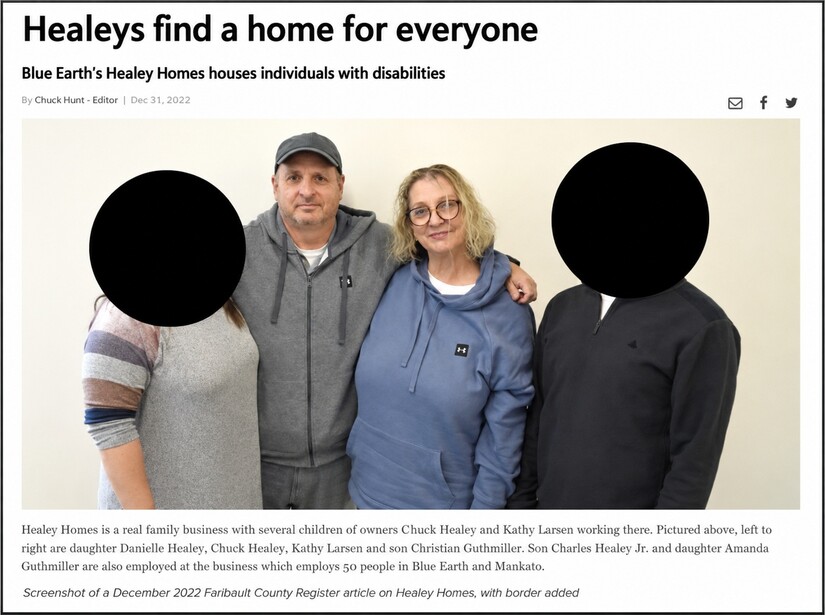
Now, the company's former operators, Charles Wayne Healey, 61, and Katherin Suzan Larsen-Guthmiller, 66, face federal criminal charges alleging they used that mission as the foundation for a years-long scheme that generated approximately $22.7 million in fraudulent Medicaid reimbursements.
The pair were indicted by a federal grand jury on May 21, 2026, on charges of conspiracy to commit health care fraud and money laundering, according to the U.S. Department of Justice.
Federal prosecutors allege the scheme operated between 2021 and the fall of 2025, when the Minnesota Department of Human Services shut down Healey Homes after identifying compliance concerns related to the company's operations.
The indictment is part of a broader federal and state enforcement action announced jointly by the U.S. Department of Justice and Minnesota Attorney General Keith Ellison. Authorities say the multi-agency effort uncovered approximately $90 million in alleged Medicaid fraud across Minnesota, spanning multiple health care, housing and support-service programs funded by taxpayers.
Among those cases, Healey Homes stands out because of both the amount allegedly involved and the population prosecutors say was exploited: vulnerable adults receiving Medicaid-funded support services intended to help them maintain independent lives in community settings.
At the center of the indictment is Minnesota's Individualized Home Supports (IHS) program.
The Medicaid-funded program was designed to provide assistance to people with disabilities and other vulnerable adults who are living in homes they own, lease, or otherwise independently control. The intent is to allow recipients to remain integrated within the community rather than residing in provider-operated residential facilities.
According to federal prosecutors, that distinction is critical.
Authorities allege Healey and Larsen-Guthmiller systematically violated the rules governing the program by placing clients in residences that were secretly owned and controlled by the defendants while simultaneously billing Medicaid for IHS services that, under program regulations, were not eligible for reimbursement in provider-controlled settings.
The indictment alleges that the defendants concealed their ownership interests in the homes and structured transactions through an entity known as Briar Cliff Homes.
Prosecutors contend the arrangement allowed Healey Homes to create the appearance that clients were living independently while enabling the company to continue billing Medicaid for services that otherwise would not have qualified for reimbursement.
According to the Department of Justice, Healey Homes ultimately received approximately $22.7 million in Medicaid payments during the period covered by the indictment.
Federal authorities allege the operation relied on a combination of housing control, financial incentives and false billing.
The indictment claims the defendants charged residents below-market rent, creating an incentive for vulnerable adults to remain in the properties and continue participating in the arrangement.
Prosecutors further allege that residents effectively allowed Healey Homes to use their living arrangements as the basis for ongoing Medicaid billing despite the fact that the housing situation violated eligibility requirements for the program.
Beyond the alleged structural violations, authorities also claim some services billed to Medicaid were never provided.
According to allegations outlined by investigators, Larsen-Guthmiller submitted claims for in-person support services on behalf of at least one recipient who was actually residing in an inpatient drug treatment facility at the time the services were purportedly delivered.
Federal authorities further allege that documentation and case notes were falsified to support those reimbursement claims.
The government argues that these actions transformed what it describes as a regulatory violation into a criminal fraud operation that generated millions of dollars in public reimbursements.
The criminal allegations follow the dramatic collapse of Healey Homes in 2025.
After a state review identified concerns regarding compliance with Medicaid requirements, the Minnesota Department of Human Services terminated funding for the operation.
The closure reverberated throughout Blue Earth and surrounding communities.
Approximately 100 employees lost their jobs, according to local reporting, while roughly 20 vulnerable adults residing in Healey Homes-related properties were forced to relocate and transition to new service providers.
For many residents, the shutdown represented the abrupt end of an organization that had become a visible part of the local community.
Long before federal charges were filed, Charles Healey publicly challenged the state's characterization of the issues facing his company.
In interviews with the Faribault County Register following the closure, Healey maintained that Healey Homes had been targeted over administrative deficiencies rather than fraudulent conduct.
He described the problems identified by regulators as record-keeping and compliance issues that the company was actively attempting to correct.
Healey argued that the organization's mission was to provide vulnerable adults with a higher quality of life than traditional group-home settings often offer.
According to his public statements, clients were able to live in neighborhood homes, maintain employment, participate in recreational activities and experience greater independence than would otherwise be available in more institutional environments.
"There has never been even a whiff of fraud in our operation," Healey told the newspaper at the time.
He further asserted that local human services agencies, guardians and other stakeholders were aware of the housing arrangements utilized by the company.
Federal prosecutors now dispute those assertions through the allegations laid out in the indictment.
Neither Healey nor Larsen-Guthmiller has been convicted of any crime, and both are presumed innocent unless and until proven guilty in federal court.
The Healey Homes prosecution emerged from a broader effort by federal and state authorities to address what officials have increasingly described as systemic vulnerabilities within Minnesota's Medicaid system.
The May 2026 enforcement action involved multiple investigations and defendants accused of exploiting a variety of publicly funded programs.
Attorney General Keith Ellison said investigators from the Minnesota Medicaid Fraud Control Unit worked closely with federal partners to identify and pursue cases involving alleged misuse of taxpayer dollars.
The Healey Homes case is being prosecuted by Trial Attorneys Sara Woodward and Sara Porter of the Department of Justice's Health Care Fraud Unit, together with Assistant United States Attorneys Rebecca Kline and Matt Evans for the District of Minnesota.
Investigative support has been provided by the Federal Bureau of Investigation, the U.S. Department of Health and Human Services Office of Inspector General, and the Minnesota Attorney General's Medicaid Fraud Control Unit.
Federal officials have not announced a trial date.
If convicted, Healey and Larsen-Guthmiller could face substantial prison sentences and financial penalties associated with federal health care fraud and money laundering offenses.
For now, the case moves into the federal court system, where prosecutors will attempt to prove that what Healey Homes publicly portrayed as a model for independent living was, in reality, a vehicle for improperly obtaining millions of dollars in Medicaid funds.
The outcome could carry implications far beyond Blue Earth, as state and federal officials continue examining how Minnesota's rapidly expanding network of Medicaid-funded support programs can be protected from fraud while still serving the vulnerable populations they were created to help.
Sources: U.S. Department of Justice; Minnesota Attorney General's Office; Faribault County Register; FOX 9; federal court filings.
MinneapoliMedia | Community. Culture. Civic Life.



Sunny, with a high of 97 and low of 66 degrees. Sunny in the morning, clear for the afternoon and evening,