Image




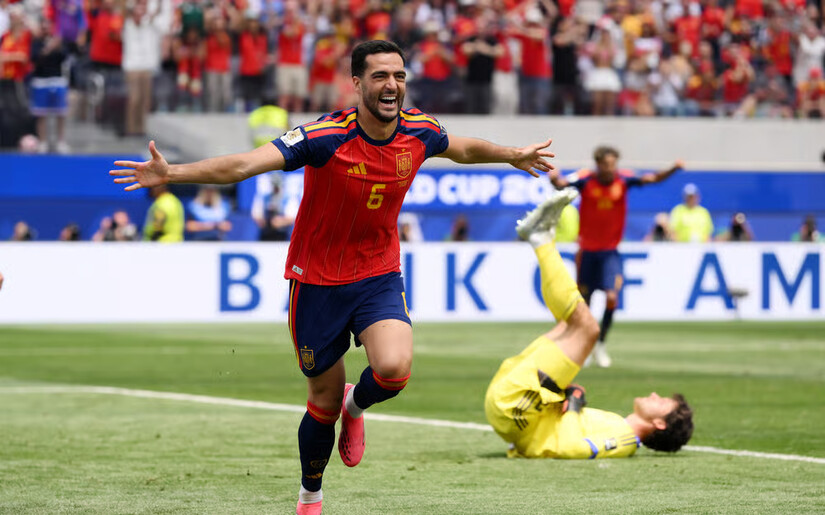
The 2026 FIFA World Cup continued its relentless march toward crowning a global champion Friday as the second quarterfinal fixture delivered another classic chapter in a tournament governed by razor-thin margins. Inside a sold-out SoFi Stadium in Inglewood, California, two of Europe's most technically sophisticated national programs collided in a dense tactical battle that remained entirely undecided until the closing minutes of regulation play. For the second consecutive matchday, Spain discovered its ultimate knockout catalyst in midfielder Mikel Merino.
Unlike the opening quarterfinal block, where France gradually suffocated Morocco through superior baseline attacking depth, Spain and Belgium produced a high-floor chess match defined by relentless physical adjustments and volatile emotional swings. Luis de la Fuente’s selection took the pitch carrying the tournament's most pristine defensive record, having logged four consecutive clean sheets. Conversely, Domenico Tedesco's Belgium group aimed to extend their remarkable summer of survival following dramatic, back-to-back elimination triumphs over Senegal and the United States.
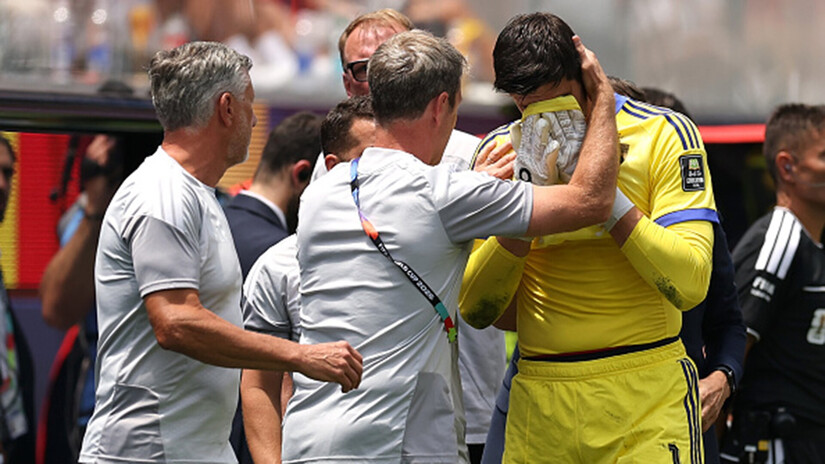
The match ultimately turned upon two landscape-defining moments in the final twenty minutes. First came a severe muscular injury that prematurely stripped Belgium of world-class goalkeeper Thibaut Courtois. Then, in the 88th minute, substitute Mikel Merino validated his extraordinary spatial instincts once more, hammering home a loose ball to secure his second consecutive late match-winner. The dramatic 2-1 result thrusts Spain into a blockbuster semifinal collision against France, positioning the three-time European champions exactly two victories away from capturing their first World Cup title since South Africa in 2010.
|
Match |
Score |
Venue |
Status |
|
Spain vs. Belgium |
2 – 1 |
SoFi Stadium, Inglewood, CA |
Spain advances |
The tactical atmosphere inside SoFi Stadium crackled with immense gravity from the opening whistle. More than seventy thousand fans packed the California venue to witness Spain attempt to impose their structured positional identity against a veteran Belgian Golden Generation chasing their ultimate international landmark. De la Fuente surprised observers before kickoff by deploying Fabián Ruiz in the starting engine room, prioritizing his vertical ball progression to break through Belgium's physical midfield lines. Across the technical zone, Tedesco organized Belgium inside a highly compact 5-4-1 defensive ring, deliberately surrendering early possession metrics to lock down central passing corridors.
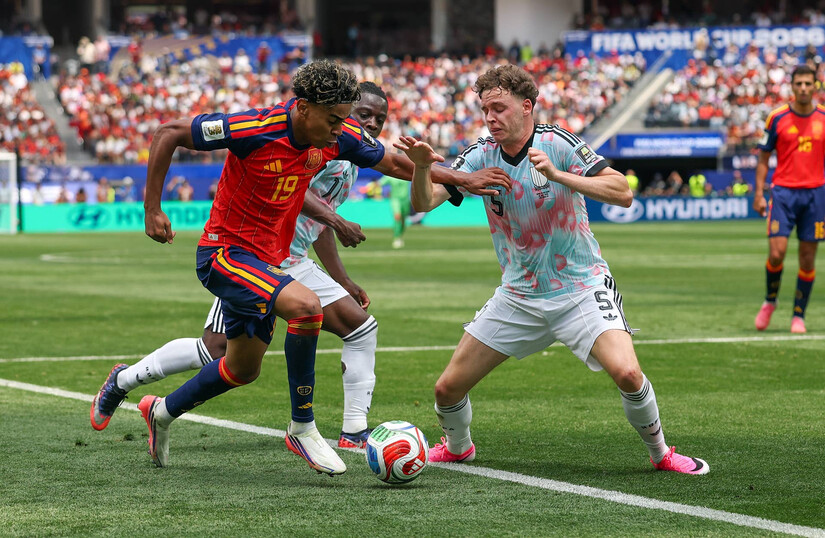
The strategic intentions of both managers materialized instantly. Spain monopolized early ball circulation, routinely commanding over 70 percent of structural possession during the initial fifteen minutes of play. Rodri orchestrated the lateral recycling paths from deep midfield, while Dani Olmo drifted intelligently between the Belgian lines to search for interior half-spaces. Nico Williams repeatedly challenged the right side of the Belgian backline, forcing fullback Timothy Castagne into a grueling, exhausting tracking shift out wide.
Belgium remained flawlessly disciplined through the opening phase. Rather than chasing the ball across horizontal tracks, the Red Devils compressed the distance between their defensive and midfield boundaries, frustrating Spain's central targets while waiting to launch lightning-fast transitions through the vision of Kevin De Bruyne and the explosive separation pace of Jeremy Doku.
Spain manufactured the initial clear look of the match in the 18th minute when Williams cut inside from the left wing to unleash a curling, right-footed strike aimed at the far post. Courtois reacted with phenomenal technical precision, lunging full-length to push the ball past the upright. The world-class intervention merely delayed the Spanish breakthrough, which arrived precisely at the 30-minute mark.
Olmo collected a sharp horizontal pass near the edge of the box, driving a powerful low effort through a crowded lane. Courtois managed to parry the initial blast, but the rebound fell directly into the path of the oncoming Ruiz, who reacted with superb quickness to slide the second ball into the back of the net to establish a 1-0 advantage.
The opening blow rewarded Spain’s territorial dominance, but Belgium mounted an immediate, highly impressive response. Rather than fracturing their defensive shape, Tedesco's selection gradually increased their vertical ambition, granting De Bruyne complete freedom to drop deep into the center circle to pull the strings on counter-attacks.
The adjustment unpicked the lock four minutes before the halftime intermission. Intercepting a loose pass, De Bruyne delivered a gorgeous, diagonal ball to release Castagne down the right wing. Without halting his stride, the fullback hit a perfectly flighted cross into the eighteen-yard box, where Charles De Ketelaere out-jumped his marker to thwack a powerful downward header past Unai Simón. The equalizer marked the first goal Spain had surrendered in the entire tournament, terminating Simón's historic clean-sheet sequence at 650 consecutive minutes.
The tactical landscape transitioned into a brutal war of physical endurance after the second-half restart. Belgium increased their physical intensity across the center circle, contesting second balls with immense aggression and accepting higher defensive risks to release Doku down the flanks. Heavier challenges multiplied as the match clock dissolved past the hour mark, with both rosters recognizing that a singular mechanical positioning error would conclude their tournament journey.
De la Fuente executed the night's defining managerial intervention in the 65th minute, introducing Merino and Mikel Oyarzabal from the bench to inject fresh athletic energy into the Spanish pressing matrix while sustaining their patient possession baseline. The strategic substitutions paid ultimate dividends, but only after Belgium suffered a catastrophic personnel breakdown in the 71st minute.
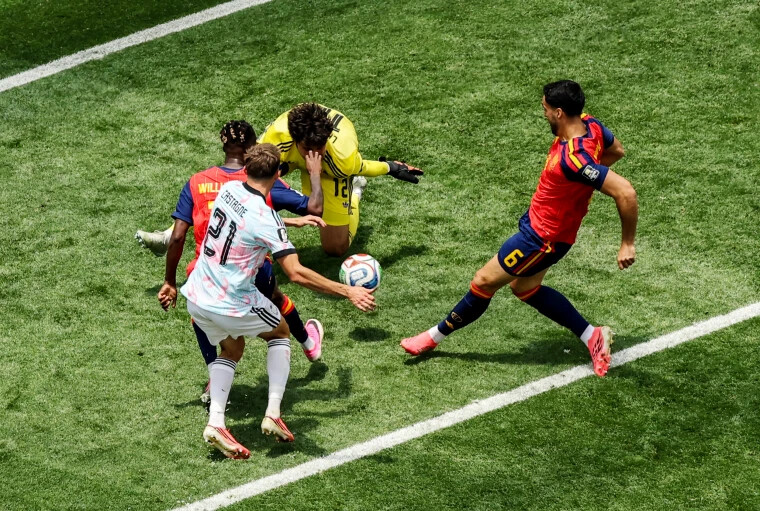
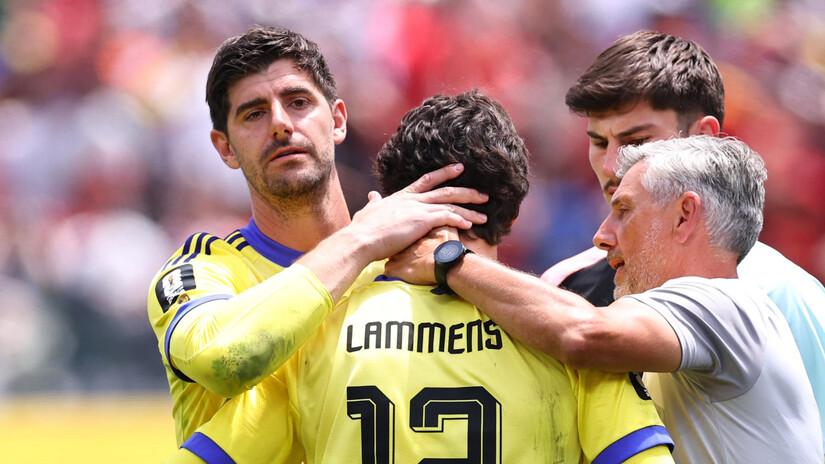
Spain executed a smooth passing sequence down the left wing, opening space for Oyarzabal to drive a vicious, dipping effort toward the bottom corner. Courtois delivered a spectacular diving stop to protect the tie, but as play halted, the legendary keeper immediately clutched his hamstring, signaling frantically to the medical staff. After a lengthy evaluation on the pitch, Courtois was forced to exit the match, leaving backup goalkeeper Senne Lammens to enter a high-stakes quarterfinal under maximum pressure.
Belgium battled with exceptional valor through the final ten minutes, and Doku nearly engineered an iconic winner in the 80th minute, weaving past two Spanish defenders before blasting a low drive inches wide of the far post. Just as extra time appeared entirely inevitable, Spain discovered the definitive breakthrough sequence in the 88th minute.
Recycling possession around the Belgian penalty box, teenage defender Pau Cubarsí advanced confidently into the final third, unleashing a speculative, bouncing long-range drive. Lammens struggled to control the tricky trajectory, spilling a heavy rebound directly into the center of the six-yard box.
Merino anticipated the spatial vacancy perfectly. Reacting a split-second ahead of the recovering defenders, the Real Sociedad midfielder hammered the loose ball violently into the roof of the net to fire Spain ahead 2-1. For the second consecutive knockout match, Merino had executed the late, terminal blow. Belgium pushed all personnel forward during four tense minutes of added time, but Rodri managed the closing sequences with absolute composure to seal a magnificent ticket to the final four.
Several vital strategic conclusions crystallized from the conclusion of the second quarterfinal:
The first official component of the semifinal grid is formally locked into place. With Spain and France booked for an absolute blockbuster head-to-head collision, the tournament bracket transitions into its absolute ultimate tier, where historical reputations are completely discarded and execution on the pitch remains the solitary boundary of survival.
MinneapoliMedia | Community. Culture. Civic Life.



Overcast, with a high of 73 and low of 53 degrees. Sunny for the morning, light rain shower for the afternoon, light drizzle in the evening, overcast overnight.