67° and Cloudy
Image




FRIDLEY, MN (July 15, 2026) Minnesota Attorney General Keith Ellison has filed a lawsuit against a Fridley-based vaping company, alleging it continued selling nicotine products designed to appeal to children despite receiving a warning from the state and misled consumers about whether federal regulators had approved its products.
The lawsuit, filed Wednesday in Ramsey County District Court, names Maduro Distributors Inc., which conducts business under the Loon brand.
State attorneys accuse the company of violating Minnesota’s consumer-protection laws and a 2024 statute prohibiting deceptive vapor products that imitate foods, beverages, candy and other items commonly marketed to children.
The lawsuit alleges that Loon sold products using flavors such as Cotton Candy, Strawberry Popsicle, Blue Razz Slushy and Banana Taffy. Other products allegedly used characters, creatures and imagery the state contends would be familiar or attractive to minors.
Those products included “Bowzer Berry,” which the complaint says references Bowser from Nintendo’s Super Mario franchise, along with products called “Frankenstein” and “Dragon’s Blood.”
“I have no tolerance for corporations that prey on young people to turn a profit, from big tobacco to big tech and beyond,” Ellison said in announcing the lawsuit. “As long as I am Attorney General of Minnesota, this office will fight to protect young people across our state.”
The allegations have not been proven in court. Maduro Distributors had not publicly responded to the lawsuit as of Wednesday evening.
The Attorney General’s Office said it sent warning letters to more than 5,000 tobacco distributors and retailers in August 2024 after Minnesota enacted its deceptive-vaping law.
Loon was among the businesses that received a letter, according to the complaint.
State officials asked companies to stop selling vaping products that violated the new restrictions, including products using flavors, packaging, characters or symbols associated with items marketed to children.
The Attorney General’s Office opened an investigation into Loon in January 2025. The lawsuit alleges the company continued marketing and selling dozens of prohibited products after receiving the state’s warning.
Minnesota’s law took effect August 1, 2024. It prohibits businesses from marketing, distributing or selling vapor products that imitate candy, desserts, beverages or other products commonly marketed to minors.
The law also covers products featuring characters, personalities, mythical creatures, video-game figures and other symbols known to appeal to children.
Beyond the youth-oriented flavors and branding, the lawsuit accuses Loon of misleading consumers about the federal regulatory status of its products.
According to the complaint, Loon’s wholesale website stated from October 2021 through October 2024 that its products had been “accepted for PMTA approval from the FDA.”
PMTA refers to the Food and Drug Administration’s premarket tobacco product application process. Tobacco manufacturers must obtain FDA authorization before legally marketing new tobacco products in the United States.
Submitting or having an application accepted for review does not mean that a product has been approved, authorized or certified as safe.
Minnesota argues that an ordinary consumer could interpret Loon’s representation as meaning federal health regulators had reviewed and approved the company’s products.
The FDA has not authorized any Loon products for sale, according to the Attorney General’s Office.
Federal regulators previously sent the company a warning letter in August 2021 concerning the sale of unauthorized products that the agency characterized as adulterated and misbranded.
The state’s complaint says the FDA has authorized only 45 e-cigarette products for sale nationally and that none of Loon’s products is among them.
Ellison is asking the court to permanently prohibit Loon from engaging in the practices described in the complaint.
The lawsuit also seeks civil penalties of up to $25,000 for each violation, restitution or repayment for affected consumers, disgorgement of money allegedly obtained through unlawful conduct and reimbursement of the state’s investigative and legal expenses.
The amount Loon could ultimately be required to pay has not been determined. That figure would depend on the court’s findings, the number of violations established and any settlement reached between the state and the company.
The case does not represent a judicial determination that Loon violated the law. The company will have an opportunity to respond to the allegations and contest the state’s claims in court.
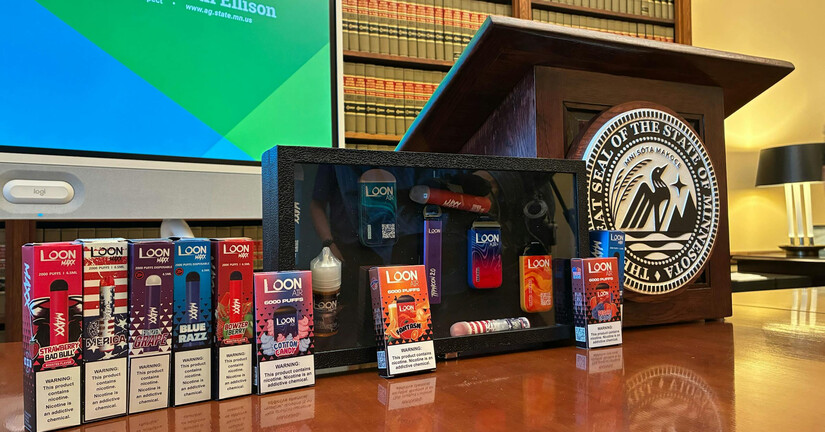
The case gives the lawsuit a direct north-metro connection.
Maduro Distributors is based in Fridley, placing a company accused of contributing to Minnesota’s youth-vaping problem within Anoka County and MinneapoliMedia’s principal coverage region.
Although the lawsuit targets one manufacturer, its outcome could influence vaping retailers and distributors throughout Minnesota. A court ruling or settlement could clarify how aggressively the state may enforce restrictions involving flavors, packaging, fictional characters and representations about federal authorization.
Retailers carrying Loon products could also face questions about whether products covered by the lawsuit may continue to be sold while the case proceeds.
The lawsuit does not automatically establish a statewide recall or immediate prohibition against every Loon product. The state is asking the court for an injunction that would stop the conduct alleged in its complaint.
The lawsuit continues Minnesota’s broader effort to hold e-cigarette manufacturers accountable for marketing practices alleged to attract young users.
In 2019, Ellison sued JUUL Labs, accusing the company of deceptively marketing nicotine products to children and teenagers. Minnesota became the first state to take JUUL to trial.
The state reached a $60.5 million settlement with JUUL and its former investor, tobacco company Altria, in 2023. Settlement funds were directed toward programs addressing youth smoking and vaping prevention and cessation.
Minnesota later pursued High Light Vapes, whose products were designed to resemble highlighter markers and could be concealed among school supplies. A Ramsey County court order subsequently prohibited that company, its owner and a related business from operating in Minnesota.
In June 2026, Ellison joined other attorneys general in welcoming Shopify’s decision to prohibit e-cigarette sales through its online commerce platform.
The new lawsuit against Loon shifts the state’s enforcement focus toward the intersection of product flavoring, child-oriented imagery and claims about federal regulatory approval.
E-cigarettes can expose users to nicotine, a highly addictive substance that can affect the developing adolescent brain. Public-health officials have repeatedly warned that sweet flavors, colorful packaging and familiar imagery can make vaping products appear less dangerous to young people.
The lawsuit now asks a Minnesota court to determine whether Loon’s products crossed the line established by state law and whether its statements about the FDA misled consumers.
For parents, schools and public-health organizations, the case will test whether Minnesota’s 2024 deceptive-vaping law can meaningfully restrict products that state officials say were deliberately fashioned to resemble the flavors and characters children already recognize.
For manufacturers and retailers, it delivers a separate warning: receiving a product application number or entering the FDA review process is not the same as obtaining federal authorization to sell a product.
The case is pending in Ramsey County District Court.
Sources: Reporting and court details published by CBS News Minnesota, Valley News Live and the Minnesota Attorney General’s Office.
MinneapoliMedia | Community. Culture. Civic Life.


Overcast, with a high of 86 and low of 67 degrees. Moderate rain for the morning, overcast in the afternoon,