67° and Cloudy
Image
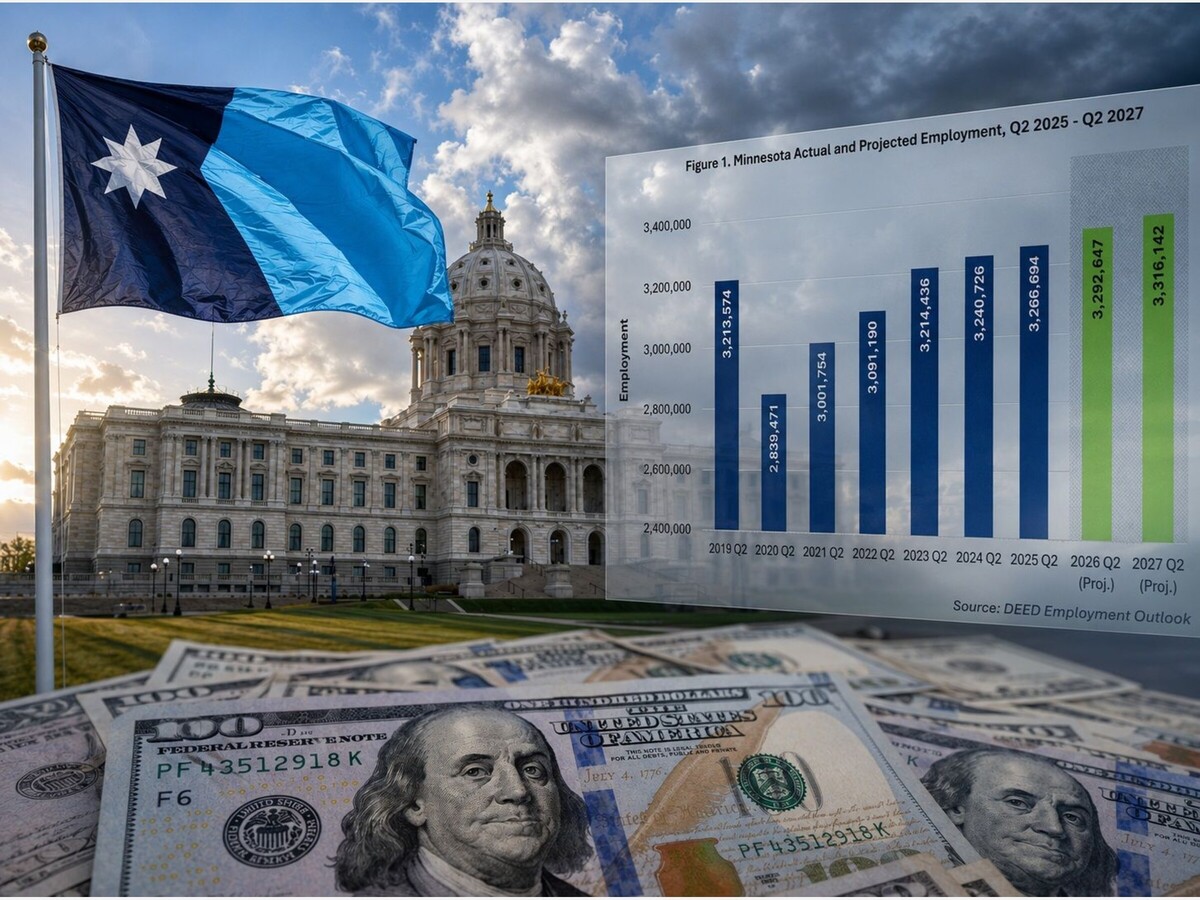



ST. PAUL, MN (July 17, 2026) Minnesota employers added 13,200 jobs in June, extending the state’s employment growth to a third consecutive month, but the latest report also revealed continuing concerns about a shrinking labor force, stalled wages and an unemployment rate above the national level.
The Minnesota Department of Employment and Economic Development reported that private-sector employers accounted for 14,600 additional jobs during the month.
The private-sector increase exceeded the state’s overall net gain because government employment fell by 1,400 jobs.
Minnesota’s unemployment rate remained at 4.4 percent. The national unemployment rate stood at 4.2 percent after declining by one-tenth of a percentage point.
Five major industry groups added jobs during June.
Educational and health services produced the largest gain, adding 7,800 positions, an increase of 1.2 percent.
Professional and business services added 3,500 jobs, representing 1 percent growth. Manufacturing gained 2,800 positions, an increase of 0.9 percent.
Leisure and hospitality added 2,700 jobs, also increasing by 1 percent. Other services gained 1,300 positions, or 1.1 percent.
The figures suggest that June’s growth reached several different areas of the economy, including industries employing health care workers, educators, factory employees, hospitality workers and professional-service staff.
The strength in educational and health services is particularly significant because health care remains a major source of employment across Minnesota, including hospitals, clinics, nursing facilities, home-care providers and community-based organizations.
The report was not uniformly positive.
Trade, transportation and utilities lost 2,000 jobs, a decline of 0.4 percent. Government employment fell by 1,400 jobs, or 0.3 percent.
Construction lost 1,100 positions, a 0.7 percent decrease, despite June ordinarily falling within Minnesota’s busiest construction season.
The information sector lost 400 jobs, representing a 1 percent decline.
Mining and logging employment was unchanged, as was employment in financial activities.
These losses matter because statewide job growth can conceal substantial differences between industries and communities. A worker displaced from construction, retail or government does not automatically benefit when employment increases in health care or professional services, particularly if the available positions require different training, credentials or locations.
The June increase marks Minnesota’s third consecutive month of employment growth following job losses earlier in 2026.
State officials welcomed the continued improvement but described the overall picture cautiously.
DEED Commissioner Matt Varilek said the gains were positive for workers and businesses while emphasizing the need to reverse the continuing decline in labor-force participation.
Labor Market Information Director Angelina Nguyen characterized the results as mixed because employment grew while the labor force and wage growth continued to weaken.
That distinction is critical. An economy can add jobs while still struggling to attract or retain enough workers.
A shrinking labor force may reflect retirements, population changes, workers leaving the state, barriers to child care, health problems, discouragement among job seekers or people deciding that available wages do not justify employment-related costs.
Minnesota’s unemployment rate remained unchanged at 4.4 percent, two-tenths of a percentage point above the national rate.
A steady unemployment rate alongside strong monthly job growth can occur for several reasons. Newly available positions may not match the skills or locations of unemployed residents. Some jobs may be filled by people who were already employed, and changes in labor-force participation can affect how the unemployment rate is calculated.
The unemployment rate also does not capture everyone experiencing economic hardship.
People who want work but have stopped actively searching are generally not counted as unemployed. Nor does the headline rate show whether workers are receiving enough hours, whether they are employed in their preferred field or whether their wages cover housing, food, transportation, child care and health care.
For Minnesota families, the quality of the jobs matters as much as the total number.
DEED officials identified weakening wage growth as another source of concern.
When pay does not keep pace with housing, utilities, groceries, insurance and other necessities, an expanding job market may not translate into greater household stability.
Slow wage growth can be particularly difficult for lower-income workers and families in the Twin Cities, where rent, child care and transportation consume large portions of monthly income.
The state’s next challenge is therefore twofold: sustain employment growth and ensure that residents can enter the labor market and earn enough to remain there.
That work may require expanded training, more accessible child care, transportation assistance, support for workers returning after prolonged absences and stronger connections between employers and communities still facing high unemployment.
June’s addition of 13,200 jobs is a meaningful improvement and provides momentum after Minnesota’s difficult start to the year.
But the report does not support an unqualified declaration that the state’s labor market has fully recovered.
Employment has now grown for three consecutive months, yet unemployment remains higher than the national rate. Several industries lost positions, wage growth weakened and the available labor force continued to contract.
For workers and businesses, the coming months will show whether June represents the foundation of a durable recovery or a temporary surge within a still-fragile economy.
MinneapoliMedia | Community. Culture. Civic Life.



Overcast, with a high of 86 and low of 67 degrees. Moderate rain for the morning, overcast in the afternoon,