85° and Overcast
Image
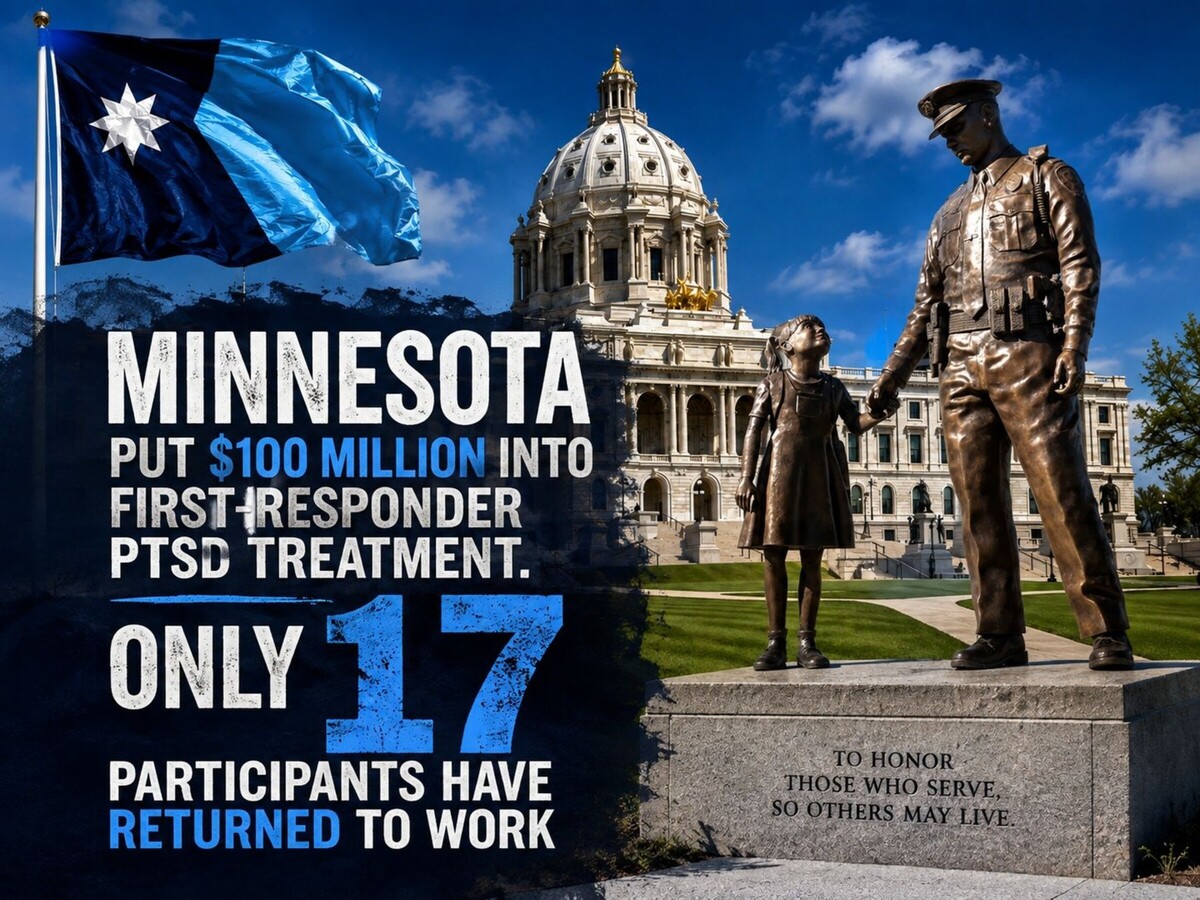



MINNEAPOLIS, MN (August 9, 2026). Minnesota committed $100 million three years ago to confront a growing crisis among police officers, firefighters and other first responders leaving their careers with post-traumatic stress disorder. The intervention was designed to change what had become an increasingly costly and troubling pattern by providing treatment before injured first responders moved permanently toward disability and retirement.
Instead of allowing a PTSD diagnosis to become the beginning of an almost automatic exit from public service, lawmakers wanted Minnesota to create an opportunity for workers to receive treatment, recover and, where medically appropriate, return to their careers. Three years later, however, the early results raise difficult questions.
Of 337 first responders who have entered treatment through the state-supported program, only 17 have returned to work, representing roughly 5 percent of participants. Another 158 completed treatment but ultimately retired, while about 100 remain in treatment.
Those numbers do not necessarily mean the treatment itself has failed. Successful mental-health care cannot reasonably be measured only by whether a person returns to the same job that contributed to or intensified a traumatic condition. But the results do raise an important question for Minnesota policymakers: Is the state's $100 million intervention accomplishing what lawmakers intended?
Minnesota's first-responder PTSD problem did not begin with the 2023 legislation. Police officers, firefighters, paramedics and other emergency personnel routinely encounter traumatic events, including fatal crashes, suicides, child deaths, violent assaults, homicides, fires and mass-casualty incidents. Repeated exposure to those experiences can accumulate over years.
Minnesota law recognizes PTSD as a potential occupational injury for certain workers, including police officers and firefighters. As PTSD disability claims increased, concerns grew that the system had become oriented toward helping injured workers leave their professions rather than helping them recover sufficiently to remain employed when possible.
The Legislature responded in 2023 by creating a treatment-centered approach and committing $100 million to the effort.
The concept was significant. Rather than treating a PTSD diagnosis as the beginning of an almost automatic path toward permanent disability, eligible first responders would receive treatment before a final determination about whether they could return to work.
For some participants, treatment can take months. For others, recovery may not make returning to police work, firefighting or another emergency-response profession medically advisable. That distinction is crucial.
A firefighter who receives effective treatment but cannot safely return to firefighting has not necessarily experienced a treatment failure. Neither has a police officer whose mental health improves but who determines, with medical guidance, that returning to law enforcement would jeopardize that recovery.
The state's challenge is determining whether the program is producing better outcomes for the people receiving treatment while also meeting the public-policy objectives that justified the investment.
That question is becoming increasingly urgent because the $100 million fund is not unlimited. The remaining balance is expected to fall to approximately $41 million by the end of 2026, and at the current pace the money could be depleted by the end of 2027.
That creates a looming decision for lawmakers. Should Minnesota put additional money into the program? Should eligibility or treatment requirements change? Should the state intervene earlier in first responders' careers, before PTSD becomes severe enough to force someone away from work? And should returning to the same profession remain one of the principal measures used to judge whether the program is working?
Those questions should be answered before Minnesota simply replenishes the account.
Seventeen out of 337 participants is a small number, but Minnesota should resist drawing a simplistic conclusion from it. PTSD is a medical condition, not an attendance problem, and the objective cannot be to push traumatized police officers or firefighters back into demanding jobs simply to improve a government statistic.
At the same time, taxpayers are entitled to understand what a $100 million public investment is accomplishing. That requires more information than a return-to-work percentage.
Minnesota should know how many participants experienced meaningful clinical improvement, how many returned to employment outside public safety, how many remained out of work because clinicians determined returning would be unsafe and how many entered treatment only after PTSD had become severe.
Perhaps most importantly, Minnesota needs to know whether first responders are receiving help soon enough.
If substantial mental-health intervention begins only after a condition has deteriorated enough to threaten someone's career, the state may be attempting to reverse injuries accumulated over many years.
Earlier intervention could mean routine mental-health screenings, greater access to confidential counseling, better supervisor training, peer-support programs and systems allowing first responders to seek help without believing that doing so will automatically jeopardize their careers.
The $100 million program was created because Minnesota recognized that the previous system was not working well enough. Three years later, Minnesota has another responsibility: determine whether the new one is.
The answer cannot come from the number 17 alone, but the number 17 makes asking the question unavoidable.

Local stories matter. Subscribe free to MinneapoliMedia and receive independent news, community reporting and important updates from Minneapolis, the North Metro and communities across Minnesota.
SUBSCRIBE FREE: https://minneapolimedia.town.news/subscribe
MinneapoliMedia | Community. Culture. Civic Life



Sunny, with a high of 86 and low of 50 degrees. Partly Cloudy for the morning, overcast in the afternoon, clear overnight.