50° and Patchy rain nearby
Image



ROCHESTER, MN (October 5, 2026).
Rochester officials face a consequential decision Monday over how far the city should go to protect small businesses caught inside one of the largest redevelopment projects in Minnesota, after four businesses along the Second Street corridor closed this year and others warned that prolonged construction is threatening their survival.
The Rochester City Council is scheduled to consider an additional $500,000 for the city's Business Forward program, which supports businesses disrupted by construction connected to the Link bus rapid transit project and the broader Destination Medical Center redevelopment.
The Destination Medical Center Corporation board has already approved the additional $500,000. The City Council must now decide whether to join the funding arrangement.
The decision arrives after months of disruption along Second Street.
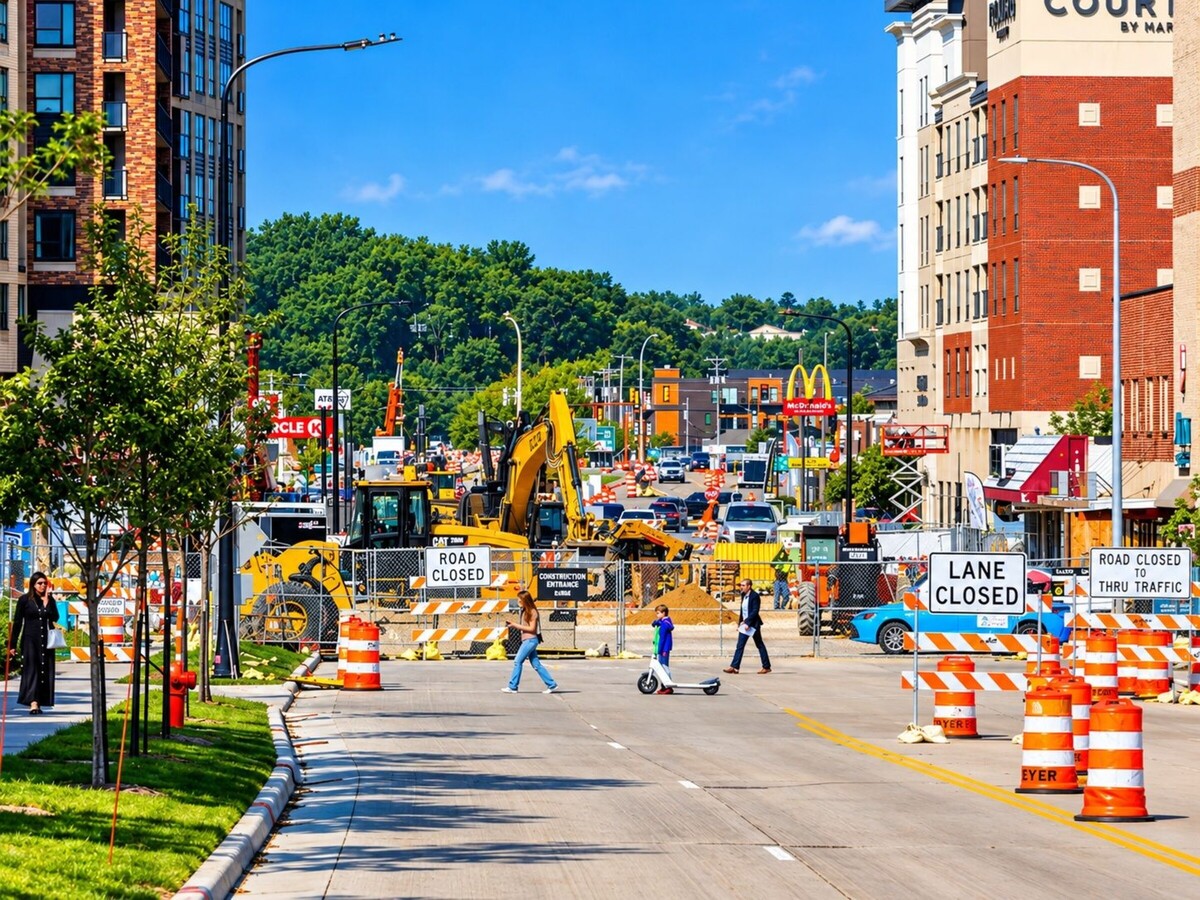
Construction equipment, barricades and changing access routes have surrounded businesses as Rochester rebuilds the corridor for a nearly three-mile bus rapid transit system. Storefronts have become difficult to reach, traffic patterns have changed and some businesses say customers increasingly avoid the area altogether.
Four shops and restaurants along Second Street have closed this year, two of them during the past week. Other business owners say they are struggling to remain open.
The Link bus rapid transit system is scheduled to begin service in August 2027, meaning businesses that survive the current construction season could still face months of disruption before the project is complete.
The transit project is a major component of Rochester's 20-year, $5.6 billion Destination Medical Center redevelopment, an effort intended to prepare the city for growth around Mayo Clinic and make Rochester easier to navigate for residents, patients, workers and visitors.
The long-term argument for the investment is substantial. The immediate economic consequences for businesses sitting behind barricades are becoming harder to ignore.
Rochester has already spent approximately $231,000 through Business Forward on measures including directional signage, marketing and professional photography intended to help customers find and support businesses affected by construction.
The proposed $500,000 would extend that work.
Destination Medical Center says the money could support outreach, business visibility, marketing, promotions, customer-traffic initiatives and other construction-mitigation strategies. The funding is designed to remain flexible so assistance can be adjusted according to the severity and duration of disruption.
Some business owners argue that the approach does not address their central problem.
Their concern is not simply that customers do not know businesses exist. It is that customers cannot conveniently reach them or are choosing to avoid the construction corridor altogether.
That distinction has fueled calls for direct financial assistance.
The current Business Forward program does not provide direct grants or loans to affected businesses. Rochester officials have said restrictions governing public money limit what the city can provide.
There is precedent elsewhere in Minnesota for more direct assistance.
During construction of the Green Line light rail corridor in 2011, Minneapolis and Saint Paul offered qualifying small retailers and restaurants interest-free, forgivable loans of up to $20,000 to help them withstand construction-related losses.
Rochester is not currently proposing a comparable program.
That leaves Monday's council decision carrying two separate questions.
The first is whether the city should approve the additional $500,000 already supported by the Destination Medical Center board.
The second is whether marketing, signage and customer-access programs are sufficient when businesses say their underlying problem is lost revenue.
The debate illustrates a recurring problem with major public infrastructure projects. Improvements designed to strengthen a commercial district over decades can impose their greatest financial burden on businesses that must survive the construction period before those benefits arrive.
Rochester's challenge is particularly acute because the construction is tied to an unusually large transformation of the city.
The Destination Medical Center initiative is intended to reshape transportation, development and the public realm around Mayo Clinic. Link BRT is a major part of that future, promising frequent transit along the reconstructed corridor.
But four businesses have already closed.
For the remaining operators along Second Street, the question is no longer theoretical. They must generate enough revenue to reach August 2027.
Monday's council action will determine whether another $500,000 is deployed toward that effort and will provide an early indication of whether Rochester believes its existing business-support strategy is sufficient for the disruption still ahead.

Local stories matter. Subscribe free to MinneapoliMedia and receive independent news, community reporting and important updates from Minneapolis, the North Metro and communities across Minnesota.
SUBSCRIBE FREE: https://minneapolimedia.town.news/subscribe
MinneapoliMedia | Community. Culture. Civic Life


Overcast, with a high of 57 and low of 49 degrees. Overcast for the morning, patchy rain nearby overnight.