76° and Overcast
CATCHING UP WITH JACKSON FULLER | The Life He Almost Left Behind in Poland



Seven difficult weeks in Gdańsk nearly overwhelmed the Minnesota hockey player who had traveled overseas to pursue a dream. Now, back for a second season, the former University of Minnesota Crookston captain is discovering how much that decision has changed his understanding of hockey, friendship, home and the future he once thought was settled.
By Tom Akaolisa, Editor
MINNEAPOLIS, MN (October 12, 2026).
Spend enough time alone in the same foreign apartment, and eventually the walls start talking back to you.
For Jackson Fuller, that feeling defined his first seven weeks playing hockey in Gdańsk. He had traveled thousands of miles from Minnesota for an opportunity that many college players never receive, yet the excitement of continuing his career overseas had done little to prepare him for the isolation that accompanied it. He missed his family, his friends and the ordinary routines of a life he understood. His teammates were still strangers, the language presented daily challenges, and even simple interactions required an unfamiliar degree of concentration. There were nights when he questioned what he was doing in Poland and whether returning to Minnesota might be the more sensible choice.
During an October 5 conversation with MinneapoliMedia, Fuller recalled how that loneliness could make his apartment feel smaller with each passing evening. It was a revealing admission from a young athlete whose journey might otherwise be told through contracts, victories and the excitement of living in Europe. Behind those accomplishments was a struggle to establish himself in a country where he initially knew few people and understood little of the language.
Fuller stayed. Gradually, he began understanding his teammates, building friendships and adjusting to the demands of Polish hockey. By the end of the season, the unfamiliar city had become a place he was reluctant to leave.
When he returned to Minnesota, medical school appeared to be the logical next step. He had spent years preparing for that future, and continuing hockey had never been intended to interfere indefinitely with his professional ambitions. Yet after several weeks at home, Fuller found himself thinking about the life he had left behind in Gdańsk and wondering whether he had departed before discovering everything the experience could offer.
He chose to return for a second season with Fudeko GAS Gdańsk, postponing medical school and accepting another year of uncertainty. The decision was not simply about extending his playing career. Fuller wanted to continue developing as an athlete, but he also wanted to return to a community that had become important to him.
The Decision to Return
Fuller had not expected his first season in Poland to lead immediately to a second. When he initially left Gdańsk, the transition back to Minnesota happened quickly, giving him little time to consider how much his circumstances had changed during the preceding months.
He had spent much of his first year adjusting to unfamiliar surroundings. Just as he began developing confidence in his new environment, the season ended and he was preparing to return home. Once back in Minnesota, he found that the decision about what to do next was not as straightforward as he had anticipated. There was a sense of unfinished business, particularly because he had begun developing friendships and becoming more comfortable with life in Gdańsk.
Medical school remained an important ambition, but Fuller recognized that the opportunity to continue playing competitive hockey overseas might not remain available indefinitely. Medicine offered a professional future he could pursue for many years. His athletic career operated on a less forgiving timetable.
“I have the rest of my life to be a doctor,” he said, explaining why he began seriously considering another season.
He did not make the decision without examining its consequences. Fuller contacted medical schools to discuss the possibility of deferring his plans and to determine whether another year abroad would jeopardize his future education. According to Fuller, those conversations were encouraging. He was reassured that living and working in another country could provide valuable experience and perspective.
With that concern addressed, he turned to his family.
His mother was the first person he approached, and her reaction surprised him. Before he had finished explaining his reasons for wanting to return, she was already enthusiastic about the idea. Fuller recalled her support with affection, joking that his mother usually knew best.
His younger brother, who also plays hockey at the University of Minnesota Crookston, welcomed the news. Fuller suspected that the prospect of another European visit may have contributed to his brother's enthusiasm, although the brothers also share an understanding of what competitive hockey means to one another.
His father was more cautious. He wanted Fuller to consider carefully what postponing medical school would mean and whether extending an uncertain athletic career was a sensible choice. Their discussions were serious, but Fuller appreciated the concern behind them. Eventually, they reached an understanding, and his father supported the decision.
Fuller also sought advice from mentors, friends and others whose judgment he trusted. Many encouraged him to give hockey another year, particularly because he had already demonstrated that he could compete overseas and had begun establishing a meaningful life there.
By the time he committed to returning, Fuller was no longer thinking exclusively about the opportunity to play another season. He was also thinking about the people he had met, the relationships he had developed and the possibility that another year could help him become a better player and a more experienced person.
A Wedding in Slovakia and the Friendships That Changed Everything
One of the most revealing stories Fuller shared during the interview concerned a wedding in Slovakia, an occasion that illustrated how dramatically his relationships had changed since arriving in Europe.
During his first season, Fuller developed a close friendship with a teammate named Miroslav, whom he calls Miro. Their friendship continued after the hockey season ended, with the two remaining in regular contact throughout the summer.
At one point, Miro called Fuller seeking advice about an engagement ring. Fuller was surprised because marriage had not been part of their conversations when the season ended. Soon afterward, Miro sent him a photograph of his proposal in the Slovakian countryside, followed by an invitation to the wedding.
Fuller immediately began making arrangements to attend.
He traveled from Gdańsk to Kraków by train and continued into Slovakia by bus, a journey that took approximately 10 hours. For Fuller, the distance was a small consideration compared with the opportunity to celebrate an important occasion with someone who had become one of his closest friends overseas.
The wedding introduced him to traditions he had never encountered. During the reception, he watched as a plate was deliberately smashed and guests gathered around the newly married couple. Fuller initially had little idea what was happening, particularly because he could understand only portions of the conversation around him. He later learned about the symbolism associated with the broken pieces and the couple's future family.
Another celebration involved guests forming a circle around the bride while the groom attempted to make his way through them. Fuller joined the festivities and enjoyed discovering customs that were entirely unfamiliar to him.
The experience also introduced him to Miro's childhood friends, including several hockey players. Many spoke English, and Fuller found himself quickly developing friendships with people he had never previously met. By the end of the celebration, some of those strangers had become people he would continue communicating with after returning to Poland.
What made the invitation particularly meaningful was that Fuller was the only member of Miro's team from the previous season invited to attend. He understood the significance of that gesture, especially given how recently they had met.
When asked what his teammates had become to him, Fuller described them as a second family. He smiled as he explained how much those relationships meant and why returning to Gdańsk had become important for reasons that extended beyond hockey.
The friendships have also transformed his everyday life. During his first season, it took months to become comfortable socially. Fuller discovered that people in Poland, in his experience, were generally more reserved than the Minnesotans he had grown accustomed to meeting. Casual conversations with strangers were less common, and friendships often developed more gradually.
Once those relationships formed, however, he found them particularly meaningful. During his second season, friends and teammates have regularly invited him to play pool, throw darts or simply spend an evening together. He no longer has to spend the same amount of time wondering how to fill the hours between practices and games.
The change is especially significant because Fuller remembers how difficult those evenings were during his first weeks overseas. The people he now considers family were once strangers whose personalities, customs and language he struggled to understand.
Learning to Play Hockey All Over Again
Fuller's experiences away from the rink have been transformative, but his second season also represents an important stage in his development as a hockey player.
At the University of Minnesota Crookston, Fuller spent four years playing under coach Steve Johnson, whose consistency and structured approach he remembers with considerable respect. The program gave him an established understanding of positioning, defensive responsibilities and the systems his team expected him to follow.
Years of repetition made those habits instinctive. When Fuller arrived in Poland, however, he discovered that some of the approaches he had relied upon in Minnesota did not fit the expectations of his new coaches.
He described the difficulty of adapting to a different forechecking system. At Crookston, he had become accustomed to an aggressive approach that allowed forwards to pursue the puck under particular defensive conditions. His Polish team required different positioning, especially from the third forward entering the offensive zone.
Fuller understood the instructions, but he repeatedly found himself returning to familiar habits during games. He would come back to the bench and hear another reminder that he needed to adjust. The problem was not a lack of willingness to learn. It was the difficulty of changing movements and decisions that had become automatic after years of training.
Language made the adjustment more complicated. Fuller had to become familiar with Polish hockey terminology, understand drills and learn how his teammates communicated during practices and games. Even ordinary arrangements, including where players were expected to meet and when they needed to arrive, required additional attention.
His coach spoke limited English, which meant Fuller could not always rely on detailed verbal explanations. He had to learn through observation, repetition and the assistance of teammates who understood both the system and the language.
The experience challenged his confidence in ways he had not anticipated. After more than two decades playing hockey, Fuller discovered that experience alone did not guarantee immediate success in a different environment.
He also encountered players whose creativity and decision-making differed from what he had become accustomed to seeing in North America. Their approaches encouraged him to reconsider his assumptions about how the game should be played and to become more receptive to constructive criticism.
Officiating presented another adjustment. Fuller described Polish referees as less tolerant of certain forms of physical contact and stick work than officials he had encountered in North America. Tactics he had previously regarded as ordinary parts of an aggressive game were more likely to result in penalties.
For a player who values physicality, learning to remain effective without repeatedly visiting the penalty box has required considerable adjustment. Fuller has relied on advice from Polish teammates who understand local officiating standards and know how to maintain an aggressive approach without attracting unnecessary penalties.
The process has required him to distinguish between the qualities that make him effective and the habits that need to change. He remains proud of the physical, competitive style he developed in Minnesota, but he recognizes that succeeding overseas requires more than imposing that style on a different league. It requires understanding how the game is played around him and making the necessary adjustments.
The Hardest Part Was Not Always on the Ice
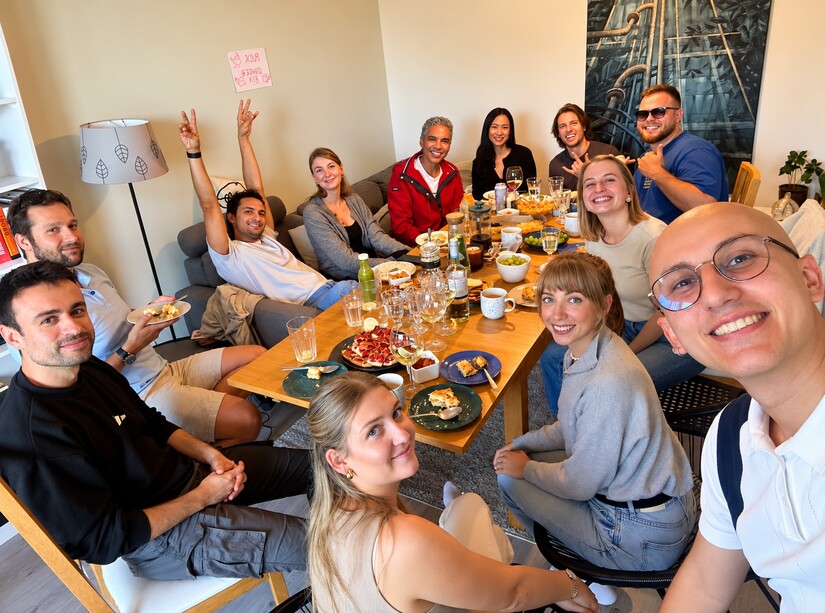 Jackson Fuller joins local residents and fellow expatriates for dinner in Poland. Fuller met members of the group through community activities, developing friendships with people from several countries, including Mexico and Colombia. Photo courtesy of Jackson Fuller.
Although Fuller has become more comfortable in Poland, he does not describe the experience as an uninterrupted adventure.
The loneliness of his first season remains one of his strongest memories. During those initial seven weeks, he sometimes wondered whether he had made a mistake by moving so far from home. The excitement of playing overseas was accompanied by evenings when he missed familiar people and questioned whether the experience was worth the personal cost.
He remembered looking at the calendar and wondering how he would manage the remaining months. The apartment could feel particularly isolating after practices and games, when there was little to distract him from thoughts of home.
Fuller eventually recognized that returning to Minnesota would not necessarily restore the life he remembered. His friends and family were continuing with their own responsibilities, and the circumstances he missed would not remain unchanged simply because he returned. He also knew that leaving prematurely might become a decision he would regret.
Those considerations helped him endure the difficult period while gradually developing friendships and routines that made life in Gdańsk more manageable.
Returning for a second season has not eliminated every challenge. Fuller acknowledged that the first weeks of his return included moments of discomfort, partly because he had spent the summer remembering the best aspects of his previous experience.
He was living in the same apartment, but his roommates had changed. Practice schedules were different, and some familiar teammates were no longer there. The life he returned to was not identical to the one he had left.
This time, however, he had the advantage of experience. He understood that adjustment could take time and that the discomfort of unfamiliar circumstances did not necessarily mean something was wrong. More importantly, he had friendships that provided support and helped him settle into the new season.
Fuller's willingness to discuss those difficult periods gives a fuller account of what it means to pursue an athletic opportunity overseas. The games, travel and friendships are genuine rewards, but they coexist with the demands of living far from home and learning to manage uncertainty without the immediate comfort of familiar surroundings.
The Minnesota He Saw Differently
Fuller did not fully appreciate how much living abroad had changed him until he returned to Minnesota and began noticing things that had once seemed entirely ordinary.
He remembered the familiarity of American streets and the casual interactions between strangers. During a grocery shopping trip with his father, he watched him strike up conversations with other shoppers, commenting on their purchases and exchanging friendly remarks.
Fuller found himself unusually conscious of those interactions. In his experience of Poland, people generally did not approach strangers with the same casual familiarity. Public conversations were often quieter, and people tended to respect one another's personal space without initiating unnecessary exchanges.
His father noticed how closely Fuller was observing these ordinary encounters.
Another revealing moment occurred when Fuller returned to the University of Minnesota Crookston to attend the graduation of friends from his former program. While working out at the campus wellness center, he encountered a former professor. They discussed Fuller's experiences in Poland and the professor's own earlier experience studying and conducting research in Spain.
During their conversation, the professor remarked that Fuller seemed different. He appeared sharper and more deliberate in his responses. Fuller initially wondered whether the observation was a criticism and asked whether he had become overly forceful or aggressive.
The professor assured him that this was not what he meant. After reflecting on their conversation, the professor later suggested that Fuller appeared to have developed greater discernment.
The observation stayed with him. Fuller began considering whether the unfamiliar situations he had navigated overseas had changed the way he assessed circumstances, made decisions and communicated with other people.
Living in Poland had required him to become more observant. He could not always rely on language, familiar customs or the assumptions he had developed in Minnesota. He needed to pay attention to how people behaved, interpret unfamiliar situations and respond appropriately.
Over time, those demands may have influenced the way he approached other parts of his life. Fuller had not necessarily recognized the changes while they were happening. It took someone who knew him before his overseas experience to notice that he had developed a different manner of thinking and responding.
A Rivalry That Now Feels Personal
 Jackson Fuller with his Canadian billet family, Lori, Curt and Ainsley Russel, whom he credits with playing an important role in his development as a hockey player. Through the family, Fuller met Parker James, beginning a chain of friendships that would eventually connect him to another American hockey player in Gdańsk, Poland. Photo courtesy of Jackson Fuller.
The coming season also gives Fuller another opportunity to participate in one of the most anticipated fixtures on his team's schedule, the Pomeranian hockey derby against GKS Stoczniowiec Gdańsk.
During his first season, Fuller initially understood the rivalry through what teammates told him. He heard about its importance to supporters and the intensity surrounding games between the city's competing clubs.
Experiencing the atmosphere firsthand changed his understanding. He remembered the enthusiasm of the crowd, the intensity on the ice and the commitment his teammates brought to the competition. By the second meeting, he felt more personally invested in the outcome. Each subsequent game strengthened that attachment.
Now, after developing friendships and becoming more familiar with Gdańsk, Fuller approaches the rivalry with a different understanding of what it means to the people around him.
The opposing club has also added North American players, introducing another dimension to the competition. Fuller shared an amusing story about a player who contacted him through a mutual connection while exploring opportunities to play overseas. Fuller approached his own club on the player's behalf but was told that another American was not needed.
Soon afterward, the player learned that a contract opportunity in Gdańsk was available after all. The confusion was eventually resolved when they realized that the offer came from the city's other team.
A player Fuller had tried to help join his club had instead signed with its local rival. The episode amused Fuller, who now looks forward to competing against familiar North American players in a rivalry that already carries considerable significance.
It also illustrates how interconnected the hockey community can be, even across continents. Players who once competed or trained in North America can find themselves representing opposing clubs in Poland, bringing familiar relationships into an entirely different competitive environment.
A Message for Young Hockey Players in Minnesota
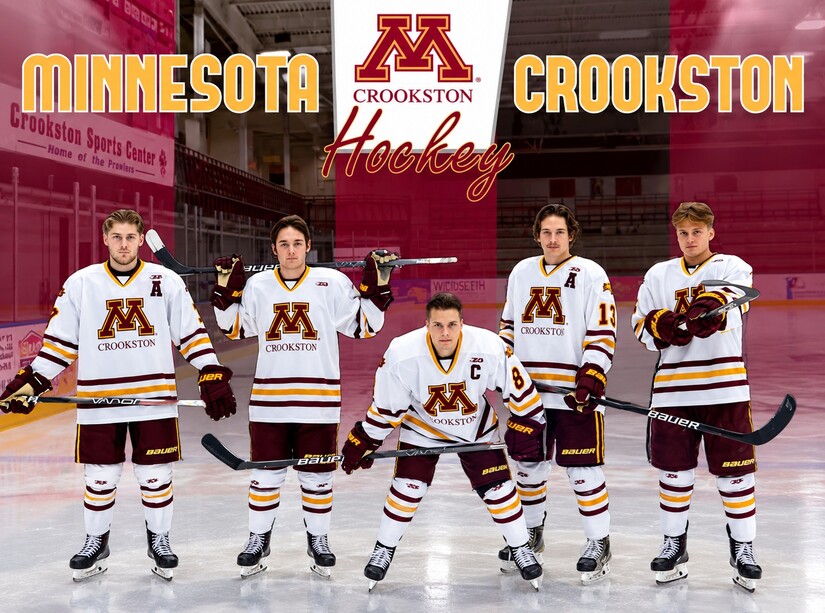 University of Minnesota Crookston hockey players in a team promotional image. Fuller, a former Golden Eagles captain, credits his ACHA Division II experience with helping prepare him for opportunities beyond college hockey. Image courtesy of Jackson Fuller.
Fuller's journey offers a perspective that may be especially meaningful to young Minnesota hockey players who believe their competitive opportunities will end when college does.
He played at the University of Minnesota Crookston in the American Collegiate Hockey Association's Division II program, a level that receives considerably less national attention than NCAA Division I hockey. Yet he found an opportunity to continue competing overseas.
Fuller understands why players who do not follow the most celebrated development pathways may assume that professional or high-level competitive hockey is beyond their reach. His own experience has convinced him that the possibilities are broader than many young athletes realize.
“It's not the NHL or nothing,” he said.
He does not suggest that every determined player will secure an overseas contract. Instead, he encourages athletes to remain open to opportunities at different levels, develop relationships within the hockey community and recognize that there are ways to continue playing beyond the most familiar routes.
His advice also concerns the pressures young players face long before they reach college. Fuller reflected on talented athletes he knew growing up in Minnesota, including players who appeared capable of reaching high competitive levels but eventually lost their enthusiasm for the game.
He believes that excessive pressure, constant comparison and the pursuit of prestigious teams can sometimes undermine the enjoyment that encourages young athletes to continue developing.
For some players, he suggested, joining a team where they receive meaningful playing time and genuinely enjoy the experience may be more valuable than pursuing a higher-profile opportunity that offers less satisfaction.
His concern is that young athletes can become so focused on advancement that they lose sight of why they began playing.
“If the passion is there, the play is there,” he said.
Fuller considers that enthusiasm essential to sustaining a long athletic career. Talent and opportunity matter, but so does the willingness to continue through disappointments, setbacks and periods when progress is difficult to measure.
He also emphasized the strength of Minnesota's hockey community, encouraging young players to seek advice from coaches, teammates and others who understand the sport. His own journey has depended on those relationships, and he remains willing to share his experience with players considering opportunities overseas.
Why the Second Contract Matters
Fuller takes particular pride in being invited back for another season with Fudeko GAS Gdańsk.
He offered an observation about employment that helps explain why the second contract means so much to him. In his view, persuading an organization to offer someone an initial opportunity can be easier than earning another invitation after that organization has observed the person's strengths, weaknesses and performance firsthand.
A first contract is based partly on what a player might become. A second reflects what the club has already seen.
Fuller knows his team has watched him compete, adjust to a different system, make mistakes and develop during his first season. Its willingness to bring him back therefore carries a significance beyond the simple continuation of his playing career.
He also recognizes what the opportunity means for the University of Minnesota Crookston program. Having a former ACHA Division II player compete overseas is an accomplishment Fuller values, and returning for a second season gives him additional reason to believe that his experience can encourage other athletes from similar backgrounds.
At the same time, Fuller is not treating the second contract as an achievement that requires no further justification. He wants to improve his performance, contribute meaningfully to his team and compete for a championship.
The club's ambitions matter to him, particularly after the disappointments of the previous season. Fuller spoke enthusiastically about the possibility of building on what the team accomplished and finishing the new campaign with a stronger result.
He is also making the most of the opportunities that come with living in Europe. Shortly before the October 5 interview, Fuller had returned from a brief trip to Croatia. A break in the hockey schedule and an inexpensive flight allowed him to spend time exploring another country before returning to Gdańsk.
He described the trip casually, as one of the opportunities that made sense to take while living overseas. Such experiences have become part of the life he is building alongside hockey.
How Far Will Hockey Take Him?
Near the end of the interview, Fuller was asked how far he would follow hockey if the sport continued opening doors.
His answer was practical rather than sentimental. He would continue playing, he said, until doing so no longer made sense.
That response reflects the balance he has tried to maintain between an athletic opportunity he values and the professional future he still intends to pursue.
Fuller remains committed to medicine, but he recognizes that careers do not always develop according to the timetable someone establishes in advance. He began college studying software engineering before changing direction toward pre-medical studies. His academic interests evolved, and his athletic opportunities have now required him to reconsider the timing of his next steps.
He does not regard those changes as evidence that his plans have failed. Rather, he has become more comfortable acknowledging that circumstances can create possibilities he did not originally anticipate.
If another hockey opportunity emerges after this season, he is willing to consider it. He will evaluate whether it makes sense for his development, his education and the life he wants to build.
For now, his immediate responsibilities are in Gdańsk. He wants to become a better player, help his team compete successfully and pursue the championship that remains an important goal.
He also wants to make the most of a period in his life that he understands will not last forever.
During his first year, Fuller learned how difficult it could be to live thousands of miles from home. He experienced loneliness, struggled with language and discovered how slowly friendships could develop in an unfamiliar environment. He also learned that those difficulties could change.
The teammates who once seemed distant became friends. One became close enough to invite him to a wedding in Slovakia. The city that initially left him feeling isolated became a place where people welcomed his return.
When asked to address the Minnesotans who have followed his journey, Fuller expressed gratitude to his family, his Bloomington community, the University of Minnesota Crookston and the many people whose encouragement helped him reach Europe.
He said the farther he travels from Minnesota, the more he appreciates the place where he grew up. He also wanted people back home to know that he is doing well.
The apartment in Gdańsk is still familiar, and the demands of living overseas have not disappeared. There are practices to attend, games to prepare for and difficult evenings that come with being far from Minnesota. But Fuller now has friends who invite him out, teammates who understand him and a city he has learned to navigate.
He returned knowing what the first season had cost him and what it had given him. This time, he knew why he wanted to stay.
EDITOR'S NOTE: FOLLOW JACKSON FULLER'S SEASON
Minnesota readers who wish to follow Jackson Fuller's second season with Fudeko GAS Gdańsk can find team updates, game announcements and broadcast information through the club's social media channels.
Fuller recommends following the team's Facebook and Instagram pages for game information and streaming links. Home games are generally available to international viewers through the club's YouTube channel, while links to away-game broadcasts are typically shared through the team's social media accounts.
Instagram: https://www.instagram.com/fudeko_gas_gdansk/
YouTube: https://youtube.com/@fudekogasgdansk
Game schedules and broadcast arrangements may change during the season.

STAY CONNECTED TO MINNEAPOLIMEDIA
Local stories matter. Subscribe free to MinneapoliMedia and receive independent news, community reporting and important updates from Minneapolis, the North Metro and communities across Minnesota.
SUBSCRIBE FREE: https://minneapolimedia.town.news/subscribe
MinneapoliMedia | Community. Culture. Civic Life