27° and Partly Cloudy
Image




MINNEAPOLIS, MN (November 23, 2026).
Minnesota's professional sports weekend concluded Sunday with two sharply contrasting performances, as the Vikings suffered a 35–10 defeat against the San Francisco 49ers in Mexico City while the Frost opened their Professional Women's Hockey League preseason with a 2–1 victory over the Vegas Vanguards in Henderson, Nevada. The Vikings entered their international matchup with a 7–2 record, one of the NFL's strongest defenses and an opportunity to establish themselves against another NFC contender. Instead, they surrendered 28 first-half points, committed two costly turnovers and failed to score after halftime. The Frost, meanwhile, found encouraging contributions from players competing for roster positions, with training camp invitees Clara Yuhn and Nara Elia providing the goals and Élizabeth Giguère assisting on both.
The remaining five franchises did not compete Sunday, although developments across their respective seasons continued to shape Minnesota's sports landscape. The Timberwolves were preparing for Monday's home game against Brooklyn following an impressive victory over Memphis, while the Wild traveled to San Jose after their 4–3 shootout loss in Vancouver. The Twins continued exploring trades and free-agent additions following a significant roster overhaul, Minnesota United FC remained engaged in contract negotiations after missing the MLS playoffs, and the Lynx focused on personnel planning following a season that produced the WNBA's best regular-season record but ended in postseason disappointment.
The weekend's results demonstrated the difference between competitive expectations and execution. Minnesota's football team entered Sunday with substantial momentum but encountered an opponent that exploited its mistakes and overwhelmed its defensive structure. The Frost, operating in a preseason environment where player evaluation matters more than the standings, received performances that could influence decisions about the team's final roster.
The Minnesota Vikings experienced their most lopsided defeat of the season Sunday night, falling 35–10 to the San Francisco 49ers at Estadio Banorte in Mexico City and dropping to 7–3, third in the NFC North. San Francisco improved to 9–1 behind a highly efficient performance from quarterback Brock Purdy, who completed 21 of 26 passes for 255 yards and three touchdowns. The 49ers repeatedly exploited openings in a Minnesota defense that entered the contest allowing approximately 14 points per game, turning what had been promoted as a confrontation between an elite offense and an elite defense into a largely one-sided affair. By halftime, San Francisco had accumulated 28 points, twice Minnesota's average defensive allowance for an entire game, and the Vikings had already committed the turnover that effectively removed any realistic chance of entering the second half within striking distance.
San Francisco established its offensive rhythm immediately, opening the contest with a seven-play, 72-yard drive that ended with Purdy connecting with tight end George Kittle for a 17-yard touchdown. Minnesota responded with its best offensive sequence of the evening, moving downfield before Aaron Jones Sr. scored on an 11-yard run to tie the game at seven. The 49ers quickly regained control, however, as Purdy found Kittle again for an eight-yard touchdown early in the second quarter. The Vikings answered with a lengthy 12-play possession that consumed more than seven minutes, but the drive ended with a 48-yard field goal by Will Reichard rather than a touchdown. That inability to finish a productive possession in the end zone became a defining problem throughout the evening, particularly against an opponent capable of scoring quickly and consistently.
With Minnesota trailing 14–10, San Francisco increased the pressure through another touchdown drive, capped by Purdy's four-yard pass to Mike Evans. The Vikings then suffered the game's most damaging individual mistake when Kirk Cousins attempted a pass over the middle intended for Tai Felton. Safety Ji'Ayir Brown intercepted the throw and returned it 18 yards for a touchdown, extending San Francisco's lead to 28–10 with 1:59 remaining before halftime. The interception was especially costly because Minnesota had been attempting to regain offensive momentum before the break. Instead, the 49ers converted a single defensive play into seven points and effectively transformed a competitive game into a commanding advantage. Reichard attempted an unusual 71-yard fair-catch kick as the half expired, but the attempt fell short, leaving the Vikings facing an 18-point deficit.
Minnesota's difficulties continued after halftime, when a promising possession ended with another turnover. Cousins completed a pass to Justin Jefferson, who advanced the ball deep into San Francisco territory before cornerback Deommodore Lenoir forced a fumble, recovered it and returned the football 17 yards. The turnover eliminated an opportunity to reduce the deficit and reinforced the difference between the teams' performances. Minnesota finished with 333 total yards compared with San Francisco's 350 and controlled possession for 32 minutes and 20 seconds, nearly five minutes longer than the 49ers. Those numbers suggested a closer contest than the scoreboard reflected, but the Vikings converted only one of three red-zone opportunities and committed two turnovers while San Francisco committed none. The 49ers added their final touchdown early in the fourth quarter when Christian McCaffrey scored on a six-yard run, completing a 98-yard possession and establishing the final 35–10 margin.
Cousins finished 26-for-38 for 235 yards, no touchdowns and one interception, producing a 73.9 passer rating. Backup Carson Wentz entered late and completed three of five passes for 29 yards. Jefferson led Minnesota with seven receptions for 86 yards, although his third-quarter fumble proved costly, while T.J. Hockenson added six catches for 55 yards and Felton recorded six receptions for 42 yards. The Vikings' running game provided little consistent support, with Jordan Mason gaining 38 yards on 11 carries and Jones adding 30 yards on eight attempts, including Minnesota's only touchdown. The team finished with just 69 rushing yards, limiting its ability to establish a balanced attack or sustain the kind of offensive pressure necessary to challenge San Francisco.
Minnesota's defense also struggled to generate the disruption that had defined much of its early-season success. Blake Cashman and James Pierre led the team with nine tackles apiece, while Eric Wilson recorded the Vikings' only sack. Purdy repeatedly found receivers before pressure could reach him, and San Francisco's offensive execution prevented Minnesota from establishing the rhythm needed to force difficult situations. The Vikings also faced personnel concerns, with left tackle Christian Darrisaw leaving the game briefly during the first half and then departing permanently in the fourth quarter because of a shoulder injury. Wide receiver Jordan Addison remained inactive following thumb surgery, quarterback Kyler Murray was unavailable because of a hamstring injury, and cornerback Isaiah Rodgers missed the contest with a quadriceps injury.
The defeat raises questions that extend beyond the final score. Minnesota entered Mexico City with a reputation for defensive discipline and the ability to disrupt opposing quarterbacks, yet San Francisco consistently defeated its pressure and capitalized on favorable matchups. The Vikings' offense generated yardage without producing enough points, and turnovers eliminated opportunities to remain competitive. Injuries and the challenges of international travel may have complicated preparation, but they cannot fully explain the disparity in execution. Minnesota remains firmly involved in the NFC playoff race at 7–3, although Sunday's performance exposed weaknesses that future opponents will study. The Vikings must now determine whether the loss represents an isolated failure against an outstanding opponent or a warning that more substantial adjustments are necessary before the postseason.
The Minnesota Frost began their 2026–27 Professional Women's Hockey League preseason with an encouraging 2–1 victory over the Vegas Vanguards on Sunday night at America First Center in Henderson, Nevada. The result was particularly meaningful for players attempting to secure positions on Minnesota's final roster, as both Frost goals came from training camp invitees and the team's two goaltenders combined to stop 31 of 32 shots. For General Manager Melissa Caruso and Head Coach Ken Klee, the game provided an opportunity to evaluate players in competitive situations after weeks of training camp preparation, with the performances of newcomers offering early evidence of the organization's developing depth.
Clara Yuhn opened the scoring at 10:35 of the first period, converting a power-play opportunity after receiving a setup from Élizabeth Giguère, with Lilli Welcke also earning an assist. The goal provided Minnesota with an early advantage and demonstrated the potential of a combination featuring players seeking to establish themselves within the organization. Vegas responded during the second period when forward Darcie Lappan scored unassisted at 6:35, tying the contest and forcing Minnesota to regain control against an expansion opponent eager to demonstrate its own readiness. The teams remained tied entering the third period before another Frost invitee delivered the decisive contribution. At 11:06, Nara Elia converted a pass from Giguère to restore Minnesota's lead, and the Frost protected the advantage through the remaining minutes.
Giguère emerged as one of Minnesota's most influential players, recording primary assists on both goals and demonstrating an ability to create scoring opportunities for different teammates. Her performance was important in a preseason setting where coaches must assess not only individual skills but also how effectively players function within different combinations. Yuhn and Elia strengthened their cases for further consideration by scoring in their first exhibition opportunity, while Giguère's playmaking provided a connection between the two scoring sequences. The performances offered a reminder that preseason games can carry substantial consequences for individual careers even when the results do not count toward regular-season standings.
Minnesota also received dependable goaltending from Marlène Boissonnault and Hope Walinski. Boissonnault started and played the first two periods, stopping 20 of 21 shots, while Walinski entered for the third period and turned aside all 11 attempts she faced. Their combined performance helped Minnesota protect a narrow advantage against a Vegas team that generated 32 shots. Former Frost goaltender Nicole Hensley played the first two periods for the Vanguards and stopped 27 of 28 shots, adding another familiar connection to a matchup involving several players adjusting to new organizations. For Minnesota, the goaltending performances provided encouraging evidence that the competition for positions extends beyond the forward and defensive groups.
The Frost dressed 21 players Sunday, including 12 who had not appeared on PWHL rosters during the previous season. That composition reflected the organization's intention to use preseason competition as a meaningful evaluation process rather than merely an opportunity for established players to regain game conditioning. Minnesota opened training camp with 30 players, including 17 forwards, nine defenders and four goaltenders, leaving the coaching staff with decisions about positional depth, chemistry and readiness for the regular season. The Frost will continue that process Monday, November 23, against the Vancouver Goldeneyes in another preseason scrimmage scheduled for 3 p.m. Central Standard Time.
Minnesota's regular season begins December 5 against PWHL San Jose, followed by the team's home opener December 13 against the Seattle Torrent at Grand Casino Arena in St. Paul. Those games will carry the competitive consequences that preseason exhibitions do not, but Sunday's victory offered an encouraging opening to the preparation process. The contributions of Yuhn, Elia, Giguère, Boissonnault and Walinski demonstrated that the Frost have players capable of influencing games while competing for roster opportunities. For a franchise seeking to maintain its place among the PWHL's leading organizations, the ability to develop and evaluate that depth will be an important part of its next campaign.
The Minnesota Timberwolves were idle Sunday following their 104–95 victory over the Memphis Grizzlies at Target Center on Saturday night, a performance that improved their record to 12–5 and demonstrated their ability to defeat a strong opponent without injured star Anthony Edwards. Minnesota's victory ended Memphis' unbeaten road start and provided one of the Timberwolves' most impressive defensive efforts of the young season. Jaden McDaniels led the team with 25 points, while Ayo Dosunmu contributed 19, Jonathan Kuminga scored 16, Terrence Shannon Jr. added 15 and LaMelo Ball finished with 12. The balanced scoring helped Minnesota compensate for Edwards' absence while maintaining enough offensive production to support a dominant defensive performance.
The game's decisive stretch came during the second quarter, when the Timberwolves outscored Memphis 28–12 and transformed an early deficit into a halftime advantage. Minnesota disrupted the Grizzlies' offensive rhythm, contested shots and prevented one of the NBA's most productive teams from establishing consistent scoring opportunities. The Timberwolves extended their advantage during the third quarter and eventually led by 23 points before Memphis mounted a late comeback. McDaniels responded with consecutive baskets after the Grizzlies reduced the deficit to seven, preventing the visitors from completing a dramatic reversal. His performance was significant not only because he led Minnesota in scoring but also because he delivered when the team needed an offensive response.
The victory nevertheless exposed an issue that Minnesota must address as the season progresses. The Timberwolves committed 23 turnovers, continuing a pattern of careless possessions that had appeared in their previous games. Their season-high 58% shooting performance helped offset those mistakes against Memphis, but relying on extraordinary efficiency to compensate for repeated turnovers is not a sustainable approach against elite competition. The Timberwolves will attempt to improve their ball security Monday when they host the Brooklyn Nets, seeking to preserve the defensive intensity and balanced scoring that have allowed them to remain competitive without Edwards.
Minnesota's early-season success has demonstrated the importance of depth, particularly when injuries alter the team's normal offensive structure. McDaniels, Dosunmu and other contributors have accepted greater responsibilities, while the defense has provided a foundation for victories that do not depend exclusively on one player's scoring. The challenge now is to translate those strengths into consistent performances against different opponents. Monday's game against Brooklyn provides another opportunity to establish that Minnesota can sustain its strong start while addressing the mistakes that nearly allowed Memphis to return from a substantial deficit.
The Minnesota Wild spent Sunday preparing for the next stage of their road trip after losing 4–3 in a shootout to the Vancouver Canucks on Saturday night, a result that ended their five-game winning streak but extended their overall point streak to 14 games. Minnesota entered the new week with a 17–3–5 record and 39 standings points, remaining among the NHL's strongest teams despite a disappointing finish in Vancouver. The Wild appeared positioned to secure another victory when Nick Foligno scored with 1:58 remaining in regulation, giving Minnesota a 3–2 advantage. Former Wild forward Marco Rossi, however, tied the contest with 1:23 left, scoring his second goal of the evening before Jake DeBrusk delivered the deciding shootout goal for the Canucks.
The loss was particularly frustrating because Minnesota had regained control during the final minutes against a Vancouver team struggling to establish consistency. Matt Boldy, Jared Spurgeon and Foligno scored the Wild's regulation goals, while Kirill Kaprizov recorded two assists and continued his exceptional offensive production. Kaprizov has been central to Minnesota's success, generating scoring opportunities and helping the team maintain pressure through a stretch in which the Wild have repeatedly collected standings points. The Vancouver result demonstrated that even an outstanding record cannot compensate for defensive lapses at decisive moments, particularly when an opponent is able to create a scoring opportunity with an extra attacker on the ice.
Minnesota's immediate concern extends beyond the shootout defeat because defenseman Quinn Hughes remains sidelined by an upper-body injury sustained during Thursday's victory over Calgary. Hughes missed the Vancouver game and returned to Minnesota for further evaluation, leaving the Wild without one of their most influential players during the remainder of the road trip. His absence affects puck movement, offensive transitions and defensive organization, creating additional responsibilities for the remaining defensemen. Minnesota's ability to maintain its strong form will depend partly on how effectively the team adjusts without a player whose contributions extend well beyond the scoresheet.
The Wild return to action Monday against the San Jose Sharks, seeking to respond to the Vancouver defeat while preserving the consistency that has defined their season. The team's 14-game point streak reflects an impressive capacity to remain competitive even when individual games do not produce victories, but the late equalizer against Vancouver illustrates the importance of protecting leads and executing under pressure. Minnesota remains in an excellent position in the standings, although the combination of Hughes' injury and Saturday's defensive breakdown presents an immediate test of the team's depth and discipline.
The Minnesota Twins continued their offseason restructuring Sunday, with the front office evaluating trade possibilities and free-agent additions following one of the organization's most consequential stretches of roster activity in recent years. Jeremy Zoll, the club's senior baseball operations executive, indicated that Minnesota remains engaged in discussions intended to address remaining weaknesses, particularly in the bullpen and on the right side of the infield. The effort follows the return of veteran starting pitcher Sonny Gray on a reported two-year agreement, the retention of catcher Ryan Jeffers and the trade of former first overall draft pick Royce Lewis to the Los Angeles Dodgers. Minnesota also declined to tender contracts to Bailey Ober, Trevor Larnach and Matt Wallner, creating additional openings and changing the composition of the major league roster.
The Lewis trade represents a particularly significant decision because of the expectations that accompanied his selection first overall in the 2017 MLB Draft. Lewis demonstrated substantial offensive potential during his time in Minnesota, but injuries repeatedly interrupted his development and prevented him from consistently fulfilling those expectations. The Twins received right-handed pitcher Bobby Miller and catching prospect Francisco Espinoza in the exchange, shifting part of the organization's investment toward pitching and longer-term player development. Miller has previously demonstrated the ability to succeed at the major league level, although injuries and inconsistent performance have complicated his progress. Espinoza represents a developmental prospect whose eventual value will depend on his advancement through the minor leagues.
Minnesota's bullpen remains a pressing concern after finishing the 2026 season with a 4.74 earned run average, ranking near the bottom of Major League Baseball. Adding Gray strengthens the starting rotation, but it does not eliminate the need for dependable relief pitching capable of protecting leads and handling difficult late-game situations. The front office must determine whether the most effective approach involves acquiring established relievers, identifying undervalued pitchers or developing existing organizational talent. Each option carries financial and competitive implications, particularly as the club attempts to improve without unnecessarily limiting future flexibility.
The right side of the infield presents another challenge. Kody Clemens offers versatility at first and second base, while Luke Keaschall provides additional positional options, but Minnesota must determine whether its current personnel can deliver the offensive production and defensive reliability needed for a competitive lineup. Those decisions are taking place against the possibility of a Major League Baseball lockout when the current collective bargaining agreement expires in early December. The uncertainty may accelerate some negotiations while complicating others, leaving the Twins with a limited window to complete transactions before potential labor restrictions affect league operations.
For Minnesota supporters, the central question is whether the organization's aggressive changes will produce a more competitive team in 2027. The departure of Lewis and several established contributors represents a significant break from the previous roster, while the additions of Gray, Miller and Espinoza suggest an attempt to redistribute resources and reshape the team's strengths. The strategy will ultimately be judged by results rather than the number of transactions completed. The Twins have created room for a different roster, but the front office must now demonstrate that the remaining moves will address the weaknesses that contributed to the club's disappointing season.
Minnesota United FC remained in offseason negotiations Sunday as the organization continued reshaping its roster following a disappointing 2026 Major League Soccer campaign. The Loons finished 10th in the Western Conference and missed the MLS Cup Playoffs, prompting a review of the team's personnel and competitive direction. The club announced several initial roster decisions November 19, including the permanent acquisition of forward Aziel Jackson and the retention of defender Cherrion Valerius. Minnesota also signed goalkeeper Drake Callender to a multiyear agreement and exercised options on several younger players, signaling an intention to preserve parts of its developing roster while creating room for changes elsewhere.
The futures of experienced players Michael Boxall and Wil Trapp remain among the organization's important unresolved questions. Both are out of contract, and negotiations concerning potential returns have continued. Boxall and Trapp have provided substantial leadership and experience during their time with the club, making their situations consequential beyond the immediate allocation of roster positions. Retaining veteran contributors can preserve tactical familiarity and organizational continuity, but Minnesota must also determine whether those contracts align with its plans for improving a team that failed to qualify for the postseason. The club faces similar decisions involving other players whose options were declined or whose agreements have expired.
Minnesota United's challenge is to identify the reasons for its disappointing finish and determine which changes are necessary to restore competitiveness. MLS roster regulations require clubs to balance salary commitments, designated-player positions, international roster considerations and long-term development. The Loons cannot address every weakness simply by acquiring additional players, making careful evaluation essential. Decisions involving the attack, midfield and defensive organization must reflect a coherent approach rather than a series of unrelated transactions. The club must also consider whether its existing tactical structure provides the foundation for improvement or whether more substantial adjustments are needed.
For supporters, the offseason represents an opportunity to assess the organization's ambitions for 2027. The retention of younger players suggests that Minnesota sees value in continuity, while ongoing negotiations and departures indicate that the roster is far from settled. The success of the rebuilding process will depend on whether the club can improve its balance, consistency and ability to compete against the Western Conference's strongest opponents. Until the next season begins, the most consequential developments will continue to occur through personnel decisions rather than results on the field.
The Minnesota Lynx remained focused on offseason planning Sunday as the organization evaluated its roster and prepared for the 2027 WNBA Draft following a season that combined regular-season excellence with postseason disappointment. Minnesota finished the 2026 campaign with a 33–11 record, the best in the league, but its championship ambitions ended with a first-round playoff defeat against the New York Liberty. That contrast has placed renewed attention on the team's ability to translate consistent regular-season success into stronger performances during elimination games, when defensive matchups, scoring versatility and roster depth become especially important.
The front office must determine whether the existing roster requires targeted improvements or more significant changes to compete effectively in the postseason. The draft provides an opportunity to add younger players, but successful roster construction also depends on development, contractual decisions and the ability to maintain productive combinations among established contributors. Minnesota's regular-season record demonstrated that its foundation remains competitive, although the early playoff exit exposed limitations that cannot be ignored. The organization must evaluate those weaknesses without unnecessarily disrupting the qualities that made the Lynx one of the WNBA's strongest teams.
Olivia Miles remains an important part of Minnesota's future after an outstanding rookie campaign that established her among the league's most promising young guards. Her continued development will be significant as the Lynx seek greater offensive versatility and the ability to respond to different defensive strategies. Offseason playing opportunities can provide valuable experience, although the organization must also consider workload and recovery as players prepare for another demanding WNBA schedule. The objective is to ensure that individual improvement contributes to a more complete and adaptable team when competition resumes.
Minnesota's next major developments will emerge through roster decisions, draft preparations and the eventual return of training camp. The Lynx have already demonstrated that they can perform at an elite level over a long regular season, but the next challenge is building a team capable of sustaining that performance when the stakes are highest. For an organization with championship expectations, the offseason is not simply a period of rest. It is an opportunity to address the weaknesses that prevented a promising season from producing a deeper postseason run.
Sunday's results left Minnesota's professional sports landscape with two very different stories. The Vikings entered Mexico City carrying considerable expectations, but their performance against San Francisco exposed problems in offensive execution, ball security and defensive adaptability. The 49ers capitalized on mistakes, controlled the decisive moments and demonstrated the level of efficiency required to compete among the NFL's strongest teams. Minnesota remains in the playoff race, but the defeat requires more than a routine review of missed opportunities. The Vikings must identify why a defense that had performed so effectively throughout the season struggled to contain San Francisco and why an offense that generated more than 300 yards could produce only 10 points.
The Frost offered a contrasting example of execution, opening their preseason with a victory built on contributions from players attempting to secure permanent roster positions. Yuhn and Elia provided the goals, Giguère created both scoring opportunities, and Minnesota's goaltenders protected a narrow lead. Although the result carries no regular-season standings implications, the performances provide useful evidence for coaches evaluating the team's depth. The Timberwolves and Wild, meanwhile, return to competition Monday with opportunities to reinforce their strong early-season records. Minnesota's basketball team will seek to build on its defensive victory over Memphis, while the Wild must respond to a late collapse in Vancouver and adjust to the absence of Hughes.
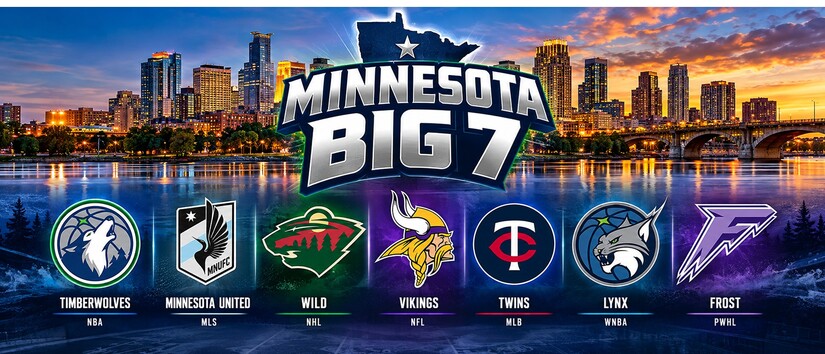
For the Twins, United and Lynx, the work remains focused on future competitiveness. Minnesota's baseball franchise is attempting to reshape its roster after moving on from several familiar players, United is evaluating the changes necessary to return to the MLS playoffs, and the Lynx are seeking the improvements required to turn regular-season dominance into postseason success. Their decisions may not produce immediate results, but they will shape the expectations surrounding each franchise when competition resumes. Across Minnesota's Big 7, the central lesson of the weekend is that strong records, promising rosters and ambitious plans establish possibilities. Sustained execution determines whether those possibilities become achievements.

Local stories matter. Subscribe free to MinneapoliMedia and receive independent news, community reporting and important updates from Minneapolis, the North Metro and communities across Minnesota.
SUBSCRIBE FREE: https://minneapolimedia.town.news/subscribe
MinneapoliMedia | Community. Culture. Civic Life



Sunny, with a high of 31 and low of 25 degrees. Sunny in the morning, clear during the afternoon and evening, partly cloudy overnight.