49° and Sunny
Image
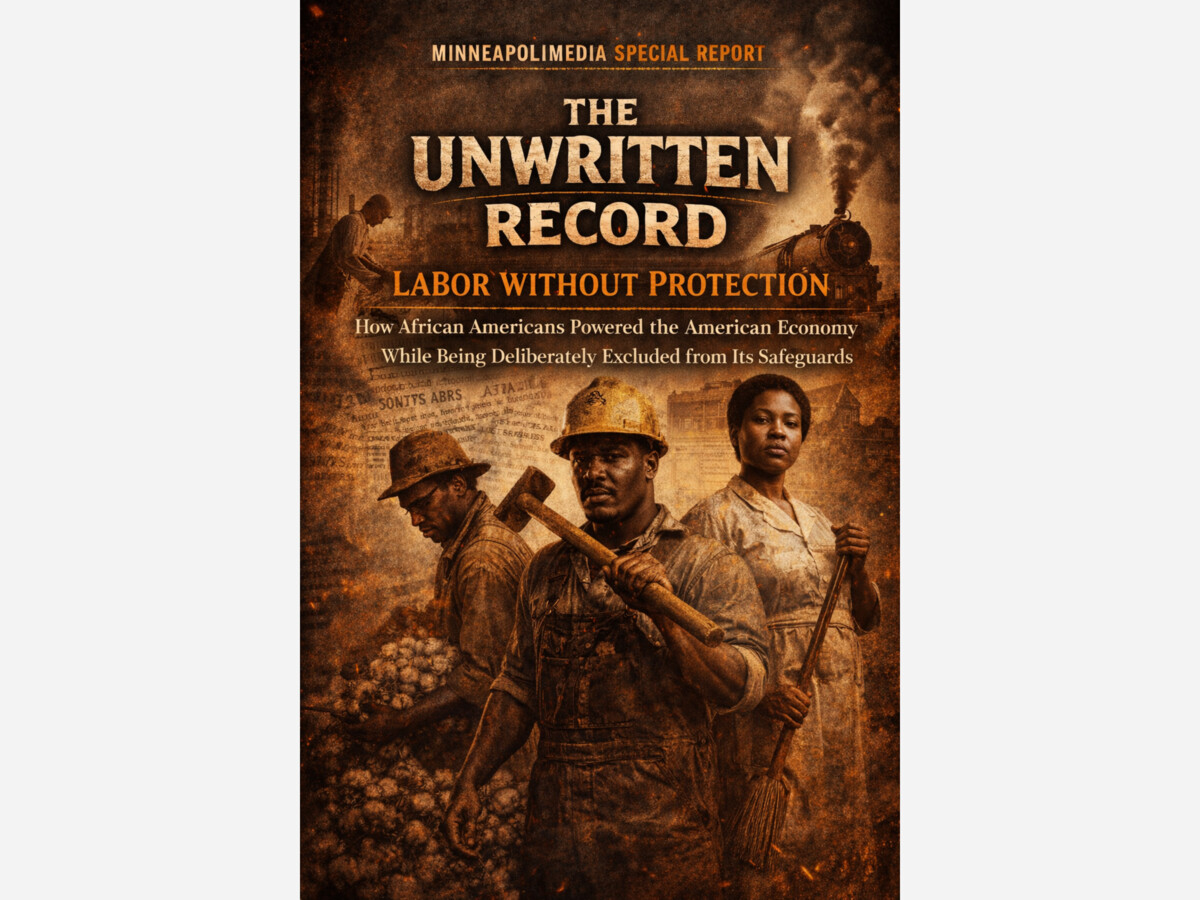



The United States did not merely rely on African American labor. It structured that labor as expendable.
From enslavement through industrialization and into the modern era, African Americans supplied essential labor across agriculture, railroads, domestic service, manufacturing, and public works. Yet when the nation began constructing labor protections in the twentieth century, many of those safeguards were drafted in ways that excluded the very workers who had built its wealth.
This was not oversight. It was architecture.
Protection was written into law selectively. And the selectivity had consequence.
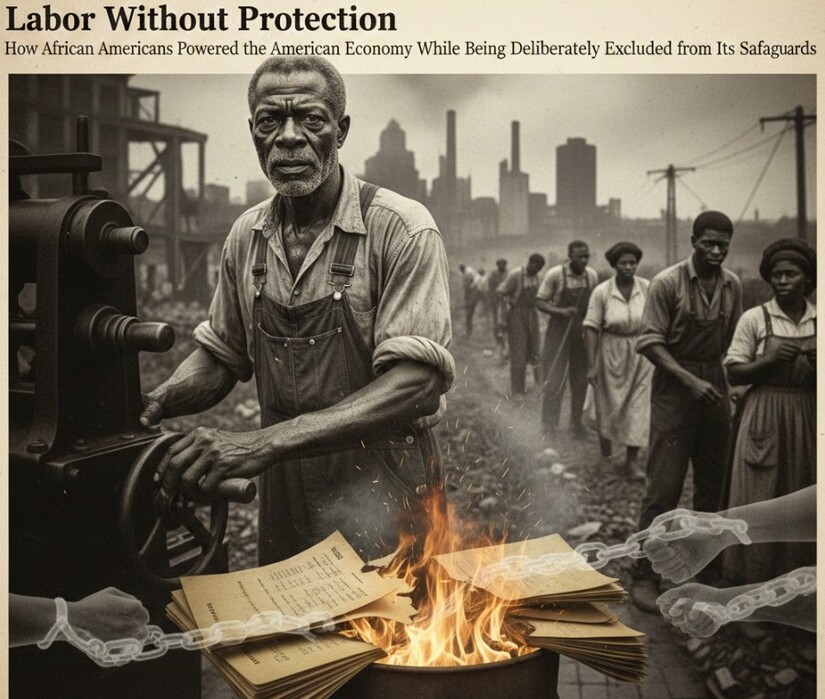
Before wage labor became the dominant American labor model, enslaved labor powered agriculture, port cities, and infrastructure development. Cotton, rice, tobacco, sugar, and indigo production depended overwhelmingly on enslaved workers. By 1860, cotton alone accounted for more than half of American export value.
This was not marginal output. It was national revenue.
Enslaved laborers also worked in skilled trades. Blacksmiths, carpenters, masons, coopers, and dockworkers operated in urban environments under enslaved status. Cities such as Charleston, New Orleans, and Richmond depended on enslaved labor beyond plantation fields.
Yet none of this labor carried rights, wage contracts, or workplace protection.
When emancipation came, the labor system changed form but retained hierarchy.
After the Civil War, land redistribution did not occur at meaningful scale. The promise of forty acres and a mule was abandoned. Formerly enslaved people often entered sharecropping contracts with former slaveholders.
These contracts were structured to maintain economic dependency.
Sharecroppers supplied labor in exchange for a portion of the crop. Landowners controlled credit for tools, seed, and food supplies. Interest rates were high. Accounting was opaque. At harvest time, many sharecroppers were informed that debt exceeded earnings.
The system functioned through contract language that appeared neutral.
Debt peonage criminalized leaving the land before settling accounts. Courts enforced labor continuation under the guise of contract law.
Wage protection did not exist. The vocabulary of agreement concealed coercion.
In the 1930s, the federal government constructed landmark labor protections.
The Social Security Act of 1935 created retirement benefits and unemployment insurance. The National Labor Relations Act of 1935 protected collective bargaining. The Fair Labor Standards Act of 1938 established minimum wage and overtime protections.
Yet agricultural and domestic workers were excluded from many of these provisions.
At the time, African Americans comprised a large percentage of the agricultural and domestic workforce, particularly in the South.
The exclusion was not incidental. Southern legislators insisted on these carve-outs to preserve racial labor hierarchy.
As a result, millions of African American workers were denied access to Social Security benefits, unemployment insurance, and minimum wage protections during the early decades of federal labor reform.
Protection was selective.
Law acknowledged labor but withheld safeguards.
Domestic workers cleaned homes, cooked meals, cared for children, and maintained households. The work was intimate and essential. It was also undervalued and unregulated for decades.
Because domestic labor occurred in private homes, it was framed as personal service rather than formal employment.
The absence of labor protection meant no guaranteed minimum wage, no overtime pay, no workplace safety standards.
African American women disproportionately filled these roles.
Their labor sustained middle-class households while their own economic security remained precarious.
The language of help masked economic dependency.
Labor unions expanded protections in many industries during the twentieth century. Yet African American workers were frequently excluded from union membership or relegated to segregated locals with limited bargaining power.
In industries such as steel, auto manufacturing, and railroad operations, white unions sometimes negotiated contracts that maintained racial job hierarchies.
Skilled positions were reserved for white workers. African Americans were confined to lower-wage roles with higher risk.
Unionization improved wages for many Americans. It did not do so equally.
Access to collective bargaining became another boundary.
World War I and World War II created labor shortages. Industrial employers recruited African Americans into defense production and manufacturing roles.
Executive Order 8802, signed by President Franklin D. Roosevelt in 1941, prohibited racial discrimination in defense industries after pressure from civil rights leader A. Philip Randolph.
This marked an important moment.
But inclusion was often temporary. After wartime demand subsided, layoffs disproportionately affected African American workers. Structural job segregation reasserted itself.
Labor access expanded under pressure. It contracted when pressure receded.
Protection was conditional.
The Servicemen’s Readjustment Act of 1944, commonly known as the GI Bill, provided education benefits and home loan guarantees to returning veterans.
On paper, the law was race-neutral.
In practice, local administration often limited African American access.
Southern colleges barred Black veterans from enrollment. Northern universities imposed informal quotas. Banks denied mortgage loans to Black applicants despite federal backing.
The benefits of the GI Bill contributed significantly to white middle-class wealth accumulation in the postwar period.
African American veterans often faced barriers in accessing the same opportunities.
Language of universal benefit masked unequal application.
By the 1970s and 1980s, deindustrialization reshaped American labor markets. Manufacturing jobs relocated overseas or automated. Urban factories closed.
African American workers, many of whom had migrated north for industrial employment, were disproportionately affected.
The shift to a service economy produced fewer unionized, high-wage positions.
Public discourse framed economic restructuring as inevitable globalization.
Rarely did it foreground the racialized impact of industrial decline.
Labor without protection became labor without opportunity.
Minnesota’s economy has long included manufacturing, agriculture, meatpacking, and transportation sectors.
African American workers entered these industries during wartime recruitment and postwar expansion.
Employment records from mid-twentieth-century Minneapolis show African Americans concentrated in lower-paying positions within food processing and rail operations.
Housing segregation limited access to suburban job markets. Public transportation gaps constrained mobility.
As meatpacking plants and industrial facilities restructured in the late twentieth century, job security declined.
Labor policy at state and federal levels often addressed industry change broadly without addressing racial distribution of impact.
The pattern mirrored national trends.
Even in contemporary labor markets, African Americans experience wage disparities compared to white workers in similar roles.
Occupational segregation persists. African Americans are overrepresented in service, transportation, and public sector roles, and underrepresented in executive and managerial positions.
The explanation is often framed in terms of education level or skill acquisition.
Less frequently addressed are the cumulative effects of historical exclusion from protected labor sectors, union hierarchies, housing-based school funding disparities, and intergenerational wealth gaps.
Labor markets are not neutral spaces. They are shaped by history.
Across centuries, African Americans have supplied essential labor.
Agricultural production.
Industrial manufacturing.
Domestic service.
Transportation networks.
Public sector roles.
Yet access to labor protection has lagged behind labor contribution.
From exclusion from New Deal protections to union barriers to unequal GI Bill implementation, safeguards were distributed unevenly.
Labor was welcomed. Protection was conditional.
To say African Americans built the country through labor is not rhetorical flourish.
It is documented economic fact.
To say that labor protections were structured in ways that excluded or delayed access for African American workers is also documented fact.
The tension between contribution and protection defines much of the American labor story.
When labor is extracted without corresponding safeguard, inequality compounds.
The record shows that African American workers have repeatedly powered growth while navigating systems that withheld full protection.
That is not accident.
It is policy.
And it belongs in the record.



Patchy rain nearby, with a high of 64 and low of 46 degrees. Sunny for the morning, clear overnight.