Image



The report, titled “Blaine by the Numbers,” highlights how local policing often extends far beyond crime response. Many calls involve emergency aid, traffic safety enforcement, and community welfare checks, reflecting the evolving role of modern policing in growing suburban communities.
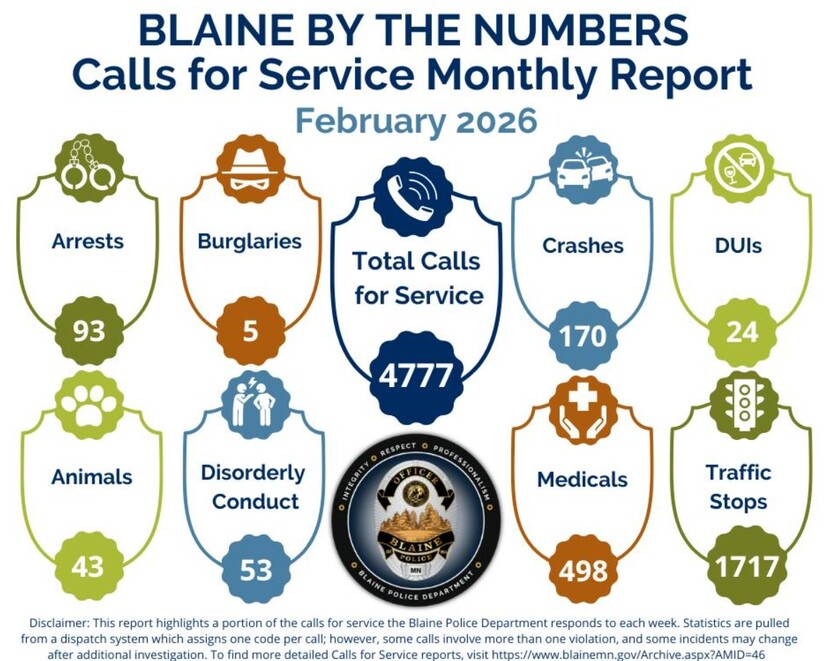
According to the department’s February report, officers responded to the following categories of incidents:
The numbers underscore how routine public safety duties often dominate police workloads, particularly traffic enforcement and emergency response calls.
Traffic-related activity represented the largest portion of police work during the month. Officers conducted 1,717 traffic stops, an indicator of ongoing enforcement efforts aimed at improving road safety across the city.
Police also responded to 170 vehicle crashes during the month and made 24 arrests for impaired driving.
Across Minnesota, traffic safety remains a persistent public concern. According to the Minnesota Department of Public Safety’s Office of Traffic Safety, impaired driving and distracted driving continue to contribute to serious crashes statewide, prompting regular enforcement campaigns and public awareness initiatives.
Local departments such as Blaine often increase traffic patrols during winter months when icy road conditions and limited daylight hours can increase crash risks.
Another significant portion of police activity involved medical emergencies, with officers responding to 498 medical calls during February.
In many Minnesota communities, police officers frequently serve as first responders alongside fire and ambulance crews, particularly when they are the closest available unit. Officers often provide immediate assistance, secure scenes, and assist paramedics until patients can be transported for care.
Nationally, public safety research has shown that medical calls and welfare checks make up a growing share of police dispatch activity, reflecting broader expectations that law enforcement provide rapid emergency support.
While most calls involve service-related duties rather than criminal activity, officers also responded to several crime-related incidents.
During February, the department recorded:
Disorderly conduct calls often involve disturbances, public intoxication, or conflicts that require officers to restore order but may not necessarily result in serious criminal charges.
City officials note that the monthly report represents a partial snapshot of police activity rather than a comprehensive accounting of every detail related to each incident.
Each call entered into the dispatch system is assigned one primary code, even though a single event may involve multiple violations or circumstances. Investigations may also lead to updates or reclassifications after additional evidence is gathered.
Because of this, the monthly report is designed primarily as a transparency tool to help residents understand general patterns in police activity rather than provide full investigative summaries.
Residents seeking more detailed call logs or additional monthly reports can review the city’s public reporting portal at:
https://BlaineMN.gov/callsforservice
Located in northern Anoka County, Blaine has grown significantly in recent decades and now ranks among the larger suburbs in the Twin Cities metropolitan region. Population growth, expanded residential development, and increased traffic volumes have steadily expanded the scope of public safety services required to support the community.
For local residents, the “Blaine by the Numbers” report provides a monthly window into the everyday work of officers who patrol the city’s neighborhoods, respond to emergencies, and help maintain safety across the community.
While major crimes often draw the most attention, the data shows that the bulk of police work continues to involve the quieter but essential tasks of traffic safety, emergency assistance, and community service.
MinneapoliMedia
Community. Culture. Civic Life.



Sunny, with a high of 67 and low of 42 degrees. Sunny in the morning, partly cloudy during the afternoon and evening, clear overnight.