53° and Clear
Image
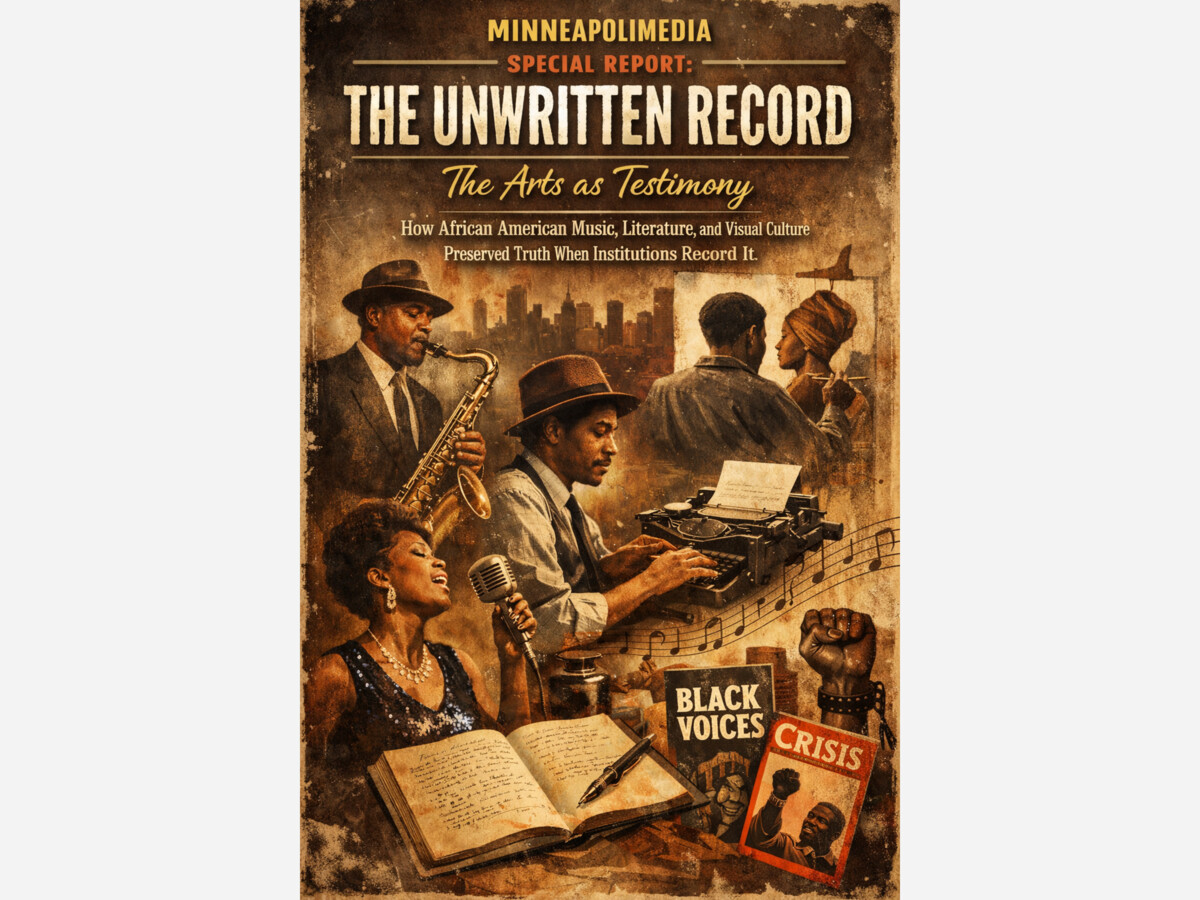



When a society controls the archive, the archive becomes a weapon.
For centuries, African Americans lived inside a contradiction: they were central to the nation’s economy and cultural production, yet routinely excluded from the institutions tasked with recording national meaning. Courts reduced them to property, then to suspects. Textbooks minimized them to a chapter on enslavement and a paragraph on civil rights. Newspapers often framed their suffering as disorder and their resistance as threat. Museums and universities collected artifacts while ignoring the people who made the world those artifacts described.
Under such conditions, art did not function as decoration.
It functioned as testimony.
African American artistic tradition emerged, again and again, as an alternative archive. It preserved lived reality when official records distorted it. It carried memory across generations. It encoded strategy, grief, intelligence, and defiance into forms that could survive censorship, survive illiteracy laws, survive segregation, survive the deliberate narrowing of what the nation would allow itself to remember.
The arts became a parallel record.
Not secondary, not supplemental, but foundational.
In the nineteenth century, enslaved African Americans created spirituals that carried multiple layers of meaning.
On the surface, the songs expressed religious longing. Beneath the surface, they carried coded language about escape, resistance, and endurance.
“Wade in the Water” was sung as worship, but it also transmitted practical advice. Moving through water could mask scent from tracking dogs. Songs functioned as communal instruction without appearing to be instruction.
This dual function mattered because enslaved people were surveilled. Literacy was often criminalized. Communication required protection.
The spiritual therefore became a medium where truth could move without permission.
These songs also preserved the emotional record of enslavement. They documented grief, separation, terror, hope, and moral clarity with an intimacy no census record could hold. Enslavers could count bodies. Spirituals recorded souls.
The archive of the plantation was written by owners.
The counter-archive was sung by the enslaved.
After emancipation, African Americans entered a world that promised freedom but delivered new systems of coercion: sharecropping, debt peonage, racial terror, and legal exclusion.
The blues emerged as a record of that reality.
The blues did not offer sanitized uplift. It named working life as it was lived. It documented exhaustion, hunger, desire, exploitation, migration, loss, and endurance. It turned everyday struggle into public language.
In the blues, an individual voice often represented collective condition. A song about missing wages, a cruel boss, a train leaving town, or a lover gone was never only personal. It was a cultural economy of truth.
The blues also marked a transition in agency. It was music of choice within constraint, a way of narrating selfhood after slavery without pretending that emancipation resolved injustice.
If spirituals encoded instruction under captivity, the blues documented the reality of nominal freedom under economic pressure.
Jazz emerged in a nation that still denied African Americans full citizenship. Yet jazz refused confinement.
Improvisation was not merely musical technique. It was philosophical claim.
In a society that attempted to script African American roles, improvisation insisted on agency. It rejected fixed narrative. It created new possibilities in real time.
Jazz also functioned as evidence of intellectual rigor. The complexity of rhythm, harmony, and arrangement disproved stereotypes of African American inferiority that lingered in popular science and public rhetoric.
But jazz history also reveals extraction. White-owned clubs profited from Black innovation. Record contracts often favored industry executives over musicians. The art was celebrated while the artists were constrained.
Even in cultural triumph, the pattern persisted: contribution without equal benefit.
Jazz stands as testimony not only to creativity, but to the ongoing contradiction between cultural value and civic exclusion.
Gospel music carried the structure of the Black church into sound.
The church was not only a religious institution. It was an organizing center, an educational base, a mutual aid hub, and a political training ground. Gospel reflected this institutional life.
Call-and-response created collective voice. Choirs modeled communal discipline. Lyrics carried both spiritual hope and practical resilience.
In eras when African Americans were excluded from formal political power, gospel functioned as public assembly. It provided emotional stamina for organizing and protest. It carried the language of moral certainty into civic struggle.
The Civil Rights Movement did not only have speeches. It had sound.
Songs such as “We Shall Overcome” were not entertainment. They were mobilization, identity, and collective resolve.
When the state refused justice, gospel asserted a moral record that law could not negate.
If music carried encoded truth, literature carried documented truth.
African American writers used autobiography, fiction, essays, and journalism to enter record with precision. They preserved what the nation attempted to exclude.
Frederick Douglass’s narratives did not merely recount enslavement. They dismantled the moral logic of slavery in public language. Douglass wrote himself into citizenship before the state recognized it.
Harriet Jacobs, in “Incidents in the Life of a Slave Girl,” documented sexual exploitation and the specific vulnerability of enslaved women, a dimension of slavery often absent from mainstream accounts. Her writing expanded the record into areas polite society tried to ignore.
Later, W. E. B. Du Bois combined sociology, history, and political theory to show that African Americans were not a problem to be managed but a people whose exclusion revealed the nation’s contradictions. His work functioned as scholarly indictment.
In the twentieth century, writers such as Zora Neale Hurston preserved Black folk culture and language as evidence of complex inner worlds. Richard Wright documented the psychological consequences of systemic constraint. James Baldwin wrote with moral clarity about the nation’s refusal to confront itself.
These writers did not merely create art. They created evidence.
In a society that misdescribed African Americans, literature became a tool of accurate description.
The visual record matters because denial often thrives on invisibility.
Photography became a form of confrontation. Images could challenge public myths by showing reality directly.
During the civil rights era, photographs of police dogs, fire hoses, and beaten protesters forced parts of the nation to witness what had been previously ignored. The image became testimony that could not be dismissed as exaggeration.
Yet visual culture also contained danger. Images could be exploited, sensationalized, or used to reinforce stereotypes if stripped of context. The politics of representation mattered as much as the representation itself.
Still, photography functioned as a counter-archive when official reports minimized violence.
An image could expose what bureaucratic language hid.
African American artistic tradition repeatedly performed the work of memory.
When textbooks erased African American presence in northern states, art preserved it. When local histories minimized Black settlement and institution building, art recorded community life. When legal systems denied structural harm, art narrated structural harm as lived truth.
This function is visible in murals, quilts, oral poetry, theater, and dance.
Quilting traditions often preserved family lineage and encoded stories. Performance traditions carried cultural continuity. Theater dramatized the moral consequences of policy. Visual art reconstructed dignity in a world that attempted to reduce it.
When official archives refused to record African American reality fully, the arts became the archive.
Minnesota is not outside this story. It carries its own patterns of omission and its own counter-record.
African American communities in Minneapolis and St. Paul built churches, businesses, and cultural institutions while navigating housing segregation and employment exclusion. Their stories have not always been treated as central to the state narrative.
Local artistic expression became a record.
Music scenes, community newspapers, visual art in neighborhoods, and public cultural events preserved memory and presence.
If the official narrative of Minnesota often leans toward neutrality, local art has often carried testimony about inequality, belonging, and survival.
The state’s record is incomplete without the cultural record produced within it.
One of the most consistent features of African American art in the United States is this contradiction:
The culture is celebrated.
The people are constrained.
African American music has been foundational to American popular culture. Yet artists have frequently faced exploitative contracts, theft of intellectual property, and exclusion from institutions.
African American literary genius has shaped national conscience. Yet educational systems have often treated Black writing as elective rather than foundational.
The nation consumes the product while resisting the full humanity of its producers.
This too is testimony.
It reveals the moral economy of the country.
The arts as testimony show that African Americans did not wait for institutions to grant record.
They recorded themselves.
They preserved truth in song when literacy was denied. They documented survival in blues when economic coercion persisted. They asserted freedom through jazz when civic freedom was restricted. They mobilized through gospel when law refused justice. They entered history through literature when textbooks distorted it. They proved violence through photography when reports minimized it.
This is not cultural trivia. It is civic evidence.
Because the arts preserved what the nation refused to remember, they have become essential to understanding the nation at all.
Without the counter-archive created through African American art, the American record would be morally incoherent.
The archive would read as progress without cost.
Democracy without contradiction.
Prosperity without extraction.
Art testified against that lie.
The arts did not merely survive history.
They carried the truth of history forward when official institutions tried to bury it.
That is why African American art is not peripheral to the American story.
It is one of the primary ways the American story can be told honestly.


Sunny, with a high of 69 and low of 40 degrees. Sunny in the morning, partly cloudy during the afternoon, thundery outbreaks in nearby for the evening, clear overnight.