63° and Moderate rain at times
Image



In the Minnesota Legislature, a proposal to reshape public transportation in the Twin Cities metropolitan area is igniting a consequential debate about efficiency, local control, and the future of regional transit governance.
At the center of that debate is House File 4041, authored by Jon Koznick. The bill would consolidate the region’s suburban “opt-out” transit providers into a single unified system operated by Metro Transit under the authority of the Metropolitan Council.
Supporters say the move would modernize a fragmented transit structure that dates back more than four decades. Critics warn it could dismantle a suburban service model many communities consider highly effective.
The proposal has become one of the most closely watched transportation policy debates of the legislative session.
The current structure of Twin Cities transit emerged in the early 1980s, when several suburban communities opted out of the regional transit system.
At the time, suburban leaders argued their residents were paying property taxes into the regional bus network while receiving limited service in return. State law ultimately allowed qualifying communities to establish independent transit providers designed around suburban commuting patterns.
Today, four agencies operate under that opt-out framework:
These agencies largely focus on express commuter routes linking suburban communities to employment centers in Minneapolis and St. Paul, while also offering circulator routes and on-demand services tailored to suburban travel patterns.
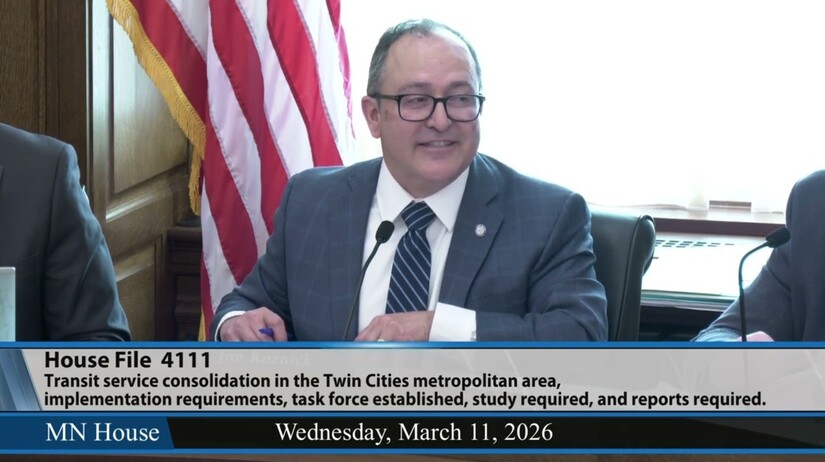
Rep. Koznick argues the political and financial conditions that led to the creation of the opt-out agencies no longer apply.
“Suburban agencies were created in the 1980s because suburban communities were paying local property taxes into the regional bus system and wanted a voice in how those local taxes were being invested,” Koznick told lawmakers during committee discussions.
But the funding structure has since changed dramatically.
In 2023, the Minnesota Legislature approved a 0.75 percent regional sales tax dedicated to transportation and transit projects in the Twin Cities metropolitan area. The shift moved transit funding away from the local property tax framework that once justified independent suburban systems.
Supporters of consolidation say that change weakens the original rationale for separate agencies.
They argue that a single regional operator could:
Some lawmakers also point to the cost disparities between certain suburban commuter routes and Metro Transit services, suggesting a unified system could better allocate resources across the region.
The legislation outlines a structured process for consolidating the system.
Under the proposal:
The transition would not happen immediately.
Key provisions include:
July 1, 2027
The proposed date for Metro Transit to assume full operational control of services currently managed by suburban providers.
Transition Task Force
A regional advisory group would help guide the transfer of assets, employees, and contracts.
Transit Service Study
The Metropolitan Council would be required to conduct a comprehensive analysis of transit service levels in communities currently served by suburban agencies to ensure service continuity.
Lawmakers say the phased approach is intended to avoid disruptions for riders while addressing operational complexities.
Despite the emphasis on efficiency, the proposal has encountered significant resistance from suburban officials and transit leaders.
During legislative hearings, representatives from suburban agencies and local governments testified against the measure, raising concerns about what consolidation could mean for riders outside the urban core.
Their concerns center on three key issues.
Suburban leaders say independent transit agencies are more responsive to the needs of their communities than a centralized regional operator.
Local governance allows agencies to adjust routes, schedules, and service models based on suburban commuting patterns that differ significantly from urban travel demand.
Agencies such as SouthWest Transit and MVTA frequently cite their strong on-time performance and specialized commuter services as evidence that the current system works.
Some officials worry that integrating those services into a larger regional network could dilute operational standards.
Another concern involves how transit funding is distributed.
Suburban officials fear that revenues generated in suburban communities could be redirected toward urban rail or bus rapid transit projects, leaving suburban riders with reduced service.
Beyond the immediate legislative fight, the proposal reflects a broader transformation in how public transit is evolving in the Twin Cities.
The COVID-19 pandemic dramatically altered commuting patterns, reducing traditional downtown commuter demand while increasing interest in flexible and on-demand transit options.
At the same time, regional policymakers are grappling with how to build a transit system capable of serving a metropolitan population of nearly four million residents.
The debate surrounding HF 4041 ultimately raises a fundamental question:
Should transit in the Twin Cities operate as a single integrated regional system, or should suburban communities continue to maintain independent services designed around their own needs?
For now, that question remains unresolved.
But as lawmakers weigh the proposal in committee rooms at the Minnesota Capitol, the outcome could shape the structure of Twin Cities transit for decades to come.
MinneapoliMedia
Community. Culture. Civic Life.



Sunny, with a high of 80 and low of 57 degrees. Sunny during the morning, clear overnight.