Image
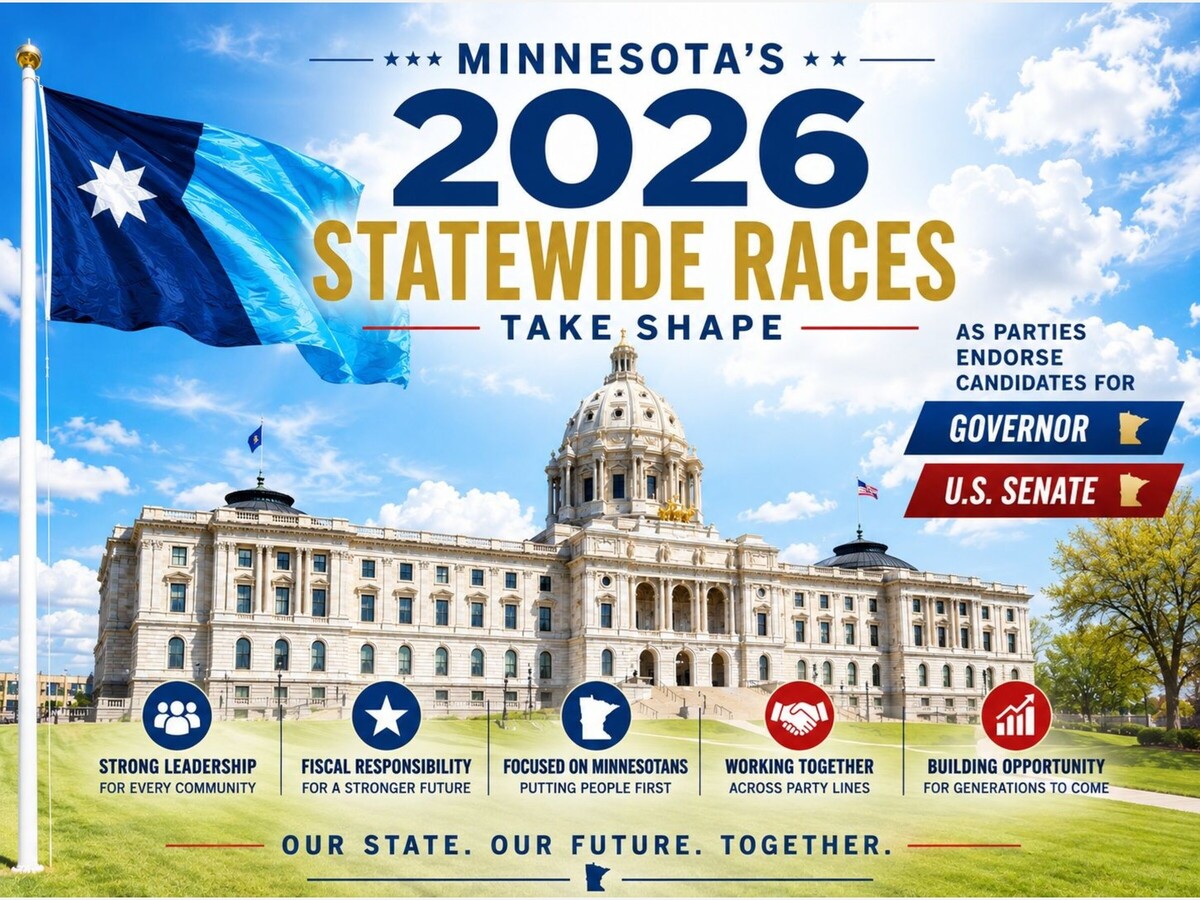



With Governor Tim Walz opting not to seek another term and U.S. Senator Tina Smith retiring at the conclusion of her current term, Minnesota voters will choose both a new governor and a new U.S. senator in November 2026. Open-seat contests for either office are uncommon in Minnesota politics. Having both offices simultaneously on the ballot has elevated the stakes for both parties and intensified attention on the endorsement process.
Republicans gathered in Duluth while Democratic-Farmer-Labor delegates convened in Rochester. By the end of the weekend, the parties had produced markedly different convention stories.
Republicans endured hours of voting delays, technical difficulties, and a 10-ballot gubernatorial battle before endorsing businessman and Army veteran Kendall Qualls for governor and former military officer Adam Schwarze for the U.S. Senate.
The DFL convention moved more quickly. Delegates endorsed U.S. Senator Amy Klobuchar for governor and Lieutenant Governor Peggy Flanagan for the U.S. Senate seat currently held by Smith.
While endorsements do not formally determine party nominees, they remain influential in Minnesota politics, particularly among Republican voters, where endorsed statewide candidates have historically enjoyed strong primary success.
A Marathon in Duluth
The Minnesota Republican Party entered its convention facing several competitive statewide endorsement battles. None proved more dramatic than the contest for governor.
Qualls ultimately secured the party's endorsement after a lengthy 10-ballot process that stretched through much of Saturday. The race narrowed over successive rounds of voting until Qualls and Minnesota House Speaker Lisa Demuth remained as the final two candidates.
The convention was repeatedly interrupted by concerns surrounding electronic voting equipment. Delegates and campaigns raised questions about vote totals and ballot reporting, resulting in lengthy delays and discussions about whether paper ballots should be used instead.
Despite the disruptions, delegates eventually completed the process, and Qualls surpassed the 60 percent threshold required to secure endorsement.
The victory represented a significant moment for Qualls, who previously sought the Republican gubernatorial endorsement in 2022 and has spent much of the current campaign presenting himself as a political outsider capable of delivering the GOP's first statewide victory in two decades.
In speeches throughout the convention, Qualls argued that Minnesota Republicans must offer voters a different type of leadership if the party hopes to break a statewide losing streak that dates back to the election of Governor Tim Pawlenty in 2002.
Demuth, meanwhile, emphasized her legislative record and leadership as Speaker of the House, arguing that governing experience would provide Republicans their strongest path to victory.
Although Qualls secured the endorsement, questions remain about whether the governor's race will proceed directly to the general election or face additional competition in the August primary. Demuth publicly raised concerns about the convention voting process following the endorsement battle. Former candidate Mike Lindell has also indicated he intends to continue pursuing the nomination despite not receiving the party's endorsement.
The possibility of a contested Republican primary means the endorsement may represent only the beginning rather than the conclusion of the governor's race.
Republicans Choose Schwarze for Senate
Republican delegates completed their Senate endorsement process before the governor's race reached its conclusion.
Delegates endorsed Adam Schwarze for the open U.S. Senate seat currently held by Tina Smith.
Schwarze emerged from a field that included former sports broadcaster Michele Tafoya and other Republican contenders seeking to become the party's standard bearer in a race that represents one of the GOP's most significant statewide opportunities in years.
The endorsement provides Schwarze access to party infrastructure, volunteer support, and organizational backing as Republicans attempt to capture a Senate seat that has remained in Democratic hands for nearly two decades.
Tafoya has indicated she intends to continue her campaign through the August primary, ensuring that Republican voters will likely have a choice before a nominee is finalized.
The eventual Republican nominee faces a difficult historical challenge. No Republican has won election to a U.S. Senate seat in Minnesota since Norm Coleman prevailed in 2002.
DFL Convention Moves Swiftly
While Republicans spent hours navigating procedural disputes and multiple rounds of voting, DFL delegates in Rochester completed their headline endorsement decisions comparatively quickly.
Amy Klobuchar secured the party's endorsement for governor, giving Minnesota's senior U.S. senator formal backing as she seeks to succeed Walz.
Klobuchar entered the convention as the clear front-runner after months of speculation surrounding her political future following Walz's announcement that he would not seek reelection.
Her endorsement signals a major shift in Minnesota politics. After nearly twenty years representing Minnesota in the United States Senate, Klobuchar is now seeking a return to state government.
At the convention, Klobuchar also introduced former Fergus Falls Mayor Ben Schierer as her running mate for lieutenant governor.
Unlike the Republican gubernatorial contest, Klobuchar's endorsement was never seriously in doubt. Delegates rallied behind her candidacy early in the convention, reflecting broad support across major segments of the DFL coalition.
Flanagan Wins Senate Endorsement
The DFL endorsement for the open Senate seat went to Lieutenant Governor Peggy Flanagan, who entered the convention with substantial delegate support and strong organizational momentum.
Flanagan's path to endorsement became significantly clearer days before delegates gathered in Rochester when U.S. Representative Angie Craig announced she would bypass the convention process and instead compete directly in the August primary.
Craig argued that the endorsement system does not fully reflect Minnesota's broader Democratic electorate and indicated that her campaign would focus on primary voters rather than convention delegates.
With Craig absent from the endorsement contest, Flanagan secured the party's backing and reinforced her position as a leading contender for the Democratic nomination.
The endorsement, however, is unlikely to settle the race.
Craig remains a formidable candidate with strong fundraising capabilities, a history of winning competitive elections in Minnesota's Second Congressional District, and significant name recognition among Democratic voters.
As a result, Minnesota appears headed toward a closely watched August primary between two prominent Democratic leaders.
A Rare Political Moment
The simultaneous openings in both the governor's office and a United States Senate seat have created a political environment rarely seen in Minnesota.
Open gubernatorial races attract intense attention on their own. Open Senate races are equally uncommon. Having both contests unfold during the same election cycle has transformed 2026 into one of the most significant political years in recent state history.
The conventions provided the first major test of organizational strength for candidates and campaigns. Yet the endorsements do not end the competition.
Several endorsed and non-endorsed candidates have already signaled plans to continue through the August 11 primary election, meaning Minnesota voters will likely play a decisive role in determining both parties' final tickets.
By the time the primary concludes, Minnesota's voters will have narrowed the field. By November, they will choose new leaders for two of the state's most important offices.
The endorsement conventions may have established the early front-runners, but the 2026 campaign is only beginning.
MinneapoliMedia | Community. Culture. Civic Life.

Sunny, with a high of 73 and low of 49 degrees. Sunny in the morning, clear in the afternoon and evening, smoky haze overnight.